
What Bulk Buying Actually Means for Your Budget
Buying in bulk means purchasing larger quantities of a product at one time, typically at a lower cost per unit than smaller packages. The appeal is straightforward: pay less per roll of paper towels, per ounce of dish soap, or per load of laundry detergent. Over months of consistent use, those per-unit differences add up.
But the strategy is not automatically a win. The upfront price is higher, and if you don't use what you buy - or can't store it properly - the math reverses. Understanding how unit pricing works is the foundation of any honest bulk-buying evaluation. A large package that costs more per ounce than a smaller one isn't a deal, regardless of how the shelf tag is formatted.
The goal isn't to buy more. It's to spend less on the things you already need.
Lower cost per unit on high-use staples
When applied to items your household reliably consumes, bulk buying consistently reduces the per-unit cost compared to smaller packages - a genuine and repeatable saving.
Fewer shopping trips over time
Stocking up on non-perishables reduces how often you need to restock, saving time and reducing the likelihood of impulse purchases during frequent store visits.
Buffer against price fluctuations
Buying at today's price protects against future price increases on commodity household goods, particularly useful for items prone to seasonal or supply-driven price swings.
Reduces decision fatigue for routine items
When everyday staples are always on hand, you spend less mental energy tracking and reordering them, freeing attention for more consequential household decisions.
Where Bulk Buying Genuinely Pays Off
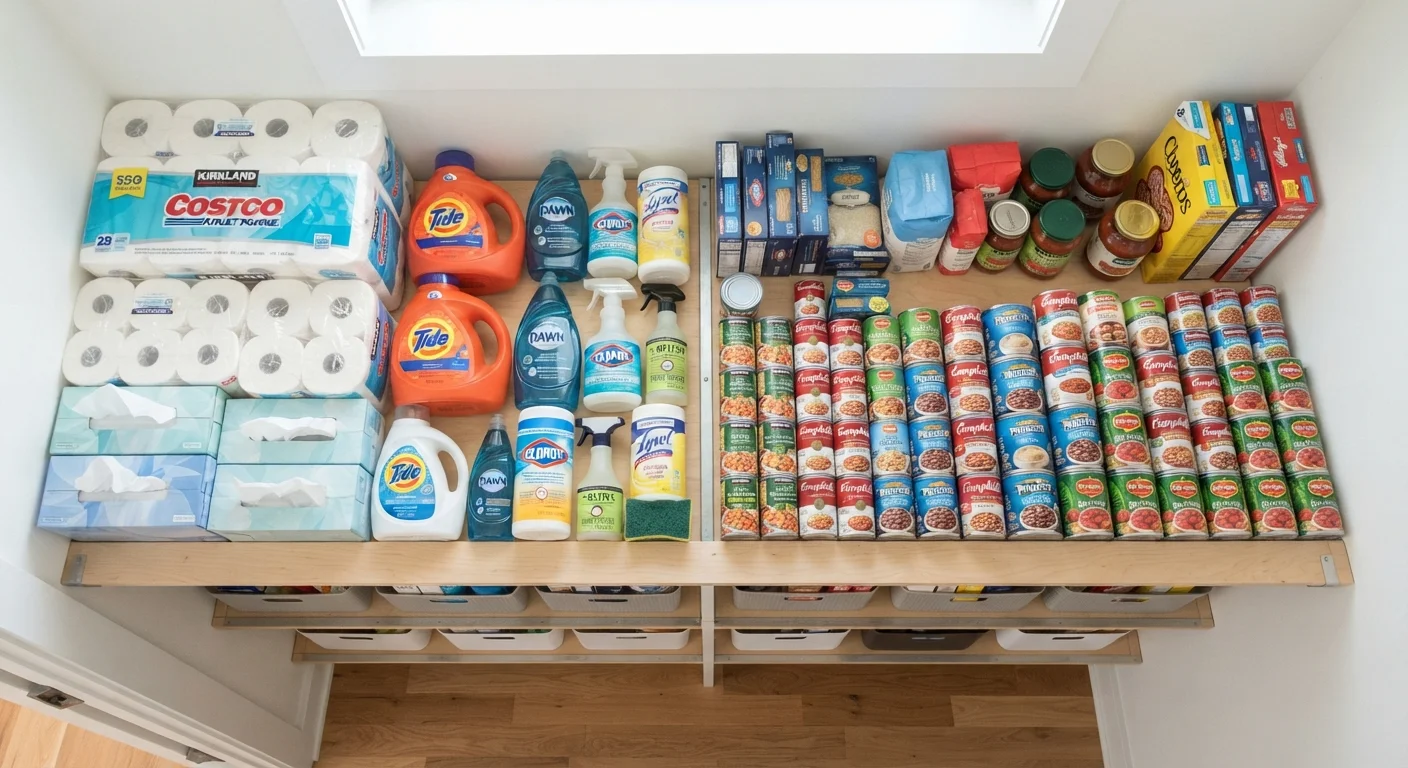
Certain household categories are well-suited to bulk purchasing because they're non-perishable, used at a predictable rate, and don't change formulation frequently. Toilet paper, paper towels, trash bags, dish soap, laundry detergent, and canned pantry staples are classic examples. These items won't expire before you use them, don't require refrigeration, and your household's usage rate is unlikely to shift dramatically.
Cleaning supplies - especially concentrated formulas - are another strong candidate. A large container of a multi-surface concentrate, properly diluted, can replace dozens of ready-to-use spray bottles at a fraction of the cost.
~15-30%
Typical per-unit savings on non-perishable staples
Consumer budget analysis generally estimates per-unit discounts in this range when buying non-perishable household staples in bulk versus standard retail sizes.
~30%
Average share of food purchased that is wasted per household
The U.S. Department of Agriculture has estimated that roughly 30-40 percent of the food supply is wasted, with household-level waste being a major contributor.
The calculus also shifts based on where you shop. Online and in-store bulk channels each carry different pricing structures, membership requirements, and shipping considerations - all of which affect whether the per-unit savings survive to your doorstep.
When Bulk Buying Backfires
The most common bulk-buying mistake is applying warehouse logic to the wrong categories. Fresh produce, dairy, and bread bought in excess routinely end up in the trash - turning a perceived bargain into an actual loss. Even longer-shelf-life foods like cooking oils, nuts, and whole-grain flours have finite windows before quality degrades.
Personal care products present a different problem: formulations change, and so do preferences. Buying a year's supply of a shampoo or skincare product means you're locked in even if the product is reformulated, causes irritation, or simply falls out of favor. The same logic applies to trying a new brand in bulk before confirming it meets your needs in regular use.
High upfront cost strains monthly cash flow
Even if the per-unit math is favorable, a large upfront outlay can disrupt a monthly budget - especially for households operating close to their spending limits.
Waste risk for perishables and changing preferences
Items that expire, go stale, or fall out of use before the supply is depleted transform savings into direct losses - a particular hazard for food and personal care categories.
Storage demands are often underestimated
Large quantities require dedicated, organized space. Without it, bulk items get lost, damaged, or forgotten - which defeats the purpose of buying ahead.
Not all bulk packages are genuinely cheaper
Larger packaging doesn't guarantee a lower per-unit price. Without checking the unit price explicitly, shoppers may pay a premium while assuming they're saving.
Storage constraints are another overlooked cost. If bulk quantities require renting additional storage, purchasing organizers, or tolerating clutter that affects household function, those are real costs that reduce net savings. A household inventory helps prevent the common scenario of buying more of something you already have in quantity.
Building a Smarter Bulk-Buying Habit
The households that benefit most from bulk buying treat it as a system, not an impulse. That means knowing your household's actual consumption rate before committing to a large quantity, checking unit prices rather than package prices, and keeping a running list of what's actually depleted versus what's merely low.
A structured shopping list prevents the drift that turns bulk buying into overbuying. If you're tracking what you use, you'll know whether a club-store package of 48 items will last your household two months or two years - and that distinction determines whether the purchase is sensible or wasteful.
It's also worth checking whether a bulk purchase actually reflects a genuine discount. Inflated reference prices are common in retail, and large-format packaging is not immune. Do the arithmetic every time: divide the total price by the unit count or weight, and compare it honestly to smaller-format alternatives - including store-brand options that may already carry a lower base price.
Bulk Buying Is a Tool, Not a Default
The discipline of bulk buying works best when it's selective. Applying it broadly - buying everything in the largest available size - often leads to overspending and waste. Reserve bulk purchasing for items you have verified consumption history with, have confirmed space to store, and have price-checked at the unit level. For everything else, standard quantities are usually the more practical choice.