
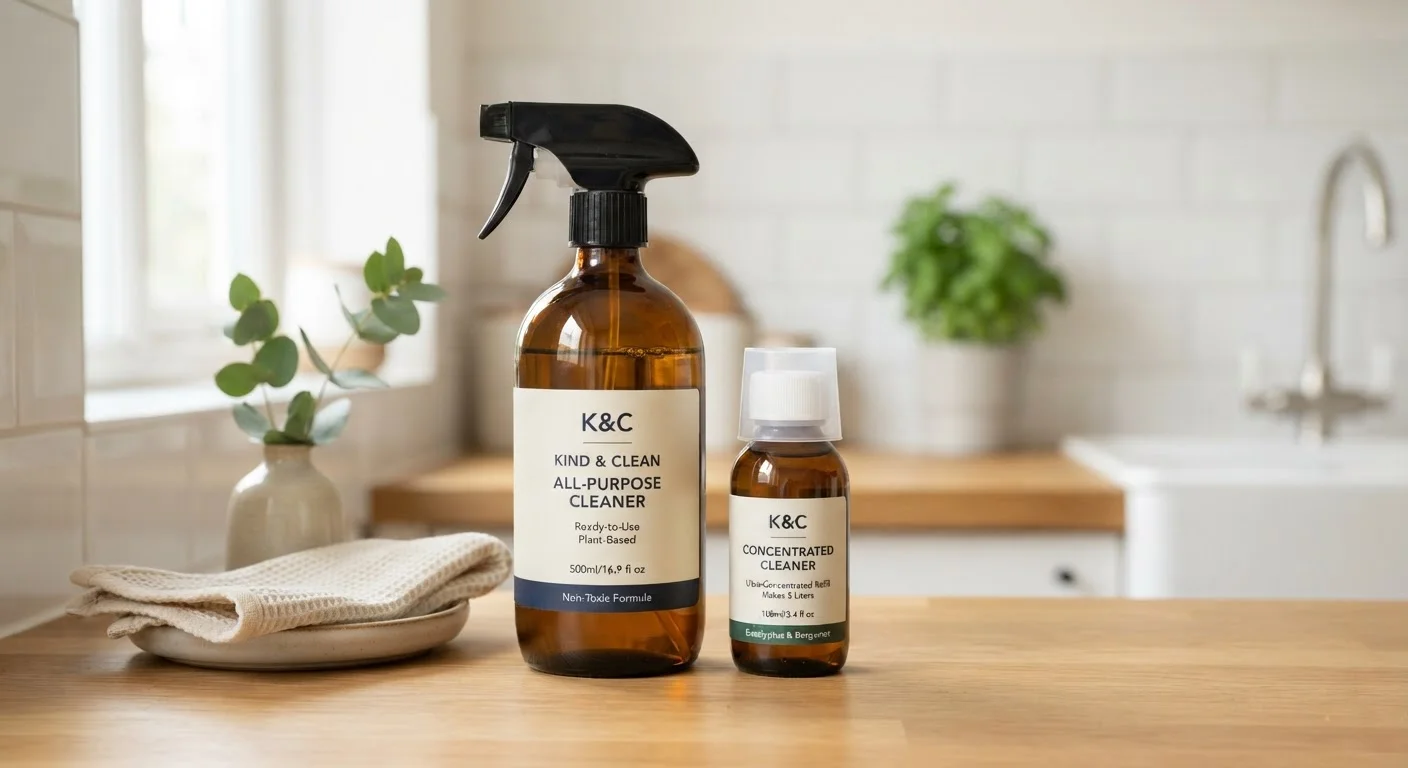
Why Shelf Price Is the Wrong Number to Compare
When you pick up a $4 ready-to-use spray cleaner and a $9 concentrate, the instinct is to see the $4 option as the better deal. But that comparison ignores the most important variable: how many uses you actually get from each bottle.
A 32 oz ready-to-use spray might yield around 30-40 cleaning applications before it's empty. A concentrated cleaner that dilutes at a 1:32 ratio - one ounce of concentrate per quart of water - can produce dozens of full spray bottles from a single purchase. The math transforms a higher shelf price into a dramatically lower cost per use. To understand this framework more broadly, see how cost-per-use reframes everyday purchases.
The key formula is simple: divide the total price by the number of uses the product yields. Doing this calculation for both formats - rather than comparing sticker prices - gives you an honest comparison.
32:1
Common concentrate-to-water dilution ratio
Many all-purpose concentrate cleaners instruct users to mix one part concentrate with 32 parts water, yielding significant volume from a small container.
~75-90%
Portion of ready-to-use cleaner that is water
Industry formulation data generally indicates that most ready-to-use household spray cleaners consist largely of water, with active ingredients making up a small fraction.
How Concentrates Work - and Where They Save
Concentrates are formulated at higher active-ingredient strength, designed to be diluted with water before use. Common household examples include all-purpose cleaners, floor cleaners, and dish soap sold in smaller, densely packed containers.
The savings case for concentrates rests on a few pillars:
- Lower cost per diluted unit: When diluted correctly, a single ounce of concentrate can produce far more usable product than a ready-to-use alternative costs.
- Reduced packaging waste: Fewer bottles purchased over time means less plastic consumed - a consideration some households factor into their purchasing decisions.
- Storage efficiency: A small concentrate bottle takes far less cabinet space than the equivalent volume of ready-to-use product.
Concentrates make the most financial sense for cleaning tasks you perform frequently - surfaces you wipe down daily or weekly. For guidance on when volume-purchasing strategies deliver genuine savings versus hidden costs, see when bulk buying actually pays off.
Label Your Diluted Bottles Clearly
When transferring concentrate to a reusable spray bottle, always label it with the product name, dilution ratio, and any relevant safety information. This prevents accidental misuse and helps everyone in the household use the correct amount. A piece of masking tape and a marker is all it takes.
The Real Advantages of Ready-to-Use Formats
Ready-to-use cleaners aren't simply concentrates with added water - they have legitimate advantages that justify their higher per-use cost for many households.
Convenience and consistency: No measuring, no mixing, no guesswork. You pick it up and use it. This matters when speed or simplicity is a priority.
Dosing safety: Concentrates used at incorrect dilutions - either too strong or too weak - can reduce effectiveness, damage surfaces, or pose unnecessary chemical exposure risks. Ready-to-use products remove that variable entirely.
Infrequent-use scenarios: If you clean a specific surface or area only occasionally, a ready-to-use product avoids the issue of a concentrate sitting in storage. Improper storage can degrade some concentrate formulas over time.
It's also worth noting that some cleaning tasks have no concentrate equivalent available at a consumer level, making the choice straightforward. And if you're questioning broader cleaning product assumptions, common cleaning supply myths covers which beliefs about products are actually supported by evidence.
Never Mix Cleaning Products Together
Combining different cleaning products - including some concentrates with bleach-based or ammonia-based formulas - can create hazardous chemical reactions. Always use products separately and follow label instructions carefully. If you're unsure about a product's ingredients, check the safety data sheet, which manufacturers are required to make available.
Side-by-Side Comparison
The table below compares concentrates and ready-to-use cleaners across the factors that matter most for household purchasing decisions.
| Concentrates | Ready-to-Use | |
|---|---|---|
| Shelf price | Often higher upfront | Lower per bottle |
| Cost per use | Typically much lower | Higher |
| Convenience | Requires dilution and mixing | Grab-and-go ready |
| Dosing consistency | Depends on user accuracy | Pre-measured, consistent |
| Storage footprint | Compact | Bulkier per volume |
| Packaging waste | Less over time | More bottles over time |
| Best for infrequent use | Less ideal - may degrade | Well-suited |
| Risk of misuse | Higher (dilution errors) | Lower |
For related purchasing decisions where per-unit math changes the answer, unit pricing labels are another underused tool at the shelf level.
Making the Decision for Your Household
A few practical questions help cut through the format debate:
- How often do you use this cleaner? Daily or weekly use favors concentrates. Monthly or occasional use narrows the savings advantage considerably.
- Are you comfortable measuring dilution ratios? If you or others in your household are likely to eyeball the ratio, a ready-to-use product may deliver more consistent results.
- Do you have appropriate storage? Concentrates require proper labeling when transferred to spray bottles, and secure storage away from children.
- What's the full cost of ownership? Factor in the cost of reusable spray bottles if you're diluting concentrates yourself.
These are the same kinds of frameworks explored in what value really means when deciding what to buy - cost is only one dimension of a useful purchase. For households exploring broader cleaning alternatives, pantry staples with documented household uses is worth a read alongside this comparison.