
The Case for Multipurpose Pantry Items
Most American households already stock the building blocks of a surprisingly capable cleaning kit - they just don't always think of them that way. Items like baking soda, white vinegar, and coarse salt have well-documented uses that extend far beyond cooking, and understanding those uses can simplify what you keep under the sink.
This isn't about chasing trends or rejecting every commercial cleaner on principle. It's about recognizing which pantry staples genuinely earn their shelf space by handling more than one job. As a starting point, it helps to know what's already in your home - something a household inventory can make much clearer before you buy anything new.
The list below covers seven pantry items with reliable, widely recognized secondary household uses. Each entry explains what the ingredient actually does and where its limits are.
Baking Soda
Baking soda (sodium bicarbonate) is a mild alkali and a gentle abrasive, which makes it useful for scrubbing surfaces without scratching them. It's commonly used to deodorize refrigerators, neutralize odors in carpets and upholstery, and clean baked-on residue from cookware. Sprinkle it on a damp sponge to scrub sinks, or pour it down a slow drain followed by hot water to help clear minor buildup.
It doesn't disinfect - important to understand if sanitation is the goal - but for odor control and light abrasive cleaning, it's hard to beat on a cost-per-use basis.
Baking soda cleans, deodorizes, and scrubs gently without scratching most surfaces.
White Distilled Vinegar
White vinegar's acidity makes it effective at cutting through mineral deposits, hard water stains, and soap scum. It's commonly used to descale electric kettles, clean showerheads clogged with mineral buildup, and remove residue from glass surfaces. Diluted with water (roughly one part vinegar to one part water), it works as a general surface cleaner on non-porous materials.
Avoid using it on natural stone (marble, granite) or unsealed grout, as the acid can etch or damage those surfaces over time.
White vinegar dissolves mineral deposits and soap scum effectively on non-porous surfaces.
Coarse Salt
Salt's abrasive texture makes it a useful scrubbing agent for cast iron cookware, where soap is typically avoided. Poured into a skillet with a paper towel or cloth, it lifts food residue without stripping seasoning. It's also used to scrub wooden cutting boards - combined with half a lemon, it removes surface stains and odors without saturating the wood with water.
Salt has no disinfecting properties in typical household concentrations, so its role here is purely mechanical abrasion.
Coarse salt is an effective mechanical scrubber for cast iron and wooden cutting boards.
Cornstarch
Cornstarch is less commonly thought of as a cleaning agent, but it has a few practical uses. It can be worked into oily fabric stains as an absorbent - applied dry, left to sit, then brushed away - before laundering. It's also used to clean and polish windows when mixed into a solution with water and a small amount of vinegar, where its fine texture is said to help reduce streaking.
It should be stored in a sealed container and kept dry; moisture will compromise both its food and household uses.
Cornstarch absorbs grease from fabric when applied dry before laundering.
Olive Oil or Vegetable Oil
A small amount of cooking oil applied with a soft cloth can condition and restore wooden furniture, cutting boards, and utensil handles that have dried out. It's also used to loosen sticker residue from surfaces - applied to the adhesive, left briefly, then wiped away. Some people use it to buff minor scuffs on stainless steel appliances, rubbing with the grain of the metal.
Use sparingly; excess oil can attract dust or go rancid on porous surfaces over time.
A thin coat of cooking oil conditions dry wood and loosens adhesive residue effectively.
Cream of Tartar
Cream of tartar (potassium bitartrate) is a mild acid that's particularly effective at removing discoloration from aluminum cookware and brightening porcelain or enamel surfaces. Mixed with a small amount of water or hydrogen peroxide to form a paste, it can be applied to stained cookware, left briefly, then scrubbed and rinsed. It's also used to polish copper and brass household items.
It's less versatile than vinegar or baking soda, but for specific metal and enamel cleaning tasks, it performs well.
Cream of tartar paste removes discoloration from aluminum cookware and enamel surfaces.
Lemon Juice
Like white vinegar, lemon juice is acidic and works on mineral deposits, hard water stains, and surface oxidation. It's particularly practical for cutting boards and kitchen surfaces where a fresher scent is preferred over vinegar. Half a lemon rubbed over a faucet or sink basin can reduce light water spotting, and lemon juice is commonly used to slow browning of cut fruit when cooking - though that crosses back into food use territory.
Fresh lemon juice can stain some fabrics and finishes; test on an inconspicuous spot first when using it on surfaces you haven't tried before.
Lemon juice tackles mineral deposits and water spots with a less pungent scent than vinegar.
Using These Staples Safely and Effectively
A few principles apply across all of the items above. First, never mix white vinegar and baking soda expecting a combined cleaning effect - the acid-base reaction neutralizes both, producing mostly water and carbon dioxide. Each works better used separately. Second, avoid combining any acid (vinegar, lemon juice) with bleach-based products, which can release harmful chlorine gas.
Start With What You Already Have
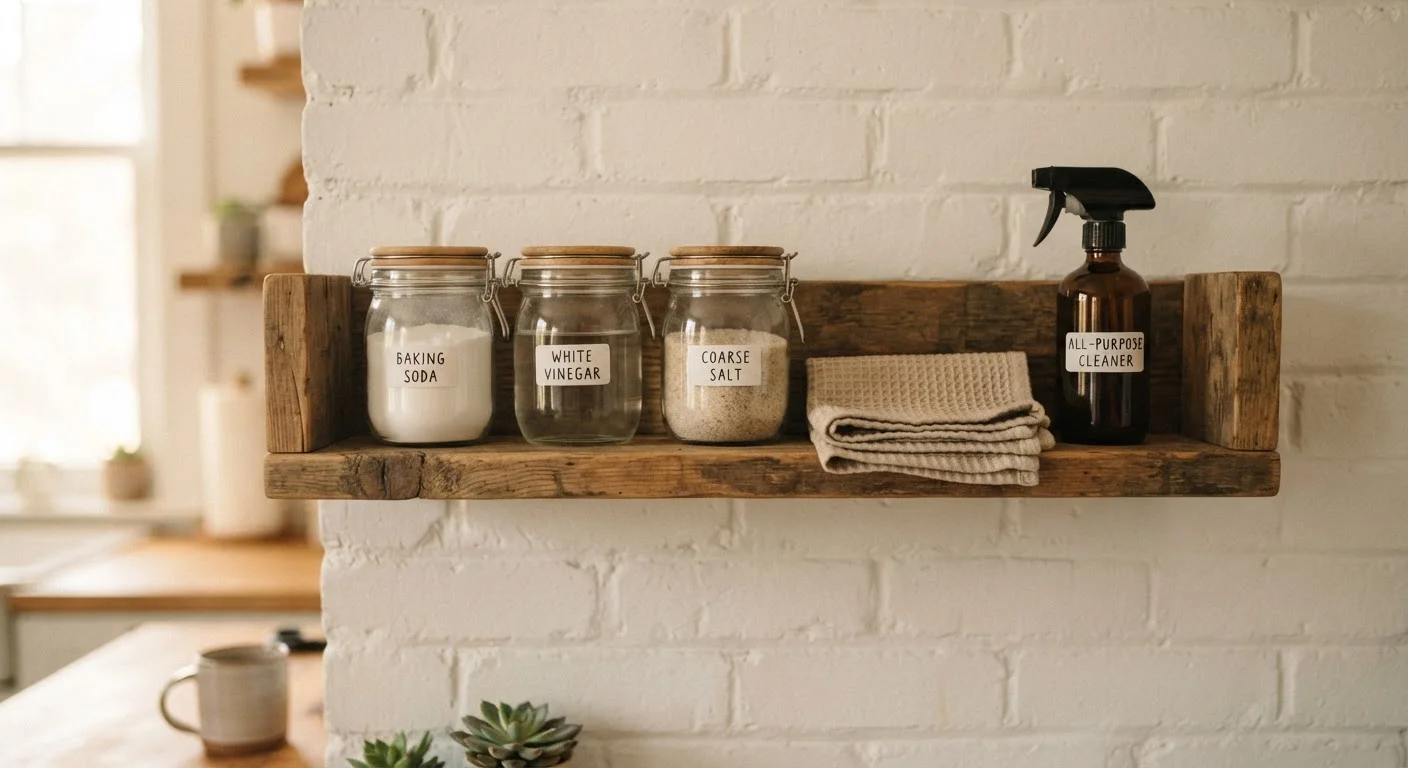
Before stocking up on any pantry item for household use, check what's already in your cabinets. Most households have at least baking soda and white vinegar on hand at any given time. Dedicating a small labeled container to household-use quantities of each keeps them separate from cooking stock and helps you track when you're running low - a small habit that aligns well with broader household budgeting goals.
It's also worth calibrating expectations. Pantry staples work well for routine maintenance and light to moderate soil, but they're not always the right tool for heavy-duty disinfection or persistent mold. For context on where commercial cleaners still make sense, cleaning supply myths is worth a read. And if you want to understand how cost-per-use compares across product formats, concentrate vs. ready-to-use cleaner value breaks that down in practical terms.
Finally, if your cleaning results feel inconsistent over time, the issue may not be the product at all - why cleaning routines stop working explains how habituated bacteria and misuse patterns can make any cleaner seem less effective. Pantry staples, like any tool, perform best when used correctly and in the right situations.