
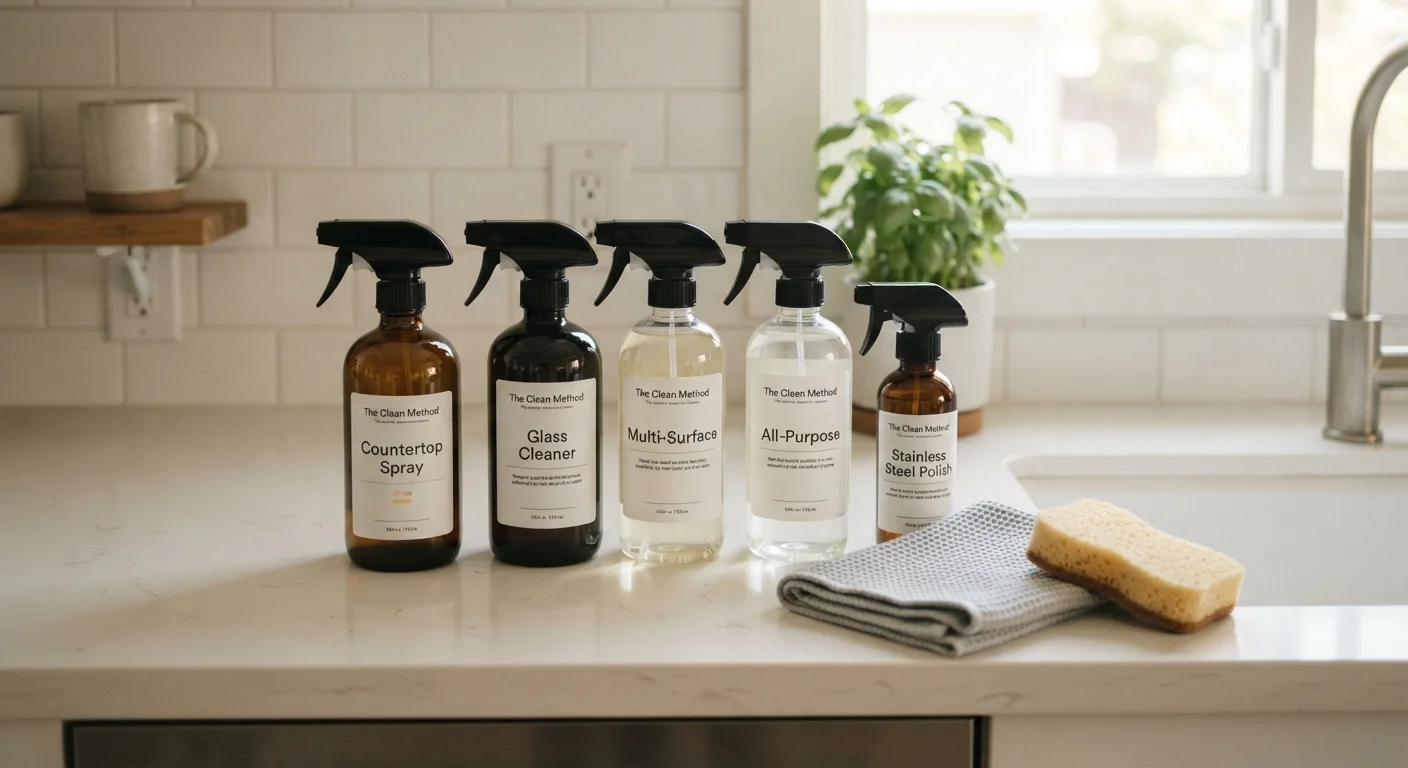
Why a Cleaner That Once Worked Seems to Fall Short
Most households settle into a routine: one spray for the kitchen, one for the bathroom, one multi-purpose bottle for everything else. It feels efficient. But if those surfaces start looking grimier sooner - or if you find yourself scrubbing harder than you used to - the product may not be the problem. How you're using it probably is.
There are two distinct reasons a cleaning routine loses its edge. The first is user behavior: skipping pre-cleaning, not allowing dwell time, or diluting a concentrate incorrectly. The second is microbial adaptation, where bacteria that survive repeated exposure to the same disinfectant gradually develop tolerance to it. Both are real, and both are fixable.
Understanding which problem you're actually dealing with determines the right solution. If the issue is technique, rotation won't help much. If tolerance is building on a heavily used surface, switching active ingredients is the most direct fix. Often, it's a combination of both.
Tolerance Is Not the Same as Resistance
The bacterial tolerance that can develop with repeated disinfectant use is distinct from the antibiotic resistance that concerns public health agencies. Tolerance means a higher concentration may be needed to achieve the same effect - not that the product becomes entirely ineffective. Good technique and rotation are practical preventive steps, not responses to a crisis-level threat.
The Science Behind Bacterial Tolerance
Disinfectants kill microorganisms through chemical mechanisms - disrupting cell membranes, denaturing proteins, or oxidizing key cellular structures. When a disinfectant is applied correctly, the kill rate is high. But in real-world use, application is rarely perfect. Some bacteria survive because they received a sub-lethal dose, either from insufficient dwell time or surface interference from organic material like food residue or soap film.
Those survivors aren't simply lucky. Research published in microbiology journals has found that prolonged exposure to sub-inhibitory concentrations of certain disinfectants - particularly quaternary ammonium compounds ("quats"), found in many household sprays - can select for bacterial strains with reduced sensitivity. This is especially relevant in consistently wet environments like bathroom sinks or kitchen drains.
This isn't the same as antibiotic resistance, and it's important not to overstate it. But the practical takeaway is sound: using a product with a different active ingredient periodically gives tolerant populations less advantage.
30-60 sec
Minimum dwell time for most household disinfectants
Most disinfectant labels specify contact time requirements; wiping immediately after application significantly reduces kill efficacy regardless of the product used.
~80%
Reduction in disinfectant efficacy on soiled surfaces
Studies in applied microbiology have shown that organic soil (food residue, bodily fluids) can dramatically reduce a disinfectant's effectiveness when pre-cleaning is skipped.
How to Rotate Products Effectively
Effective rotation doesn't mean buying a cabinet full of specialty cleaners. It means maintaining two or three products with meaningfully different active ingredients and alternating their use on high-contact surfaces over weeks or months.
- Identify your high-risk surfaces: Bathroom counters, toilet handles, kitchen sinks, and cutting boards are the places where microbial load is highest and where rotation matters most.
- Read the active ingredients label: Look for the specific compound listed, not just the marketing name. Switching from a quat-based spray to a hydrogen peroxide-based or bleach-based product is a genuine rotation.
- Fix technique first: Pre-clean surfaces to remove organic material before disinfecting. Allow the disinfectant to remain wet on the surface for the full dwell time listed on the label - this is non-negotiable for effectiveness.
- Don't over-disinfect low-risk areas: Windowsills, baseboards, and shelves rarely need disinfectant. A general cleaner or damp cloth is sufficient and reduces unnecessary chemical use.
For a broader look at what home cleaning products actually do - and what they don't - see cleaning supply myths that are wasting your money and effort. And if pantry staples like vinegar or baking soda are part of your rotation, pantry staples that pull double duty as household agents explains where they're genuinely effective.
Read the Label Before You Wipe
Every registered disinfectant lists a required dwell time - the minimum period the surface must stay visibly wet for the product to achieve its claimed kill rate. For most household sprays, this ranges from 30 seconds to 10 minutes. Setting a simple timer when disinfecting high-touch areas can meaningfully improve results without changing products at all.
When Rotation Isn't the Answer
Product rotation is specifically relevant to disinfection and pathogen control. If your concern is cleaning performance in a broader sense - removing grease, mineral deposits, or mildew stains - the solution is product-to-task matching, not rotation. Using the wrong chemistry for a specific soil type will always underperform, regardless of how recently you switched brands.
Greasy stovetops need an alkaline degreaser. Hard water deposits respond to acidic cleaners. Mold and mildew require either bleach or a peroxide-based product with adequate contact time. No amount of rotating general-purpose sprays addresses these chemistry mismatches.
The logic here parallels other maintenance routines. Just as a fitness routine may stall not because exercise stopped working but because the variables haven't changed - see diagnosing a stalled fitness routine for that parallel - a cleaning routine plateaus when the approach doesn't match the actual problem.
Take a systematic look at what's actually failing in your routine before adding more products to the mix. The solution is usually simpler than it appears.