
Why Cleaning Myths Persist - and What They Cost You
Cleaning product marketing has always leaned on the appearance of scientific authority - clinical language, laboratory imagery, and the implicit promise that more product equals more clean. These messages compound over decades into habits that feel like common sense but are often neither effective nor economical.
The practical cost is real. Households that over-apply products, buy room-specific cleaners for every surface, or mix solutions in search of extra power are spending more money and time while sometimes achieving worse results. A more skeptical, evidence-oriented approach to what's in the supply cabinet tends to simplify both the routine and the grocery bill. If you're also examining myths in other consumer categories, the same discipline applies - see how car buying myths cost consumers money for a parallel look at how persistent misconceptions affect wallets.
2016
FDA ruling on antibacterial consumer soaps
The U.S. FDA issued a final rule in 2016 requiring manufacturers to prove antibacterial wash ingredients were safe and more effective than plain soap - many could not, leading to widespread reformulation.
~5%
Acetic acid concentration in household vinegar
Standard white distilled vinegar contains roughly 5% acetic acid - enough to dissolve mineral scale but also enough to etch natural stone surfaces with repeated use.
The Most Costly Cleaning Misconceptions, Corrected
The myths below are among the most widely held - and the most likely to drive unnecessary spending or, in a few cases, genuine safety risks. Each correction is grounded in publicly available guidance from regulatory bodies and established cleaning chemistry.
Myth
Using more cleaning product gets surfaces cleaner faster.
Fact
Exceeding the recommended amount typically leaves residue that attracts more dirt and may require additional rinsing - it doesn't improve cleaning performance.
Most household cleaners are formulated to work at a specific dilution. Applying double the amount doesn't double the cleaning action; surfactants and active agents reach peak effectiveness at intended concentrations. Excess product often leaves a sticky film on floors and counters that traps dust and debris, creating a cycle where surfaces seem perpetually grimy. Following label directions is both more effective and more economical.
Myth
A stronger smell means a product is working harder.
Fact
Fragrance is added separately from cleaning agents and has no bearing on disinfecting or degreasing ability.
The association between a sharp or "clean" scent and sanitizing power is largely a marketing convention. Fragrance compounds serve an aesthetic purpose only. Some unscented or lightly scented products contain the same active ingredients - at the same concentrations - as heavily perfumed alternatives. For people with sensitivities, heavy fragrance can cause respiratory irritation without any added cleaning benefit.
Myth
Mixing two cleaners together makes a more powerful solution.
Fact
Combining cleaning products is rarely beneficial and can be outright hazardous - certain mixtures produce toxic gases.
Household chemistry doesn't work like a recipe where more ingredients improve the dish. Bleach combined with ammonia (found in some glass cleaners) generates chloramine gases. Bleach mixed with acidic cleaners like vinegar releases chlorine gas. Even combining two "natural" products can neutralize their effectiveness - for instance, mixing baking soda with vinegar produces a mostly inert salt-water solution, not a more potent cleaner. [important_callout]
Myth
Antibacterial soap is more effective than regular soap for everyday use.
Fact
The U.S. Food and Drug Administration (FDA) has stated that plain soap and water is as effective as antibacterial soap for routine handwashing in household settings.
Antibacterial soaps typically contain agents like triclosan or benzalkonium chloride. The FDA ruled in 2016 that manufacturers had not demonstrated these ingredients were more effective than plain soap for consumer use, and some were removed from the market. The mechanical action of lathering and rinsing is responsible for most pathogen removal. For everyday household handwashing, plain soap does the job without contributing to antimicrobial resistance concerns.
Myth
White vinegar is a safe, all-purpose cleaner for any surface.
Fact
Vinegar is useful for specific tasks - like descaling kettles or cleaning glass - but can actively damage grout, natural stone, and some appliance components.
Vinegar's acidity (typically around 5% acetic acid) makes it effective at dissolving mineral deposits and cutting through light grease on non-reactive surfaces. However, that same acidity erodes the calcium carbonate in marble and limestone, weakens grout over repeated use, and can degrade rubber gaskets in dishwashers and washing machines. See what pantry staples are genuinely multipurpose for context on where vinegar actually earns its place. [warning_callout]
Myth
Specialty cleaners for every room are necessary for a clean home.
Fact
Most household surfaces can be cleaned effectively with a small number of multipurpose products; room-specific cleaners are largely a marketing distinction.
The average cleaning aisle now stocks dozens of targeted products - bathroom sprays, kitchen degreasers, stainless steel polishes, and more. In most cases, a pH-neutral multipurpose cleaner handles the majority of household tasks. Specialty formulas sometimes contain higher concentrations of a specific active agent, but the underlying chemistry often overlaps significantly. Understanding how to match a cleaner's chemistry to a soil type - acid for mineral deposits, alkaline for grease - is more valuable than buying a dedicated product for every room. For a deeper look at cost-per-use, comparing concentrate formats to ready-to-use sprays can clarify where the real value lies.
Cleaning routines can also lose effectiveness over time for reasons unrelated to product choice. Why your cleaning routine stops working explores the role of application habits and product rotation in maintaining consistent results.
Building a Leaner, More Effective Cleaning Kit
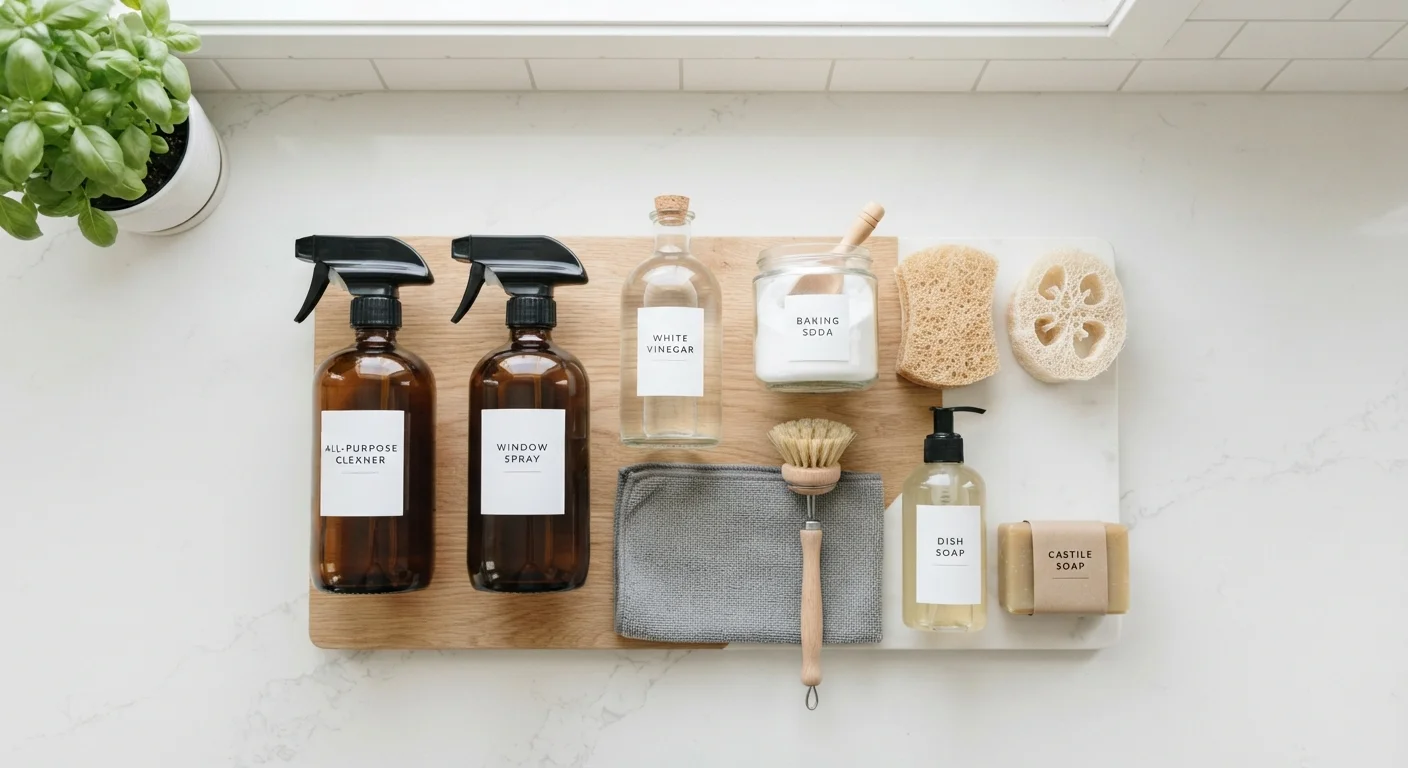
Once you strip away products that duplicate each other or don't deliver on their claims, most households can operate effectively with a short list: a pH-neutral all-purpose cleaner, a disinfectant appropriate for high-touch surfaces, an abrasive scrub for tough buildup, and plain dish soap. That's a meaningful reduction from the average under-sink cabinet.
Cost savings from simplifying extend further than the initial purchase. Fewer products mean less storage space needed, less risk of accidental mixing, and less decision fatigue during a cleaning session. The hidden costs of cheap home supplies is worth reading alongside this - because paring down doesn't mean defaulting to the lowest shelf price on everything. Some product categories reward slightly higher investment; others genuinely don't. Applying a budget-conscious framework, as outlined in budgeting basics, can help households decide where cleaning dollars are actually well spent.
This article provides general consumer information about household cleaning products. It is not a substitute for manufacturer guidance, safety data sheets, or professional advice. Always read product labels and follow usage instructions carefully.