The Two Numbers on Every Shelf Tag
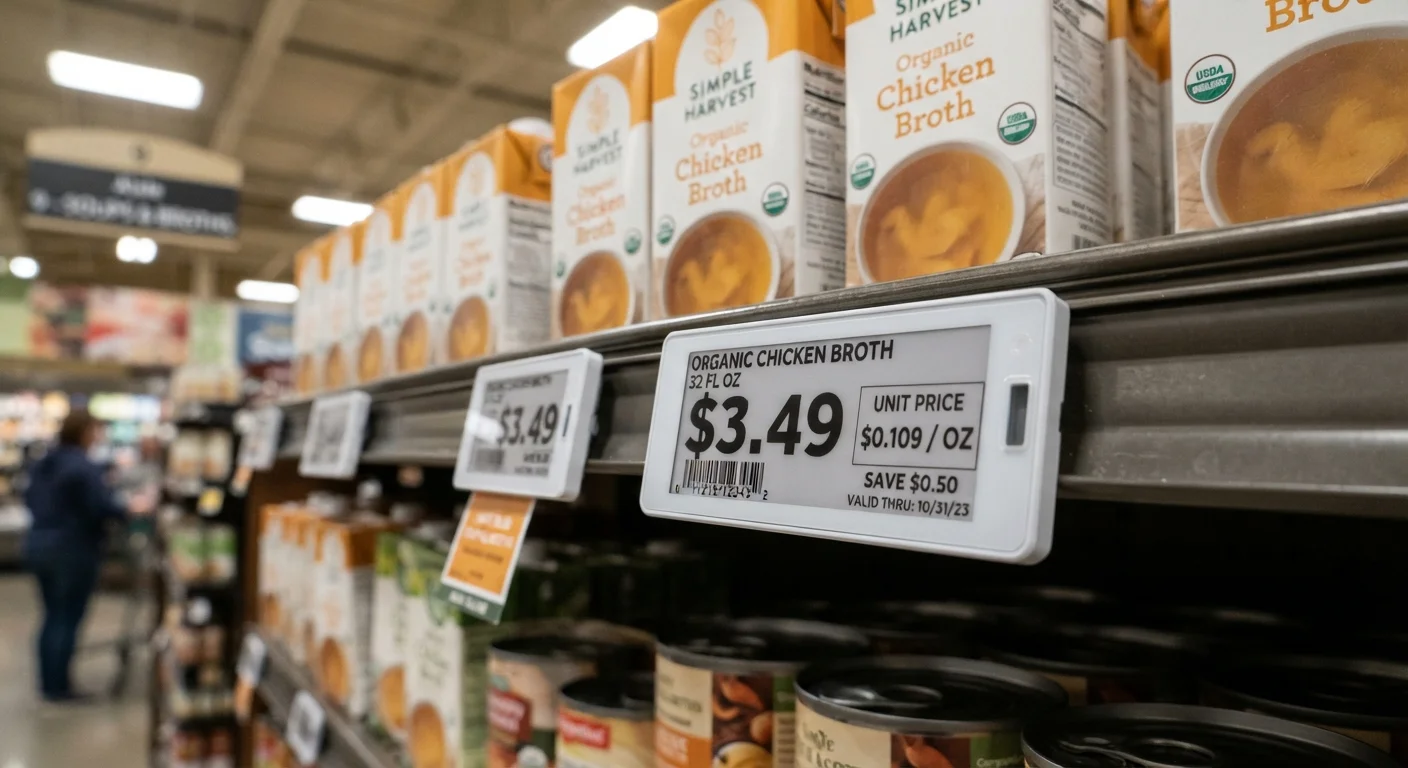
Every grocery shelf label carries at least two numbers: a large retail price and a smaller unit price. Most shoppers focus entirely on the first and ignore the second. That habit can quietly cost money on routine purchases week after week.
The large number tells you what you'll pay at the register. The small number - the unit price - tells you what you're actually getting for that money. It normalizes cost across different package sizes and brands so you can compare them fairly. Without it, you're essentially judging different-sized containers by their cover.
For a deeper look at how unit price functions as a standalone decision tool, see how unit price changes how you shop.
~70%
Shoppers who rarely use unit price labels
Consumer behavior research consistently finds that most grocery shoppers default to total price rather than unit price when making purchase decisions.
10-20%
Estimated grocery savings from consistent unit price use
Researchers studying grocery purchasing behavior have estimated that comparing unit prices on common household staples can reduce spending by roughly 10-20% on those items over time.
Why the Sticker Price Is Often Misleading
Retail pricing is structured around perception as much as cost. A $4.99 item feels meaningfully cheaper than a $5.00 item. A large package signals value even when the math doesn't support it. A bold red 'SALE' tag implies savings even when the unit price hasn't changed much - or at all.
Unit pricing cuts through these signals by reducing each product to a single, comparable number. A 15-oz can of beans priced at $1.29 costs about $0.086 per ounce. A 28-oz can at $2.69 costs about $0.096 per ounce. The bigger can has a higher unit price despite appearing to be the economy option. Without checking, that distinction is invisible.
Retail pricing tactics go further than package sizing. Reference pricing and markup strategies are worth understanding alongside unit pricing to get a complete picture of value at the shelf.
Check Before Assuming Bulk Means Better
Large packages and multipacks do not automatically carry the lowest unit price. Always compare the unit price of the jumbo size to the standard or even travel size before assuming the bigger option is the better deal. On sale weeks especially, smaller sizes sometimes undercut larger ones on a per-unit basis.
How to Read a Unit Price Label
Shelf labels follow no universal format, but unit price is typically printed in smaller type and expressed as a dollar amount followed by a slash and a unit abbreviation: $0.22/oz, $1.15/lb, or $0.09/ct. Some labels show it as cost per 100 units (e.g., per 100 sheets of paper towel).
Three things to check before using the unit price to compare:
- Same base unit: Only compare products priced per the same measure. Don't compare a price per ounce to a price per pound without converting.
- Same product category: A concentrated cleaner and a ready-to-use version serve different volumes per use - unit price alone won't capture that difference. This matters more than many shoppers realize, as explored in comparing concentrates vs. ready-to-use cleaners.
- Current label: Verify the label on the shelf matches the product in front of you; misplaced tags are common.
When Unit Pricing Matters Most - and When It Has Limits
Unit pricing is most powerful in predictable, repeat-purchase categories: canned goods, cereals, paper products, cleaning supplies, and personal care items. These are products you'll use regardless of brand, so the only real variable is cost efficiency.
It has limits, though. A product with a great unit price is only a good buy if you'll actually use it before it expires or goes to waste. Buying a larger quantity than you need introduces a hidden cost - spoilage or storage - that the label won't show you. Bulk buying carries its own set of trade-offs worth evaluating separately.
Unit pricing also doesn't account for quality differences between products. Two olive oils priced identically per ounce are not necessarily equal in flavor or use-value. For purchases where quality matters, unit price is one input - not the whole answer. The concept of cost per use complements unit pricing by factoring in how far a product actually goes.
Used consistently, even on a fraction of your grocery purchases, unit pricing is a straightforward habit that supports household budget goals without requiring any special tools or apps - just a few extra seconds at the shelf.
Unit Pricing Laws Vary by State
Not all U.S. states require retailers to display unit prices, and those that do often limit the requirement to certain store sizes or product categories. If a shelf label is missing a unit price, you can calculate it manually by dividing the retail price by the net weight or count printed on the package. Some grocery apps and store loyalty platforms display unit prices digitally when shelf labels are absent.