What Unit Price Actually Tells You
Shelf price answers one question: what does this cost at the register? Unit price answers a different and more useful question: what am I actually paying for what I get?
When two bottles of dish soap sit side by side — one at $3.49 and one at $5.29 — the smaller sticker price looks like the obvious choice. But if the cheaper bottle holds 16 oz and the pricier one holds 32 oz, the math tells a different story. At $0.22 per ounce versus $0.17 per ounce, the more expensive bottle is actually the lower-cost option.
That's the core value of unit price: it collapses variables like package size and quantity into a single, comparable number. You don't have to mentally account for the fact that one pasta box has 12 oz and another has 16 oz — the unit price does that work for you.
~70%
Shoppers who misidentify the better value without unit price
Research published in the Journal of Consumer Affairs has found that a majority of shoppers choose the higher unit-cost option when comparing products without unit price information visible.
32+ states
U.S. states with some form of unit pricing regulation
According to consumer advocacy research, most U.S. states have enacted statutes or regulations requiring unit price disclosure in grocery and retail settings, though enforcement and scope vary.
How to Read (and Calculate) Unit Price
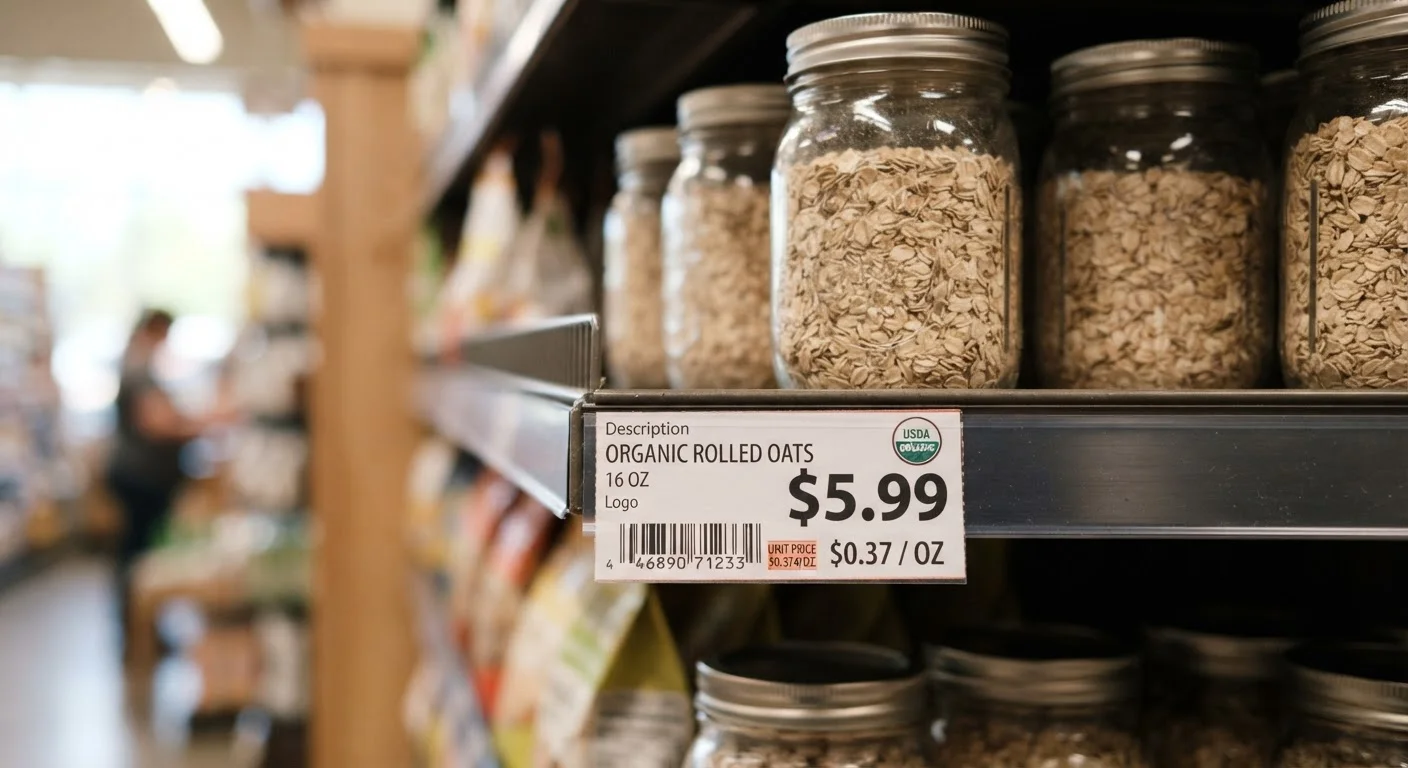
In most grocery and household goods stores, unit price is already printed on the shelf label — usually in smaller type, often in the lower left. It typically reads something like $0.19/oz or $1.24/100 ct. The unit of measure matters: make sure you're comparing the same unit across competing products before drawing conclusions.
If the label doesn't show unit price, the calculation is simple:
- Find the total price on the tag.
- Find the quantity from the product label (ounces, count, pounds, etc.).
- Divide total price by quantity.
A 48 oz container of oats priced at $4.80 has a unit price of $0.10 per ounce. A 30 oz container at $3.30 comes in at $0.11 per ounce — not much difference, but worth knowing. See our guide to reading unit pricing labels for a closer look at how shelf tags present this information.
Use the Same Unit When Comparing
Before comparing two unit prices, confirm they use the same measure. One product may show cost per ounce while a competitor shows cost per 100 grams — those aren't directly comparable without conversion. When in doubt, calculate both manually using the same unit.
When Unit Price Can Mislead You
Unit price is a reliable tool — but only when the comparison is apples to apples. Here are the situations where a lower unit price can still lead to a poor purchase:
- Perishables you won't use in time. Buying a 5 lb bag of spinach at a lower per-ounce price isn't a win if half goes into the compost. Real cost includes what you throw away.
- Different product concentrations. A concentrated cleaning spray and a ready-to-use version may have the same unit price per ounce, but deliver very different numbers of uses. Our article on concentrates vs. ready-to-use cleaners explores this distinction in detail.
- Storage constraints. A bulk purchase with a great unit price still costs money upfront and needs space. Bulk buying has real trade-offs worth evaluating.
- Mismatched base units. Some retailers list one product per ounce and a competing product per 100g. Always confirm the unit matches before comparing.
Unit price is one input in a purchasing decision — not the whole picture. What value really means when you buy something depends on quality, longevity, and personal fit, too.
Making Unit Price a Shopping Habit
The goal isn't to spend more time in the aisle doing arithmetic — it's to build a quick mental habit. Most shoppers can glance at two unit price labels in seconds once they know where to look.
For categories where you buy the same type of product repeatedly — cereal, laundry detergent, paper towels, canned goods — a few comparisons over a handful of shopping trips will quickly give you a reliable sense of what a fair unit price looks like. From there, deviations become obvious.
Unit price also pairs well with cost-per-use thinking, especially for products that last many uses, like cleaning supplies or personal care items. Together, these two numbers give you a more complete view of what something actually costs to own and use — not just to buy.
The retail environment is designed around shelf price. Unit price is the consumer's counter-tool. It takes about five seconds to check and can shift a purchasing decision meaningfully over time.