
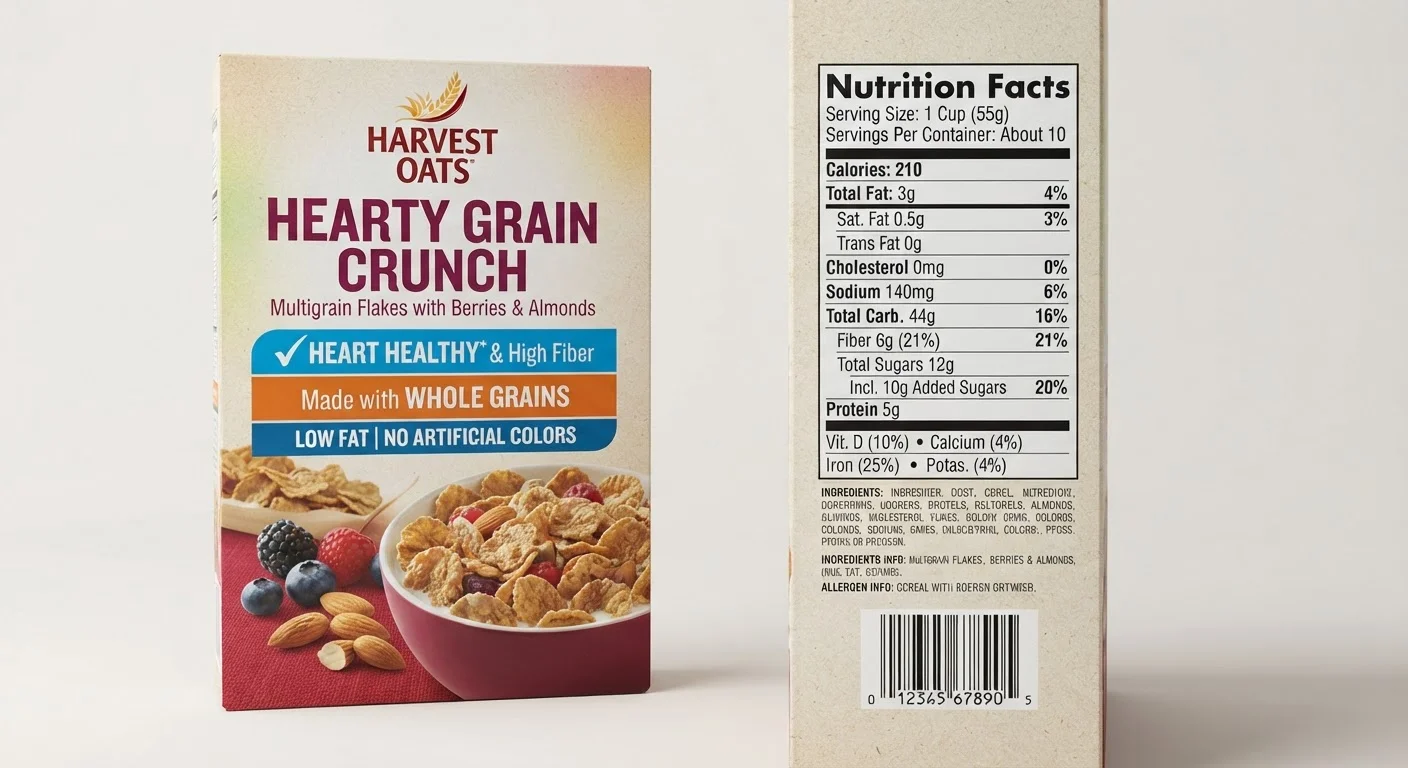
Why the Same Package Can Say Two Very Different Things
Pick up almost any packaged food and you encounter a split personality. The front shouts phrases like "high protein," "low fat," "all natural," or "made with whole grains." The back or side panel quietly presents a grid of numbers. Both appear on the same product, yet they operate under fundamentally different rules - and serve fundamentally different masters.
Understanding this divide is one of the most practical nutrition literacy skills an everyday shopper can develop. It does not require a dietetics degree; it just requires knowing which part of the label is regulated and which part is not. Our plain-language guide to the Nutrition Facts panel walks through every row of the regulated panel in detail - but let's first establish why the distinction matters.
| Criterion | Nutrition Facts Label | Front-of-Pack Health Claims |
|---|---|---|
| Regulatory oversight | FDA-mandated format and definitions | Partially regulated; many terms undefined |
| Purpose | Standardized nutrient disclosure | Attract consumer attention; drive purchase |
| Location on package | Side or back panel | Front of package |
| Comparability across brands | Yes - consistent methodology | No - language varies freely |
| Examples | Calories, %DV, Added Sugars, Sodium | "Natural," "Superfood," "High Protein," "Clean" |
| Legal definitions | All terms legally defined | Some terms defined; many are not |
| Reliability for diet decisions | High - verified, standardized data | Low to moderate - selective and variable |
The Nutrition Facts Panel: What Federal Regulation Actually Guarantees
The Nutrition Facts label is mandated and regulated by the U.S. Food and Drug Administration (FDA). Its format, the definitions of its terms, and the method of calculating its values are set by federal law. That means when you read "serving size," "calories," "total fat," "sodium," "dietary fiber," or "percent daily value (%DV)" on the panel, those figures must meet consistent legal standards - you can compare them directly across brands and categories.
The FDA updated the Nutrition Facts format in 2016, with full industry compliance required by 2021. Key changes included a more prominent calorie display, a mandatory "Added Sugars" line (separate from total sugars), and updated %DV benchmarks to reflect current dietary guidance. Vitamin D and potassium replaced vitamins A and C as required nutrients, reflecting shifts in public health priorities.
2021
Full compliance deadline for updated FDA Nutrition Facts format
The FDA's revised Nutrition Facts label - featuring mandatory Added Sugars disclosure and updated %DV benchmarks - required full industry compliance by January 2021.
20% DV
Threshold for an FDA-defined 'high' nutrient claim
Under FDA regulations, a food must provide 20% or more of the daily value per serving to legally use the terms 'high in' or 'excellent source of' a given nutrient.
No definition
FDA's formal stance on the term 'natural' for food labels
The FDA has considered establishing a formal definition for 'natural' on food labels but has not finalized one, leaving the term largely unregulated in practice.
Because the panel is standardized, it is the only part of a food package where you can reliably compare, for example, the sodium in two different brands of canned tomatoes or the fiber content across breakfast cereals. For a deeper look at how carbohydrates, proteins, and fats function in the body, that context helps you interpret those numbers meaningfully.
Front-of-Pack Claims: Marketing With Partial Rules
Front-of-pack (FOP) language lives in a far murkier regulatory space. Some terms do carry legal definitions. The FDA defines "low fat" as 3 grams or less of total fat per serving, "low sodium" as 140 milligrams or less, and "high" or "excellent source of" as 20% or more of the %DV for a given nutrient. Nutrient content claims like these have specific thresholds manufacturers must meet.
But many of the most prominent FOP phrases carry no enforceable legal definition at all:
- "Natural" - the FDA has not established a formal definition for this term on food labels.
- "Superfood" - a marketing term with no regulatory standing whatsoever.
- "Clean" - entirely undefined in U.S. food labeling law.
- "Made with whole grains" - a product containing even a small amount of whole grain can use this phrase.
This is not to say all FOP claims are meaningless - but they are selectively chosen to present a product in its most favorable light. A snack labeled "high protein" may simultaneously be high in sodium and added sugar; you would only know by checking the Nutrition Facts panel. To understand why added sugar deserves its own scrutiny, the panel's dedicated "Added Sugars" line is the place to look.
When 'Low Fat' Can Still Mean High Calories
A product legally labeled 'low fat' (3g or less per serving) can still be calorie-dense if it contains high amounts of added sugars or refined carbohydrates used to compensate for reduced fat. This substitution effect was common in the low-fat food era of the 1990s and remains relevant today. Always check total calories and the added sugars line alongside any single-nutrient FOP claim.
Practical Steps for Cutting Through Label Confusion
Building a habit of reading the Nutrition Facts panel rather than reacting to FOP claims is straightforward once you know what to look for. A few principles help:
- Start with serving size. All values on the panel refer to one serving, not the whole package. A bag listed as "2.5 servings" means you need to multiply every number by 2.5 if you eat the whole thing.
- Use %DV as a quick guide. The FDA's general rule: 5% DV or less is low for a nutrient; 20% DV or more is high. This shorthand works for both nutrients you want more of (fiber, potassium) and those to limit (saturated fat, sodium, added sugars).
- Cross-reference the FOP claim with the panel. If the front says "low sugar," check the added sugars line. If it says "good source of fiber," verify the fiber %DV.
- Ignore undefined terms. "Natural," "clean," and "superfood" tell you nothing actionable about the product's nutrient profile.
It is also worth noting that heavily processed products can technically comply with regulated FOP claims while still being nutritionally poor overall. Research into ultra-processed foods and their effects on diet quality is a useful companion to label literacy.
For a broader view of how regulated labeling works across other consumer product categories - from energy ratings to safety certifications - see our guide to consumer product labels and certifications.
This article is for general informational and educational purposes only and is not a substitute for personalized dietary or medical advice. Consult a registered dietitian or qualified healthcare professional for guidance specific to your health needs.