
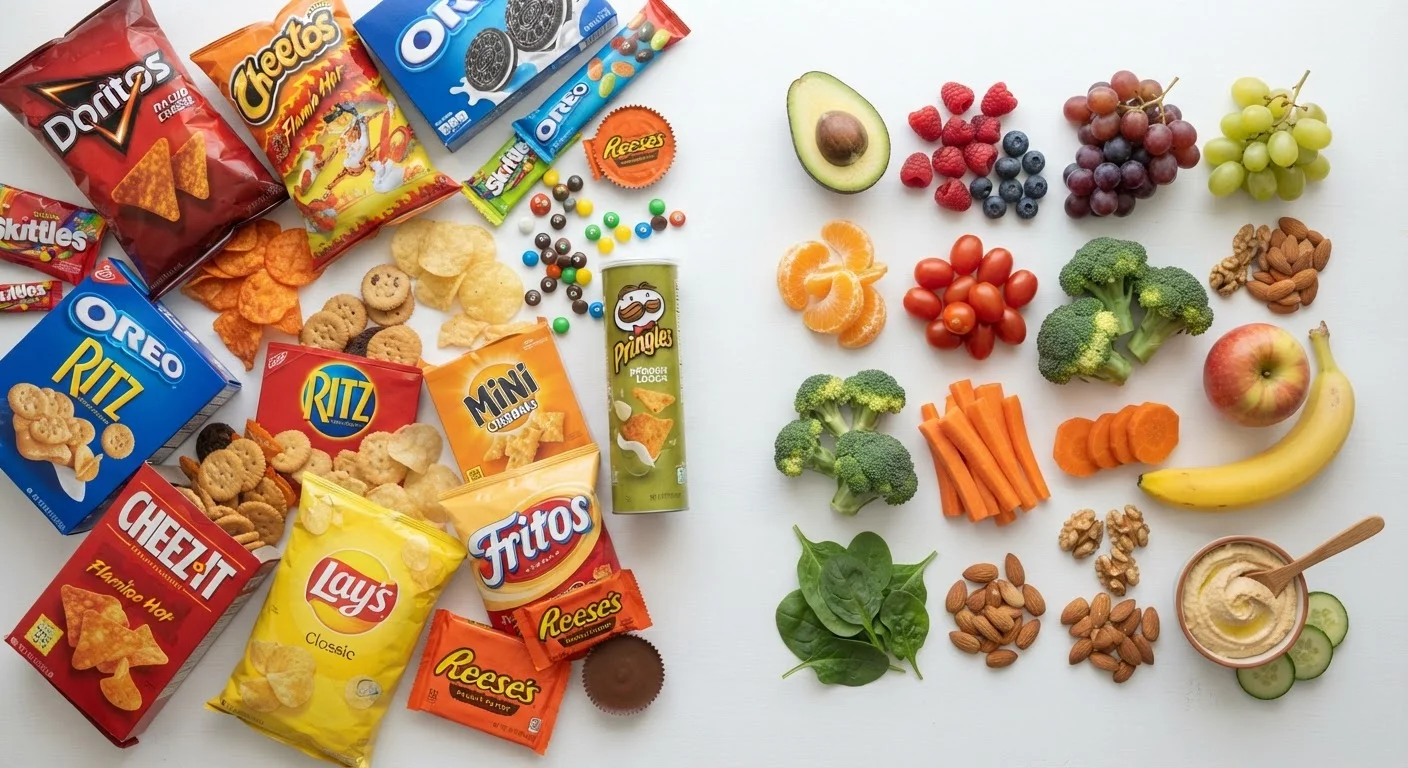
Why These Foods Don't Behave Like Other Foods
If you've ever finished an entire bag of chips without quite meaning to, you're not imagining a lack of willpower. Ultra-processed foods are deliberately formulated to be highly palatable - meaning they're engineered to hit specific combinations of fat, sugar, salt, and texture that make it difficult to stop eating at a natural stopping point.
This isn't an accident. Food scientists use the concept of sensory-specific satiety - the idea that we get tired of a single, simple flavor quickly. Ultra-processed products are crafted to sidestep this effect, delivering complex, layered flavors that keep the palate engaged. The result is what researchers sometimes call a "bliss point" - the precise formulation that maximizes craving and consumption.
Beyond taste engineering, the physical texture of many ultra-processed foods matters too. Many are designed to dissolve quickly in the mouth, reducing chewing time and potentially shortening the window in which fullness signals can register.
What the NOVA Classification Covers
The NOVA system categorizes foods by the degree and purpose of processing, not by their nutrient content. A food can be nutritionally dense and still qualify as ultra-processed if it contains industrial additives. Conversely, some processed foods - like plain yogurt or canned tomatoes - fall into less-processed categories despite containing added salt or acid. Understanding this distinction helps clarify why 'processed' and 'unhealthy' are not synonymous terms.
What Nutrition Research Actually Shows
The evidence connecting ultra-processed food intake with health outcomes has grown considerably in recent years. A landmark randomized controlled trial published in Cell Metabolism by researchers at the National Institutes of Health found that participants assigned to an ultra-processed diet consumed roughly 500 more calories per day on average compared to those on a minimally processed diet - even though both groups had unrestricted access to food and both diets were matched for total fat, sugar, carbohydrates, protein, and fiber.
This finding was significant because it suggested that something beyond raw nutrient composition drives overconsumption - possibly the speed at which these foods are eaten, their effect on satiety hormones like GLP-1 and PYY, or the disruption of normal hunger and fullness cues.
Epidemiological research has also linked high ultra-processed food consumption with poorer overall diet quality, independent of specific nutrient intake. For context on how processing changes food at the structural level, see our companion piece on what happens when grains get refined.
“We found that people ate faster when consuming ultra-processed foods and that the rate of eating was associated with increased calorie intake. The mechanisms are still being studied, but these foods appear to impair normal satiety signaling in ways that go beyond simple nutrient composition.”
— Kevin Hall, Senior Investigator, National Institute of Diabetes and Digestive and Kidney Diseases, NIH
The Role of Habit, Environment, and Convenience
Biology alone doesn't explain why ultra-processed foods are hard to quit. Habit formation, food environment, and cost all play significant roles. These products are often cheaper per calorie than fresh alternatives, heavily marketed, and strategically placed in retail environments. Many people also associate them with comfort, social occasions, or childhood memories - psychological dimensions that purely nutritional interventions rarely address.
Research on behavior change suggests that friction - or the lack of it - is one of the strongest predictors of food choice. Ultra-processed foods require almost no preparation time, making them the default option in a busy schedule. Sustainable change, for most people, means reducing that convenience gap rather than relying on motivation alone.
Practical strategies that nutrition researchers and registered dietitians commonly discuss include making minimally processed options more accessible at home, batch-preparing simple whole-food snacks, and being intentional about grocery choices. Our article on grocery shopping habits that support a more nutritious diet offers a practical framework for this.
Start With Substitution, Not Elimination
Rather than cutting out ultra-processed foods entirely, try identifying the two or three products you eat most frequently and finding a minimally processed alternative for just one of them. Research on habit change consistently shows that small, specific substitutions are more likely to stick than broad dietary overhauls. Over time, these incremental shifts can meaningfully alter the overall composition of your diet.
A Realistic Path Forward
Nutrition science does not support an all-or-nothing approach to ultra-processed food. Labeling entire food categories as forbidden tends to increase their psychological appeal and can contribute to cycles of restriction and overconsumption - a pattern well-documented in dietary behavior research.
Instead, most evidence points toward a dietary pattern built around whole and minimally processed foods as its foundation, with ultra-processed options treated as occasional rather than habitual choices. Learning to read ingredient lists critically - rather than relying on front-of-package marketing - is one concrete skill that supports this. For a closer look at how label claims can mislead, see our piece on nutrition labels versus health claims.
It's also worth noting that ultra-processed food consumption doesn't occur in a vacuum. Broader dietary patterns, activity levels, sleep, stress, and access to food all interact. Anyone seeking personalized guidance on managing their diet - especially those with specific health conditions - should consult a registered dietitian or qualified healthcare provider.
~500 kcal/day
Extra calories consumed on ultra-processed diet
Participants in a controlled NIH randomized trial ate roughly 500 more calories per day on an ultra-processed diet compared to a minimally processed one, despite matched macronutrient profiles.
57%
Share of US calories from ultra-processed foods
Analysis published in BMJ Open estimated that ultra-processed foods account for more than half of daily caloric intake among US adults, based on nationally representative dietary survey data.
2 kg
Average weight gained on ultra-processed diet
In the same NIH controlled trial, participants on the ultra-processed diet gained an average of approximately 2 pounds (about 1 kg) over two weeks, while those on the minimally processed diet lost a similar amount.
This article is for general informational and educational purposes only. It is not a substitute for professional medical or dietary advice. Consult a qualified healthcare professional for guidance specific to your health needs.