
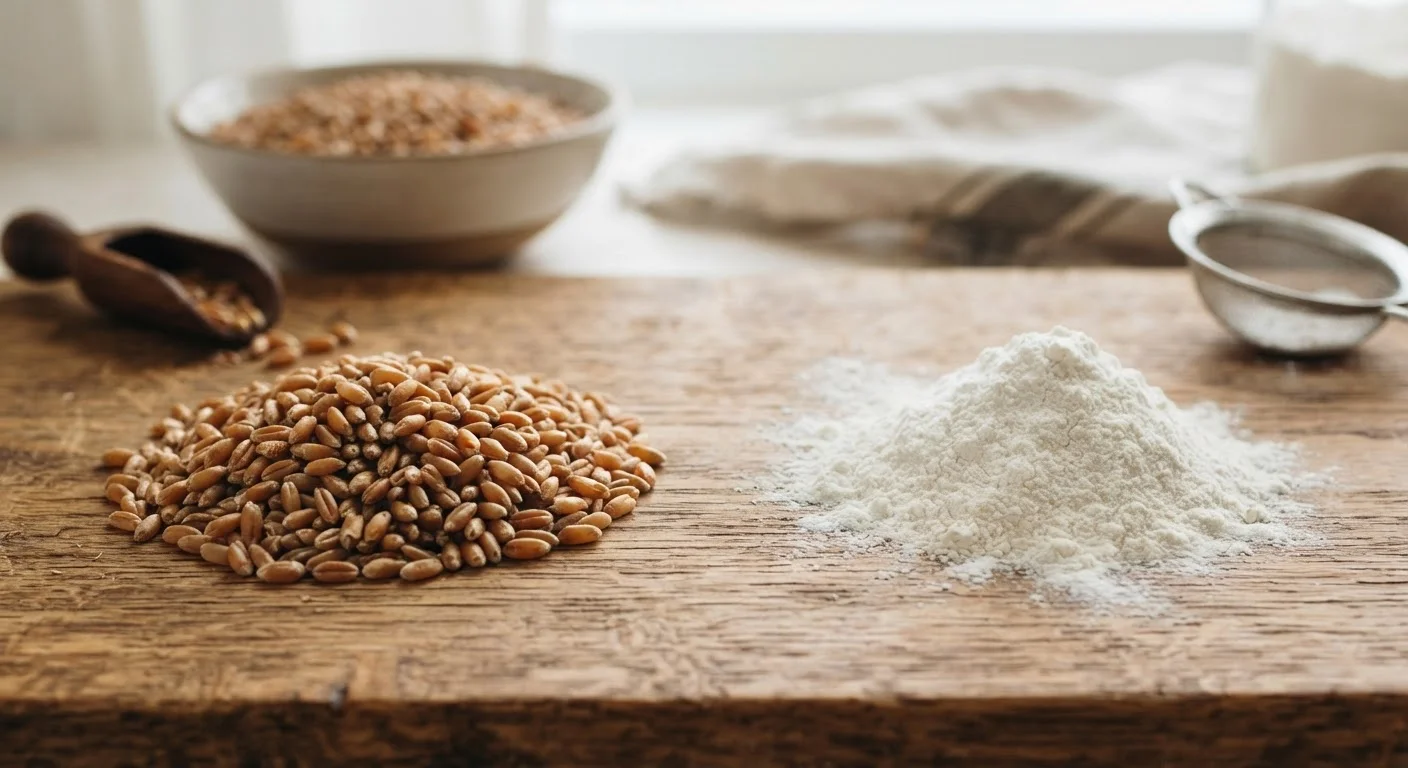
What Happens Inside the Mill
A grain of wheat has three distinct layers: the outer bran, the nutrient-rich inner germ, and the starchy central endosperm. Whole grains retain all three. Refined grains - including white flour and white rice - are milled to remove the bran and germ, leaving primarily the endosperm.
That milling process is efficient and extends shelf life, but it comes at a measurable nutritional cost. The bran is the primary source of dietary fiber. The germ is rich in vitamin E, B vitamins (particularly thiamine, folate, and niacin), iron, zinc, and beneficial unsaturated fats. When both are stripped away, the resulting grain is predominantly starch with very little else.
Many refined grain products in the United States are subsequently enriched - meaning a handful of nutrients (iron and some B vitamins) are added back after processing. Enrichment partially addresses deficiency risk but does not restore fiber, vitamin E, magnesium, or the full spectrum of phytochemicals present in the original grain. It is, by design, a partial correction rather than a full restoration.
| Criterion | Whole Grains | Refined Grains |
|---|---|---|
| Grain layers retained | Bran, germ, and endosperm | Endosperm only |
| Dietary fiber | High (naturally intact) | Very low (mostly removed) |
| B vitamins | Naturally present and complete | Partially added back via enrichment |
| Vitamin E & magnesium | Present in the germ | Largely lost; not restored by enrichment |
| Glycemic index | Lower (slower glucose rise) | Higher (faster glucose rise) |
| Shelf life | Shorter (oils in germ can go rancid) | Longer and more stable |
| Texture and taste | Denser, nuttier, more complex | Lighter, softer, milder |
How the Nutritional Difference Plays Out in Your Body
The most immediately noticeable metabolic difference between whole and refined grains is their glycemic response - how quickly they raise blood glucose after eating. Because refined grains lack fiber, they are digested and absorbed rapidly. This produces a sharper, faster blood sugar spike followed by a quicker drop, which can contribute to renewed hunger sooner after a meal.
Whole grains digest more slowly. The fiber matrix slows carbohydrate absorption, producing a more gradual glucose curve. Over time, this difference matters: large prospective studies, including research published in journals such as The BMJ and The Lancet, have consistently associated higher whole grain intake with reduced risk of type 2 diabetes and cardiovascular disease. The relationship appears dose-dependent - meaning more whole grain consumption correlates with greater observed benefit.
Fiber also plays a direct role in gut health. It feeds beneficial intestinal bacteria, supports bowel regularity, and is associated with lower risk of colorectal conditions. The average American adult consumes well under half the daily fiber intake recommended by the Dietary Guidelines for Americans, and low whole grain consumption is a major driver of that shortfall.
<5%
Americans meeting whole grain recommendations
Research drawing on National Health and Nutrition Examination Survey (NHANES) data suggests fewer than 5% of U.S. adults meet the recommended whole grain intake.
~25%
Lower cardiovascular disease risk
A large meta-analysis published in The BMJ found that eating about 70g of whole grains daily was associated with approximately 22-25% lower cardiovascular disease risk.
16g
Average daily fiber intake for U.S. adults
The Dietary Guidelines for Americans recommend 25-38g of fiber daily; most adults consume only about 16g, according to USDA data.
For a broader look at how processing shapes nutritional value, see our article on why ultra-processed foods are hard to quit.
Making the Shift: Practical, Sustainable Choices
Public health guidance - including that of the Dietary Guidelines for Americans - recommends making at least half of all grains consumed whole grains. For most people, this doesn't require eliminating white bread or pasta, but rather shifting the balance gradually over time.
Reading labels accurately is the first practical step. Look for "whole grain" or "whole wheat" as the first listed ingredient. Terms like "multigrain," "stone-ground," or "wheat flour" do not necessarily indicate a whole grain product - they can describe refined grains with added variety or texture. The presence of the Whole Grain Stamp (a voluntary industry marker) can also serve as a quick visual cue, though checking the ingredient list remains the most reliable method.
Common, accessible whole grain options include: oats, brown rice, quinoa, whole wheat bread and pasta, barley, and popcorn (yes - plain popcorn is a whole grain). Swapping white rice for brown or mixing the two is a low-friction starting point for many households.
Smart grocery shopping habits can make these swaps easier to maintain consistently. And if you want help navigating the store itself, our guide to smarter grocery shopping from list to checkout covers practical label-reading and cart-building strategies.
A Note on "Enriched" and "Fortified" Labels
Enrichment means nutrients lost during processing are partially added back; fortification means nutrients not originally present are added (as with folic acid). Both practices have meaningfully reduced deficiency-related conditions in the U.S. However, neither process replicates the full nutritional complexity of an intact whole grain - particularly its fiber and phytochemical content. Use these labels as context, not as a signal that a refined grain is nutritionally equivalent to a whole grain.
This article is for general informational and educational purposes only and is not a substitute for personalized dietary or medical advice. Consult a registered dietitian or qualified healthcare professional for guidance specific to your health needs.