
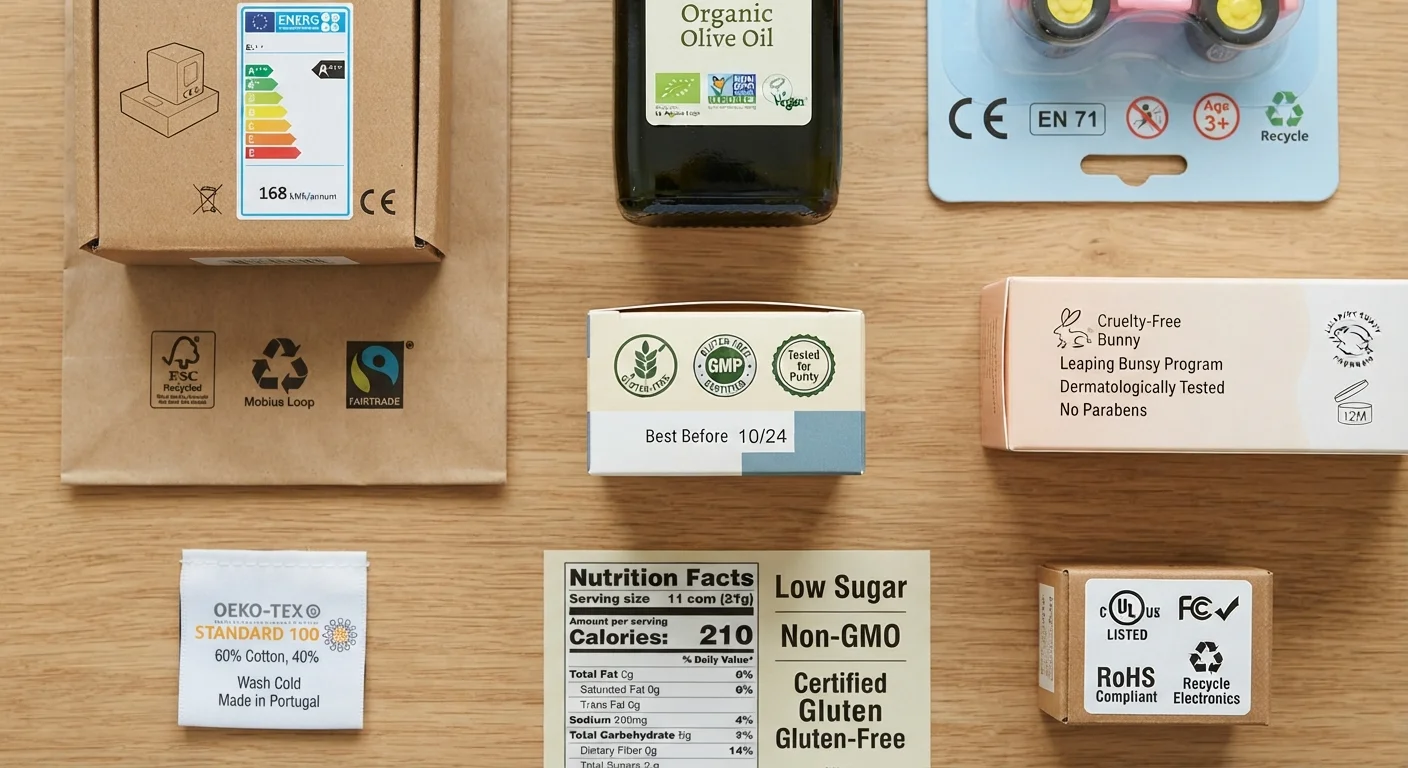
Why Product Labels Aren't Just Marketing
Walk down any store aisle and you'll see products plastered with symbols, seals, and badges - some issued by government agencies, some by independent nonprofit organizations, and some invented by the manufacturer. Not all of these marks carry the same weight, and treating them as equivalent can lead to poor purchasing decisions.
The core distinction worth understanding: regulated labels must meet specific legal or third-party standards before a manufacturer can use them. Self-declared claims - like "eco-friendly" or "premium quality" - are marketing language with no mandatory verification behind them. Knowing which category a label falls into changes how seriously you should take it.
This reference guide covers the certifications and marks you're most likely to encounter across electronics, household products, food, and personal care items. For labels specific to food packaging, see our deeper dives on reading a Nutrition Facts label and how front-of-pack health claims differ from regulated facts.
| ENERGY STAR Administered By | U.S. Environmental Protection Agency (EPA) (EPA.gov) |
| UL Listed - Issuing Body | UL (formerly Underwriters Laboratories), an accredited independent safety science organization (UL.com) |
| USDA Organic - Legal Authority | U.S. Department of Agriculture National Organic Program (USDA Agricultural Marketing Service) |
| Self-Declared Claims (e.g., "eco-friendly") | Not verified by any mandatory third-party standard; marketing language only (FTC Green Guides guidance) |
| ETL Listed - Issuing Body | Intertek, an accredited third-party testing laboratory recognized by OSHA (Intertek.com) |
| NSF Certification - Scope | Covers food equipment, water filtration, dietary supplements, and plumbing products (NSF.org) |
Common Certification Categories Explained
Consumer product certifications generally fall into four functional categories:
- Safety certifications - confirm a product meets minimum safety standards to protect users from electrical, fire, or structural hazards.
- Energy efficiency labels - communicate how much electricity or fuel a product consumes relative to comparable models.
- Environmental and sustainability certifications - indicate compliance with standards related to materials sourcing, manufacturing impact, or recyclability.
- Organic and natural certifications - signal that a product meets defined standards for ingredient sourcing or agricultural practices.
Within the electronics and appliance space, labels like UL Listed and ETL Listed indicate a product has been tested by an accredited independent laboratory for safety compliance. The ENERGY STAR mark, administered by the U.S. Environmental Protection Agency, signals that an appliance or device meets specific energy-efficiency thresholds - useful context when comparing operating costs over time. For a broader look at specs you'll encounter on electronics packaging, see our plain-language gadget specs glossary.
Third-Party Certification
Verification of a product's claims or performance by an independent organization not affiliated with the manufacturer. Third-party certification provides a higher degree of trust than a manufacturer's own declaration because the evaluating body has no financial interest in the outcome.
Self-Declared Claim
A marketing statement made by a manufacturer without mandatory independent verification. Terms like 'natural' or 'eco-friendly' on most product categories are self-declared and carry no standardized legal definition.
ENERGY STAR
A U.S. government-backed certification program administered by the EPA that identifies appliances, electronics, and other products meeting specific energy-efficiency thresholds. Products must be tested by an EPA-recognized laboratory to carry the mark.
UL Listed
A safety mark indicating a product has been tested by UL (formerly Underwriters Laboratories) against recognized safety standards, typically related to electrical, fire, or structural hazards. It is one of the most widely recognized marks in North American consumer products.
USDA Organic
A regulated certification from the U.S. Department of Agriculture indicating that agricultural products meet defined standards for organic production, including restrictions on synthetic pesticides and fertilizers. Certification requires third-party inspection.
Accredited Testing Laboratory
A facility officially recognized by a governing body to test products against specific standards. Accreditation means the lab's methods and competency have been independently evaluated - not simply that the lab exists.
What These Labels Can and Can't Tell You
Certifications answer specific, bounded questions. A UL listing tells you a product passed a particular safety test under controlled conditions - it doesn't evaluate performance, durability, or long-term reliability. Similarly, an organic certification addresses how ingredients were grown; it doesn't make claims about nutritional superiority.
Labels also have limits related to scope. A certification earned in one product category doesn't automatically transfer to another. A company's cleaning spray may carry a safer-chemistry certification, but that tells you nothing about its glass cleaner unless that product was separately evaluated.
Unverified claims remain common, especially in personal care. Words like "natural," "gentle," or "clean" have no regulated definition in most consumer product categories. The same principle applies to certain beauty product labels - as our skin type label explainer illustrates, category language is often a starting point rather than a guarantee. Understanding your consumer rights under U.S. law can help you push back when labeling seems misleading.
When in doubt, look for the issuing body behind the mark and check whether it's a government agency, an accredited independent lab, or a brand-controlled program.
Pet owners should apply the same critical lens to packaging - see how to read a pet food label for a category-specific breakdown.