
Why Style Translation Matters
Most of us live across multiple dress codes in a single week — a board meeting on Tuesday, brunch on Saturday, a casual Friday in between. The challenge isn't starting from scratch each time; it's learning to carry what's distinctly you across those different contexts. When you understand the building blocks of your own aesthetic, translation becomes straightforward rather than stressful.
If you're still figuring out your foundational look, check out Finding Your Aesthetic before diving in here. And for a broader framework that covers every dimension of personal style, Personal Style From Head to Toe is a great companion resource.
What you will need
How to Translate Your Style Step by Step
The process below works whether your everyday vibe is minimalist, eclectic, bohemian, or anything in between. The goal is to preserve your signature while adjusting the formality dial.
Identify your style's core elements
Write down three to five words that describe your everyday aesthetic — think color palette, silhouette, texture, or mood (e.g., "relaxed, earthy, structured"). These keywords become your translation guide. Any professional outfit you build should contain at least two of these elements to feel authentically like you.
Map your casual pieces to professional equivalents
Take your favorite casual item — say, an oversized linen shirt — and ask: what professional piece shares its key qualities? In this case, perhaps a linen blazer or a relaxed-fit button-down in a muted tone. This one-to-one mapping exercise surfaces the bridge pieces worth investing in. Fabric, silhouette, and color are the three axes to work with.
Adjust fit and fabric for formality
Fit is the single most powerful formality signal. A well-tailored piece in a relaxed fabric reads more professional than a stiff piece that fits poorly. Shift toward structured fabrics (ponte, wool-blend, crisp cotton) for formal contexts and softer, more textured fabrics (jersey, linen, chambray) for casual ones, while keeping your silhouette consistent.
Use accessories as your style signature
Accessories are where personal style shines loudest without disrupting formality requirements. If bold earrings are your everyday staple, they absolutely belong in a professional outfit — just paired with an otherwise clean, streamlined look. A distinctive watch, a textured belt, or a structured bag can carry your aesthetic into any dress code.
Build a small "bridge" capsule
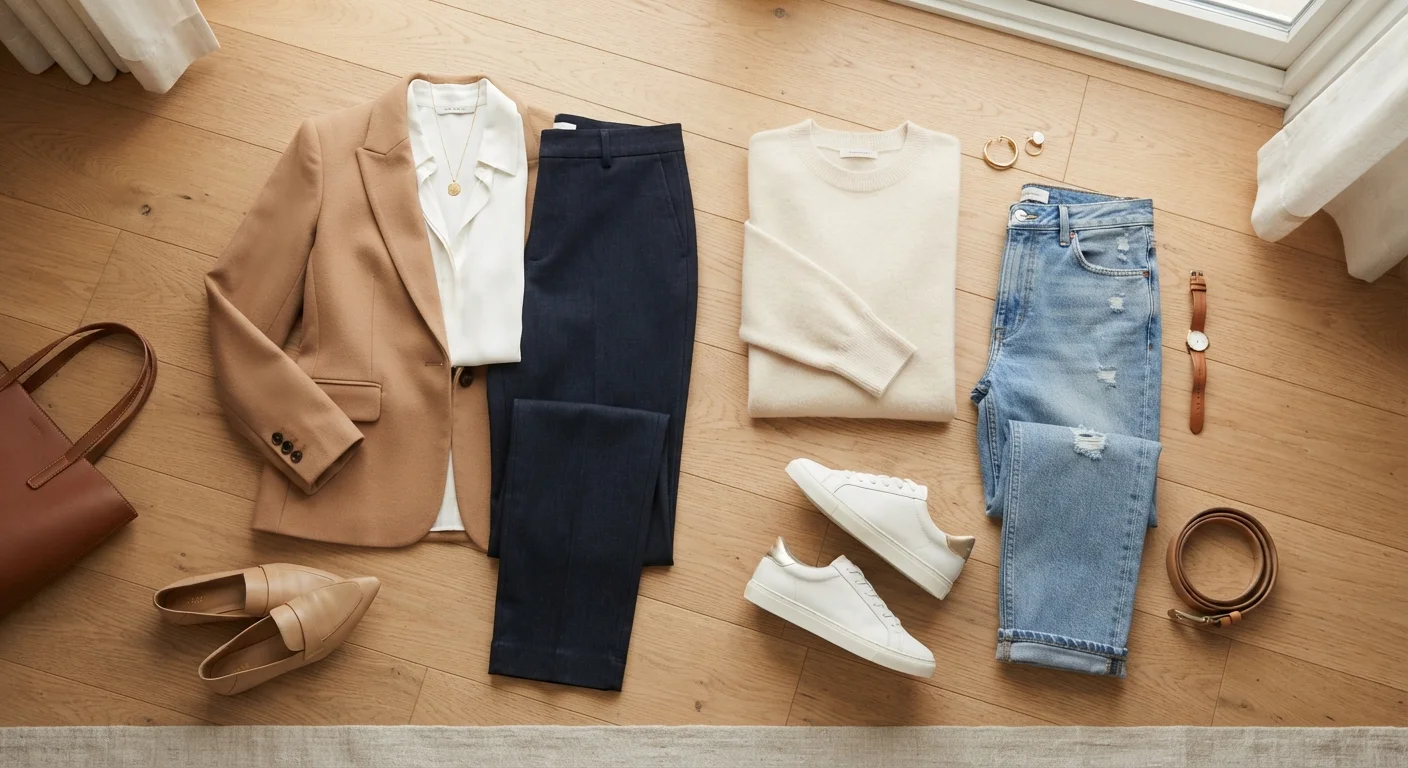
Identify five to seven versatile pieces that work across contexts with minor styling changes: a tailored trouser, a quality neutral blouse, a structured blazer, clean leather footwear, and a polished bag. These pieces bridge your casual and professional wardrobes, so you're not maintaining two entirely separate closets. Style them differently with casual or formal partners depending on the day.
Consistency Builds Confidence
The more consistently you dress in a way that reflects your actual aesthetic — even at work — the more confident and settled you'll feel in your appearance. Explore the idea further in The Case for Dressing Consistently to understand how a coherent style identity can work in your favor.
Once you've built this translation skill, you'll find that your work wardrobe and weekend wardrobe start to overlap in useful ways — something we explore more in Building a Work-to-Weekend Wardrobe on a Realistic Budget.
Common Pitfalls and How to Sidestep Them
Even with the best intentions, a few missteps can make professional dressing feel like a costume rather than a coherent extension of your identity.
Don't Abandon Your Aesthetic Entirely
One of the most common mistakes is over-correcting for formality — buying a completely separate "work wardrobe" that feels like a uniform. When your professional clothes don't feel like you, getting dressed becomes a daily chore rather than a form of self-expression. Instead, treat professional dressing as a dialect of your existing style, not a different language altogether.
The deeper principle here is intentionality. Dressing With Intention breaks down the underlying practices that make every outfit — casual or formal — feel more purposeful and authentically yours. For more practical everyday style inspiration, browse Everyday Fashion for versatile, real-life wardrobe ideas.
Style translation is ultimately about self-awareness, not self-erasure. The more clearly you understand what you love and why, the easier it becomes to show up as yourself in any room.