
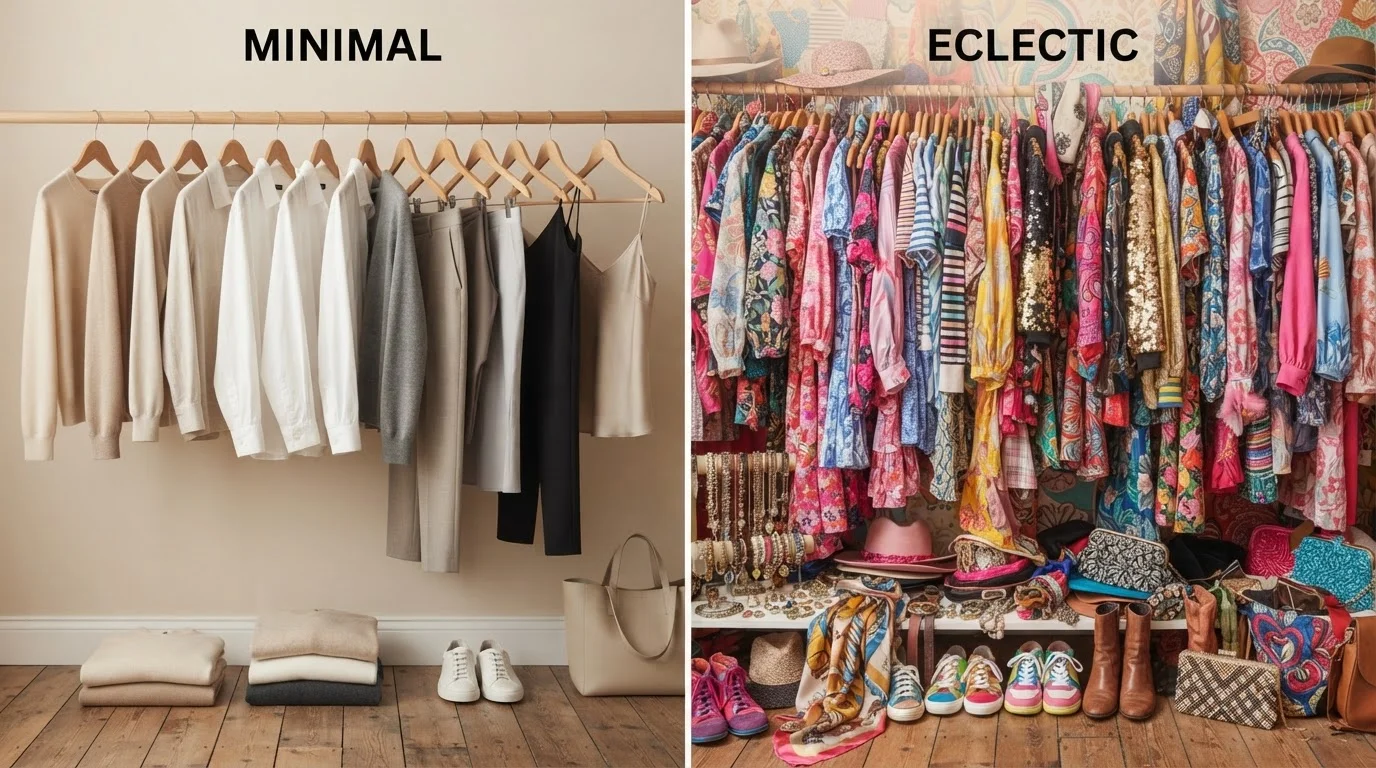
What Each Philosophy Actually Means
The term capsule wardrobe was popularized in the 1970s and describes a deliberately small, cohesive collection of clothing — typically around 25 to 50 pieces — where nearly everything works with everything else. The goal is intentionality: every item earns its space. If you want a deeper look at how this system works in practice, the capsule wardrobe explained is a great starting point.
Maximalist dressing, by contrast, is a deliberate embrace of abundance. It's characterized by layering, bold color combinations, pattern mixing, statement accessories, and a closet that reflects a wide range of moods, references, and aesthetics. For maximalists, variety isn't a problem to solve — it's the whole point.
Both are genuine philosophies, not just aesthetic preferences. How you approach your wardrobe affects your daily routine, your spending habits, your storage needs, and — importantly — how confident you feel stepping out the door.
| Criterion | Capsule Wardrobe | Maximalist Dressing |
|---|---|---|
| Typical closet size | 25–50 pieces | No defined limit |
| Morning routine | Fast, low-decision | Creative, more time-intensive |
| Core value | Versatility and simplicity | Expression and variety |
| Color palette | Neutral-leaning, cohesive | Bold, mixed, eclectic |
| Storage demands | Low to moderate | High; organization essential |
| Shopping approach | Selective, quality-focused | Broader; thrifting-friendly |
| Best suits | Simplicity-seekers | Creativity-driven dressers |
The Real Differences in Day-to-Day Life
Living with a capsule wardrobe means making most of your style decisions up front, when you're choosing and editing your closet, rather than every morning. Proponents say this reduces mental load and makes getting dressed feel almost automatic. The trade-off is that your day-to-day outfits may feel more consistent — which some people find calming, and others find a little flat.
Maximalist dressing front-loads creativity into each outfit decision. The morning routine might take longer, but for many people that time is genuinely enjoyable. The wardrobe itself becomes a resource to explore. The challenge is organization: a large, varied collection demands a thoughtful system to prevent chaos. Seasonal wardrobe rotation becomes especially important when you have a lot to work with.
Budget-wise, capsule wardrobes often encourage spending more per piece on higher-quality items. Maximalist closets can involve higher overall spend, but they don't have to — thrifting and secondhand shopping are deeply compatible with the maximalist ethos. Building a versatile wardrobe on a realistic budget covers strategies that apply to both approaches.
~33%
Clothes worn regularly from average closet
Research and consumer surveys consistently suggest most people regularly wear only about a third of what they own, regardless of closet size.
30–50 pieces
Common capsule wardrobe target range
Style educators and wardrobe consultants frequently cite this range as a practical starting point for a fully functional capsule collection.
Finding the Right Fit for Your Life
The honest truth? Most people don't live at either extreme. A useful exercise is to think about what actually happens when you open your closet. Do you feel relieved by simplicity or energized by options? Do you reach for the same five pieces regardless of what else is hanging there, or do you actively rotate through a range?
If you're naturally drawn to basics and find patterns or bold colors stressful to style, a capsule-leaning approach will likely feel like a relief. If you find a row of neutral basics vaguely depressing — if color, texture, and variety are what make dressing feel alive — then maximalism, practiced thoughtfully, is a legitimate and joyful way to build a wardrobe.
Either way, the principles that make dressing satisfying cut across both philosophies. Dressing with intention — meaning making choices that genuinely reflect how you want to feel — matters whether your closet has 30 pieces or 300. And if you want to think further about whether a consistent style or more variety suits you, the case for dressing consistently is worth a read.
Don't let either label become a rule that makes you feel like you're doing it wrong. Your wardrobe is there to work for your life — not the other way around.
A Hybrid Approach Is Totally Valid
There's no rule that says you must pick one philosophy and stick to it completely. Many people build a core of versatile, mix-and-match basics — the foundation of a capsule — and then layer in a rotating selection of expressive, seasonal, or statement pieces. This hybrid model gives you the ease of a streamlined base with room for variety where it brings you the most joy. Check out wardrobe staples that actually earn their keep for ideas on what to anchor that core with.