
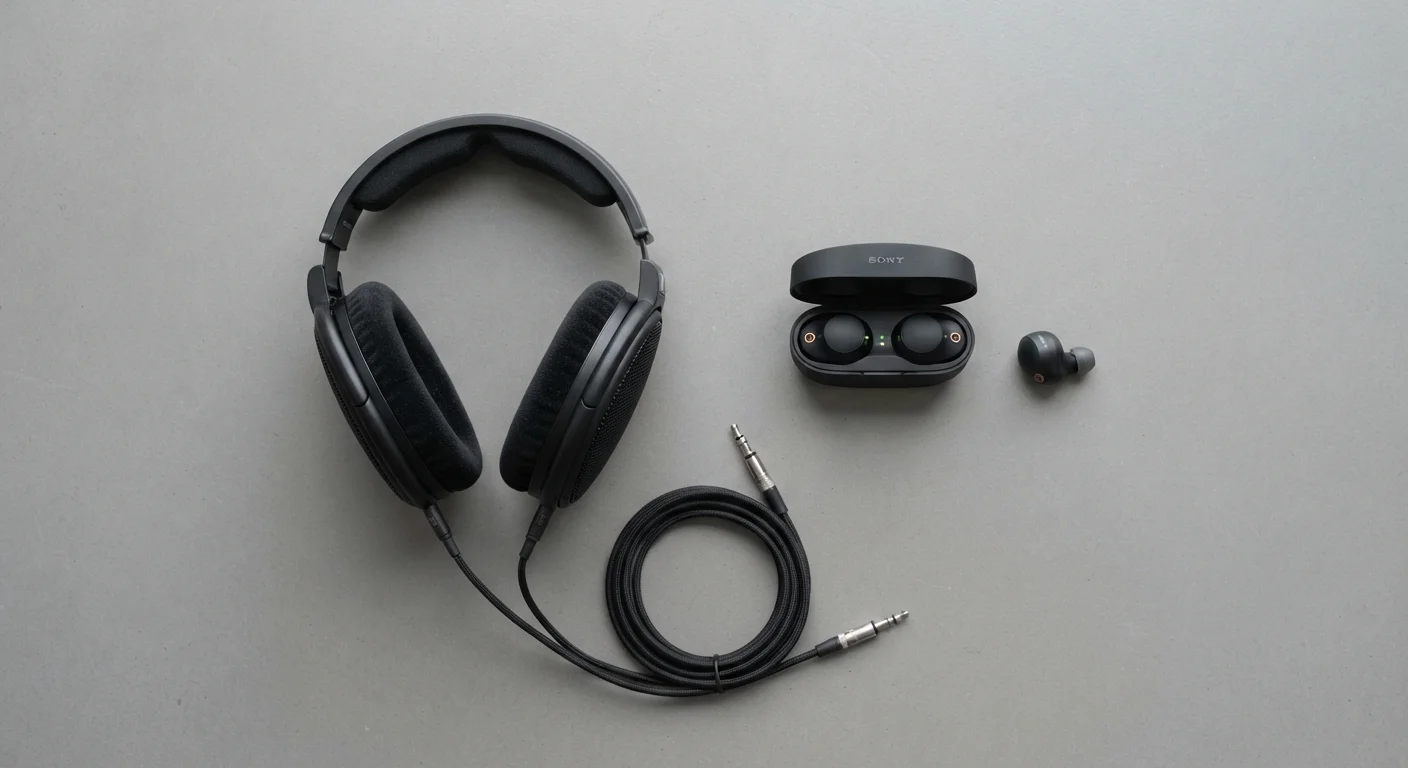
The Core Trade-Off: Signal Path vs. Freedom of Movement
Wired headphones send audio as an analog electrical signal directly from your device to your ears. There's no encoding, no wireless transmission, no decoding on the other end — just a continuous signal with no added delay. Bluetooth headphones, by contrast, compress that audio into a digital packet using a codec (such as SBC, AAC, aptX, or LDAC), transmit it wirelessly, and decode it at the headphone end.
That process introduces two meaningful trade-offs: audio compression and latency. Compression means some audio data is discarded or approximated to reduce file size for transmission. Latency means there's a slight delay — typically 20 to 200 milliseconds depending on the codec and device — between the source audio and what you hear. For casual music listening, these differences are often imperceptible. For video editing, gaming, or live instrument monitoring, they can be genuinely disruptive.
This mirrors a broader pattern in tech: convenience often costs something in precision. See how that dynamic plays out in other contexts with our wired vs. wireless home entertainment breakdown.
| Criterion | Wired Headphones | Bluetooth Headphones |
|---|---|---|
| Audio latency | Near zero | 20–200ms depending on codec |
| Audio compression | None (analog signal) | Yes, codec-dependent |
| Battery required | No | Yes (typically 20–40 hrs) |
| Device compatibility | Requires 3.5mm jack or adapter | Works with most modern devices |
| Interference risk | None | Possible on 2.4 GHz band |
| Freedom of movement | Limited by cable length | Full wireless freedom |
| Multi-device pairing | Not supported | Supported on many models |
| Ideal use case | Production, gaming, critical listening | Commuting, workouts, casual use |
Battery Life, Compatibility, and Daily Practicality
Wired headphones have one significant logistical advantage: they don't need power. Plug them in, and they work — regardless of whether you remembered to charge anything. Bluetooth headphones require a charged battery, and most consumer models offer between 20 and 40 hours of playback, with charging times ranging from one to two hours. Running out mid-commute or mid-workout is a real friction point that wired users simply don't face.
Compatibility cuts both ways. Wired headphones still depend on your device having a 3.5mm headphone jack — something many modern smartphones and thin laptops have eliminated. Adapters exist but add a point of failure and occasional signal interference. Bluetooth headphones pair with virtually any modern device and can switch between a phone and laptop with multi-point pairing on newer models, which is genuinely useful if you work across devices.
20–40 hrs
Typical Bluetooth playback battery life
Most mid-range and premium Bluetooth headphones advertise between 20 and 40 hours per charge under standard playback conditions.
~200ms
Maximum Bluetooth audio latency (SBC codec)
Standard SBC codec latency can reach roughly 200 milliseconds, which is perceptible during video playback and gameplay according to audio engineering guidelines.
2.4 GHz
Radio band shared by Bluetooth and Wi-Fi
Bluetooth and most Wi-Fi routers operate on the same frequency band, which can lead to occasional signal interference in high-density wireless environments.
Interference is also worth acknowledging. Bluetooth operates on the 2.4 GHz radio band, which it shares with Wi-Fi routers, microwaves, and other wireless devices. In densely populated environments — crowded offices, apartment buildings, busy transit — you may occasionally notice audio dropouts. Wired connections are immune to this entirely.
Audio Quality: What the Research and Your Ears Actually Tell You
The audio quality debate is real but often overstated. High-quality Bluetooth codecs like Sony's LDAC or Qualcomm's aptX HD transmit enough data to approach CD-quality audio — though they still involve some compression. Standard SBC, the baseline codec required of all Bluetooth devices, is noticeably lower quality at equivalent bitrates compared to a lossless wired connection.
Here's the practical reality: in double-blind listening tests, most people — even self-described audiophiles — struggle to consistently identify the difference between high-bitrate Bluetooth and wired audio on consumer-grade equipment. The bigger variables are usually the quality of the headphone drivers themselves, the audio mastering of the content you're listening to, and ambient noise in your environment.
Codec Quality Varies by Device Pair
A Bluetooth headphone's codec capability only matters if both your source device and your headphones support the same codec. For example, aptX HD requires aptX HD support on both ends. If one device only supports SBC, that's what gets used — even if the headphones advertise a higher-quality codec. Check your source device's specifications before assuming you're getting the best available Bluetooth audio quality.
If you're a casual listener streaming music through a subscription service, the compression already applied to that stream is likely a larger quality factor than whether you're using Bluetooth or a wire. The choice between connection types matters far more when you're working with lossless audio files in a controlled listening environment.
How to Actually Decide
Start with your real listening habits, not an idealized version of them. If you mostly listen at a desk, commute in a car, or stream music while cooking, Bluetooth is almost certainly sufficient and noticeably more convenient. If you work in audio production, play competitive games where split-second sound cues matter, or simply don't want to manage another device's battery, wired is the cleaner choice.
Also consider your device ecosystem. If your primary device no longer has a headphone jack, you're either buying a dongle or going Bluetooth — and for most people, Bluetooth is the simpler path forward. Much like choosing between new and used tech, the right answer often hinges on your actual use pattern rather than spec-sheet comparisons. Our look at real-world trade-offs in buying decisions walks through a similar decision framework.
Neither option is objectively superior. Wired headphones offer a direct, dependable signal that professionals and purists genuinely value. Bluetooth headphones offer a flexibility that fits how most people actually move through their day. Understanding exactly what you're trading in each direction is what makes the difference between a choice you're satisfied with and one you second-guess.