
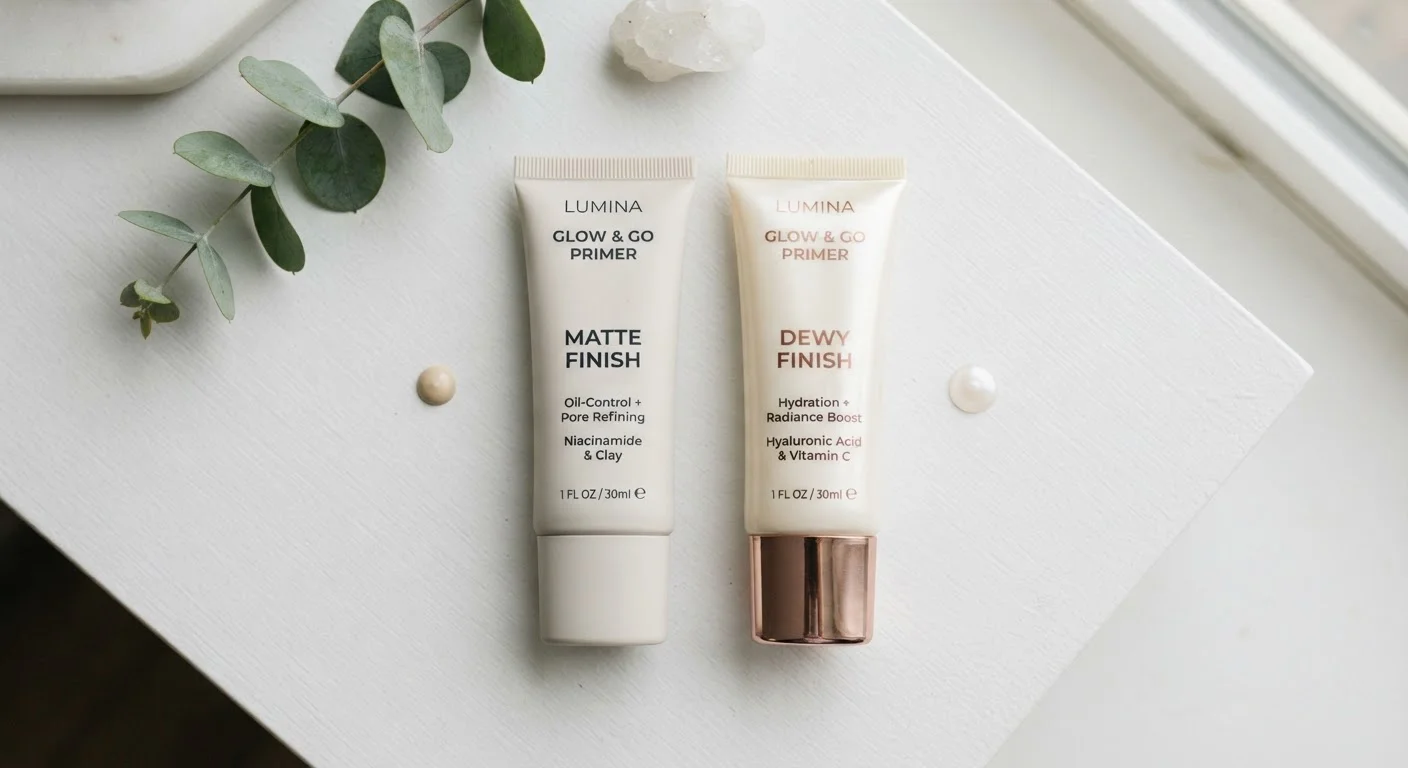
What Primers Actually Do
Think of primer as the middle child of your routine — it sits between skincare and makeup, bridging the two so each layer performs better. But not all primers do the same job. The formula you choose directly affects how your skin looks, feels, and holds up across the day.
Understanding where primer fits in your routine is step one. As a general rule, it goes on after moisturizer and SPF, right before foundation. If you're ever unsure about product order, our guide to skincare layering walks through the full sequence.
Once you've nailed the order, the next question is which type of primer your skin actually needs — and that comes down to oil balance.
Mattifying Primers: How They Work and Who They're For
Mattifying primers are formulated to absorb excess sebum, minimize the appearance of pores, and create a smooth, non-shiny canvas. Key ingredients to look for include silica (a fine powder that blurs and soaks up oil), kaolin clay (a gentle absorbent mineral), and sometimes dimethicone (a silicone that fills in texture).
These formulas work best on oily and combination skin types. If you've ever noticed your foundation sliding off by midday or your T-zone gleaming in photos, a mattifying primer can make a real difference. They're also popular among people with large or visible pores, since silica-based formulas have a soft-focus blurring effect.
One thing to keep in mind: if your skin is already on the drier side, a mattifying primer can exaggerate dry patches and cause foundation to look cakey or cling unevenly. It's always worth checking whether a product suits your skin before committing to a full routine.
| Criterion | Mattifying Primer | Hydrating Primer |
|---|---|---|
| Primary Purpose | Absorb oil, control shine | Add moisture, boost radiance |
| Key Ingredients | Silica, kaolin clay, dimethicone | Hyaluronic acid, glycerin, aloe |
| Best Skin Type | Oily, combination, acne-prone | Dry, dehydrated, mature |
| Finish | Matte, pore-blurring, velvety | Dewy, luminous, plump |
| Foundation Wear | Extends wear, reduces breakthrough | Smooths texture, prevents cakiness |
| Risk of Misuse | Can exaggerate dry patches | Can cause slippage on oily skin |
Hydrating Primers: How They Work and Who They're For
Hydrating primers are designed to add a surge of moisture beneath makeup, creating a plump, dewy base that helps foundation melt in rather than sit on top of skin. Common ingredients include hyaluronic acid, glycerin, and aloe vera — all of which draw water into the skin or form a moisture-retaining barrier.
If the distinction between humectants like hyaluronic acid and glycerin matters to you, it's worth exploring — they behave somewhat differently depending on climate and skin condition. Our breakdown of hyaluronic acid vs. glycerin goes deeper on that.
Hydrating primers are a go-to for dry, dehydrated, and mature skin types. They're also helpful if your skin tends to look flat or dull under makeup — the added moisture creates a subtle luminosity that mimics healthy, well-rested skin.
65%
Makeup wearers report midday shine as a top concern
According to consumer research cited by beauty industry analysts, oil control consistently ranks among the top reasons people reach for primer.
2–3 steps
Skincare steps primer replaces for some users
Formulas that combine primer with moisturizing or SPF properties are increasingly common, though dermatologists generally recommend keeping SPF separate.
Choosing the Right Formula — and Avoiding Common Mistakes
The most frequent mistake people make with primers is grabbing one without considering their skin type. Using a heavy mattifying formula on dry skin can pull moisture away from an already parched complexion. Using a rich hydrating primer on very oily skin can add too much slip, causing foundation to slide.
Before introducing any new primer — especially one with active ingredients like niacinamide or retinol — it's smart to do a quick patch test and consider how it layers with the rest of your products. Our checklist for trying new active ingredients applies here too.
For combination skin, consider a split approach: use a mattifying primer where you're oily (typically the T-zone) and a hydrating primer where you're drier (cheeks, around the mouth). It takes a little extra effort but delivers a noticeably more balanced result.
What About Skin That's Both Oily and Dehydrated?
Yes, skin can be oily and dehydrated at the same time — a condition sometimes called 'dehydrated oily skin.' This happens when the skin produces excess oil to compensate for a lack of water. In this case, a lightweight hydrating primer may actually help calm oil production by addressing the underlying moisture deficit. It's worth consulting a dermatologist if you're unsure which concern to prioritize.