
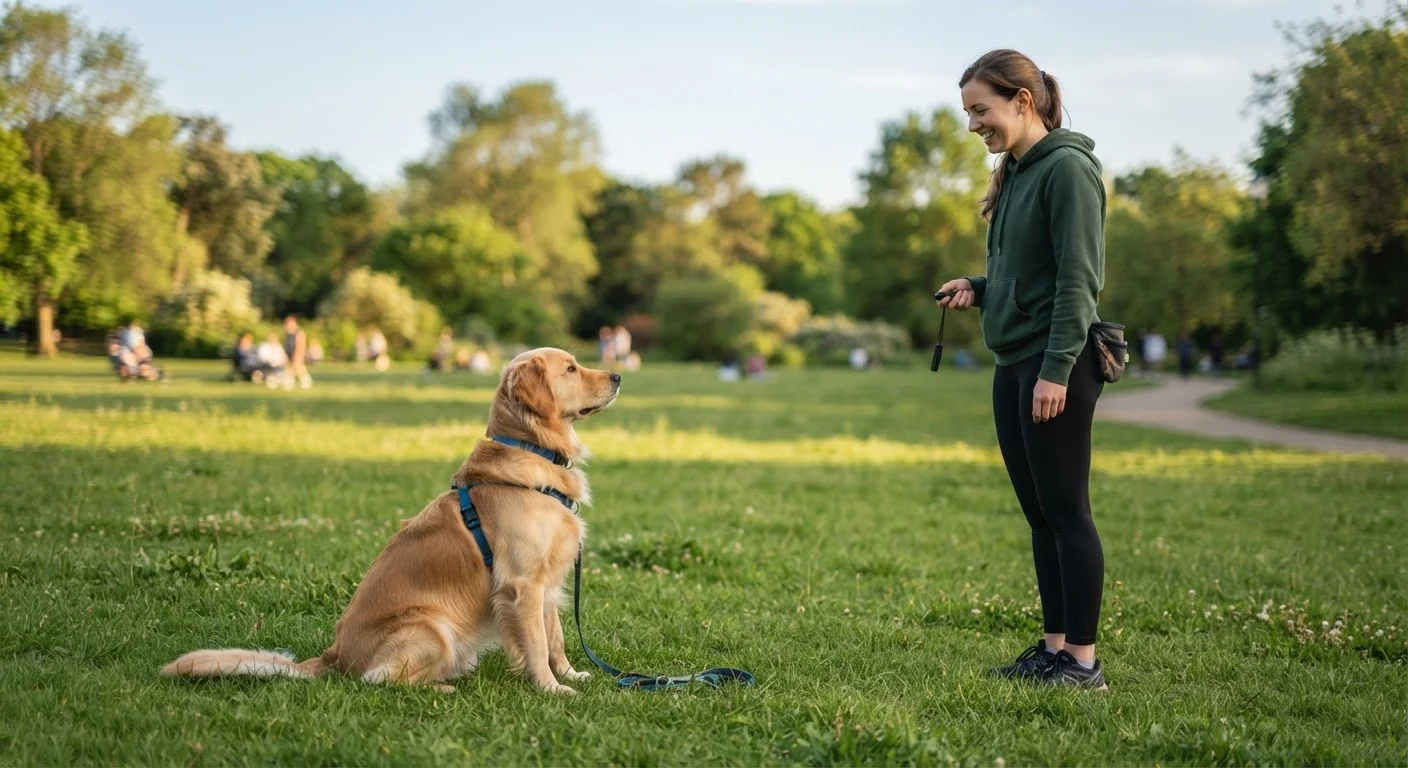
Why Stay Is Worth Teaching Carefully
Stay is one of the most practical skills a dog can learn — it keeps them safe near open doors, prevents rushing at guests, and gives owners a reliable way to pause and manage behavior in unpredictable situations. But stay is also commonly taught too quickly, resulting in a dog who holds position for a few seconds in the living room and falls apart everywhere else.
The trainers' framework behind a durable stay breaks it into three variables: duration (how long), distance (how far you move away), and distraction (what's happening in the environment). The core principle is to increase only one variable at a time. Pushing all three simultaneously almost guarantees failure and can undermine the dog's confidence in the exercise. For a broader look at how these concepts fit into a complete training approach, see our evidence-backed training practices guide.
What you will need
If you are early in your training journey, our first week with a new dog guide covers the foundational routines that make skills like stay easier to build.
Step-by-Step: Building a Reliable Stay
Follow the progression below, working through each step before moving to the next. Most dogs can make meaningful progress in short daily sessions of five to ten minutes. Consistency across all household members matters — if one person always releases the dog from stay early, the behavior will erode quickly.
High-value training treats
Provides positive reinforcement precisely timed to reward correct stay behavior.
Treat pouch or bait bag
Keeps rewards accessible so you can deliver them quickly without breaking the training flow.
Clicker or marker word
Marks the exact moment the dog is performing the desired behavior before the treat is delivered.
Long training leash (15–20 ft)
Provides a safety backup when practicing stay at greater distances outdoors.
Establish a starting position
Ask your dog to sit or lie down. Once they are settled, pause for one full second, then mark the behavior with a click or a verbal marker (such as "yes") and immediately deliver a treat. Do not yet say "stay" — at this stage you are simply rewarding the dog for remaining still.
Add the verbal cue
Once your dog is consistently holding still for one to two seconds across multiple repetitions, introduce the word "stay" in a calm, clear voice immediately after they settle into position. Mark and reward after just one or two seconds. Repeating the cue before the dog breaks will inadvertently teach them that multiple repetitions of the word are required — say it once, then wait.
Build duration gradually
Extend the time between the cue and your marker in small increments — one to two seconds at a time. Vary your durations rather than always increasing them (e.g., 3 seconds, 5 seconds, 2 seconds, 6 seconds). This variability prevents your dog from anticipating the release and teaches them that stay means "hold until I hear the release word."
Introduce a release word
Choose a release word — "free," "okay," or "all done" are common choices — and use it consistently to signal the end of every stay. Say the word, then move toward your dog or encourage movement. The release word teaches your dog that stay is still active until they hear that specific signal, not simply until you return.
Add distance in small steps
With your dog in a stay, take one step back, pause briefly, return to your dog, mark, and reward. Reward upon your return — not after calling the dog to you — so that staying put remains the behavior being reinforced. Gradually increase to two steps, then three, working toward being able to walk to the end of a room while your dog holds position.
Proof with real-world distractions
Once duration and distance are solid in a quiet space, introduce controlled distractions: another person walking past, a dropped toy, or training near a doorway. Begin with mild distractions and reward generously for holding the stay. This phase — called generalization — is where the skill becomes genuinely reliable. Moving to new environments (a driveway, a park) also counts as a form of proofing.
Short Sessions, Consistent Progress
Five focused minutes of stay training is more productive than a twenty-minute session where both you and your dog lose concentration. End every session on a successful repetition, even if that means making the last one easier on purpose. Dogs learn faster when training feels like a win.
Don't Rush the Proofing Phase
Many owners declare victory after their dog holds a stay in the kitchen — then are surprised when the skill fails at the park. Real reliability requires deliberately practicing in multiple environments with varying levels of distraction. Skipping this phase is the most common reason stay breaks down when it matters most.
Once your dog can hold a stay reliably through moderate distractions, consider how this skill connects to broader independence and separation tolerance. Our article on separation anxiety and gradual desensitization explores related techniques for dogs who struggle when left alone. For a deeper understanding of the training methods referenced here, our comparison of lure-based, shaping, and capturing techniques provides useful context.