
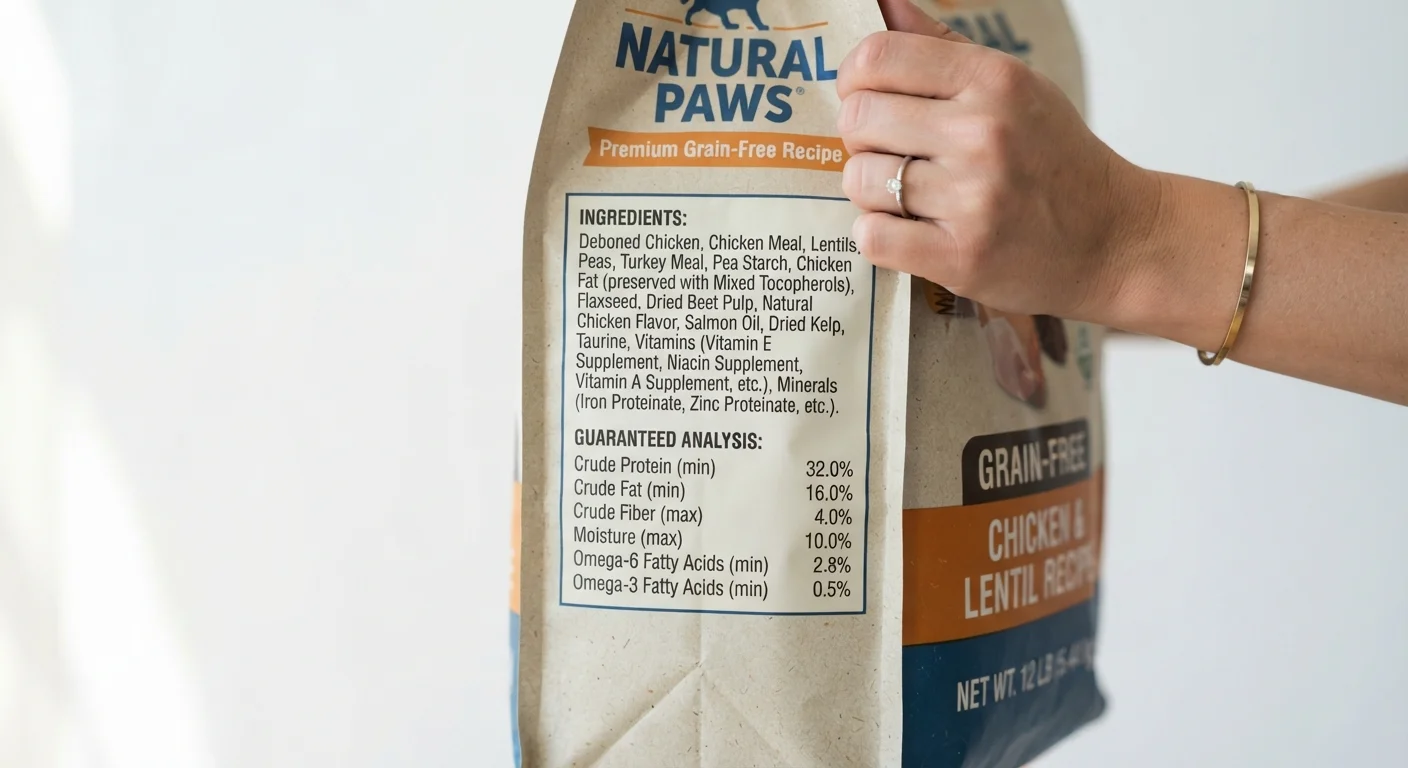
What the Ingredient List Actually Tells You
Pet food ingredient lists follow the same descending-weight rule you'll find on human food packaging: ingredients are listed from heaviest to lightest by weight before cooking. This means a named meat — "chicken," "salmon," or "beef" — listed first indicates that ingredient contributed the most weight going into production. However, raw meat contains significant water weight, so after cooking, its actual contribution may be smaller than it appears.
Watch for ingredient splitting, a practice where a single ingredient is divided into multiple forms to push it lower on the list. For example, "corn," "corn gluten meal," and "corn flour" are all corn. When grouped together, corn might outweigh the named meat protein at the top of the list.
Named proteins — "chicken meal" rather than just "chicken" — are worth understanding: meal is a concentrated dry protein source with the water already removed, so it often contributes more actual protein by dry weight than fresh meat listed above it. See our guide to dry kibble vs. wet food for more on how moisture content affects how these labels read.
The Guaranteed Analysis Panel
The guaranteed analysis (GA) lists minimum or maximum percentages for four core nutrients: crude protein, crude fat, crude fiber, and moisture. "Crude" refers to the chemical measurement method used, not the quality or digestibility of the nutrient.
Because wet foods contain far more moisture than dry kibble, comparing GA numbers across formats can be misleading. To make a fair comparison, you need to convert both to a dry matter basis — divide the nutrient percentage by 100 minus the moisture percentage, then multiply by 100. This strips the water out of the equation and gives you comparable figures.
The GA does not tell you about digestibility, ingredient quality, or the specific source of those nutrients. A food could meet its protein minimum using plant-based protein that is less bioavailable to obligate carnivores like cats. The panel is a starting point, not the complete picture.
AAFCO Statements and What They Mean
The Association of American Feed Control Officials (AAFCO) sets the nutritional standards that most U.S. states reference in their pet food regulations. An AAFCO nutritional adequacy statement tells you whether a food is formulated to be complete and balanced — and for which life stage.
AAFCO
The Association of American Feed Control Officials, a voluntary membership organization that develops model regulations and nutritional standards widely adopted by U.S. states for pet food oversight.
Nutritional adequacy statement
A required label statement declaring whether a pet food is complete and balanced for a given life stage, and the method — formulation or feeding trial — used to substantiate that claim.
Dry matter basis
A calculation method that removes moisture from nutrient percentages so foods with different water contents can be compared on equal terms.
Meal (as in chicken meal)
A rendered, dried protein concentrate from a named animal source. Because water has been removed, meal contributes more protein per unit weight than fresh meat listed above it on an ingredient list.
Feeding trial
A controlled study in which actual animals are fed a diet under AAFCO protocols to confirm the food supports health over a defined period — considered stronger real-world evidence than formulation alone.
Ingredient splitting
A practice in which a single ingredient is listed under multiple forms (e.g., corn, corn meal, corn flour) to distribute its weight across the list and make it appear lower than a named protein.
There are two ways a food can earn this statement: it was formulated to meet AAFCO nutrient profiles (a mathematical calculation), or it passed an AAFCO feeding trial (actual animals were fed the food under controlled conditions). Feeding-trial foods carry stronger evidence of real-world nutritional support, though both methods are legitimate pathways.
Look carefully at the life stage: "Adult maintenance" foods are not appropriate as the sole diet for puppies or kittens, and "All life stages" must meet the higher bar set for growth and reproduction. "Complementary" or "intermittent feeding" labels mean the product is not nutritionally complete on its own.
Marketing Language vs. Regulated Terms
The front of a pet food bag is pure marketing territory. Words like "premium," "natural," "holistic," and "human-grade" have no standardized regulatory definitions under AAFCO guidelines and carry no nutritional guarantee. The term "natural" does have an AAFCO definition — it broadly means no chemically synthesized ingredients — but its practical significance on a label is limited.
"Natural" Has a Definition — But It's Limited
AAFCO defines "natural" as coming from plant, animal, or mined sources without chemically synthetic processing. However, the term does not speak to ingredient quality, sourcing practices, or nutritional value. A food labeled "natural" still needs to stand on the merit of its guaranteed analysis and AAFCO adequacy statement.
AAFCO does regulate specific naming rules that are actually meaningful. The "95% rule" requires that if a single ingredient is named ("Tuna Cat Food"), it must make up at least 95% of the product by weight, excluding water. The "25% or dinner rule" applies when a descriptor like "dinner," "entrée," or "formula" follows the ingredient name — the named ingredient only needs to comprise 25–95% of the product. The "with" rule" drops the threshold to just 3% ("Cat Food with Tuna"). Understanding these naming conventions reveals how much of a key ingredient is actually present. For a broader look at how regulated terms differ from marketing claims, see our piece on nutrition labels vs. health claims.
Once you can read the ingredient list, guaranteed analysis, and AAFCO statement together, marketing language loses most of its power. Your pet's coat, energy, and stool quality remain the most practical indicators of whether a food is working well — track those over time and discuss any concerns with your veterinarian. You can also review signs your pet is thriving to know what to look for.
This article is for general informational purposes only and is not a substitute for personalized veterinary advice. Consult your veterinarian before making significant changes to your pet's diet, especially for animals with health conditions or specific nutritional needs.