
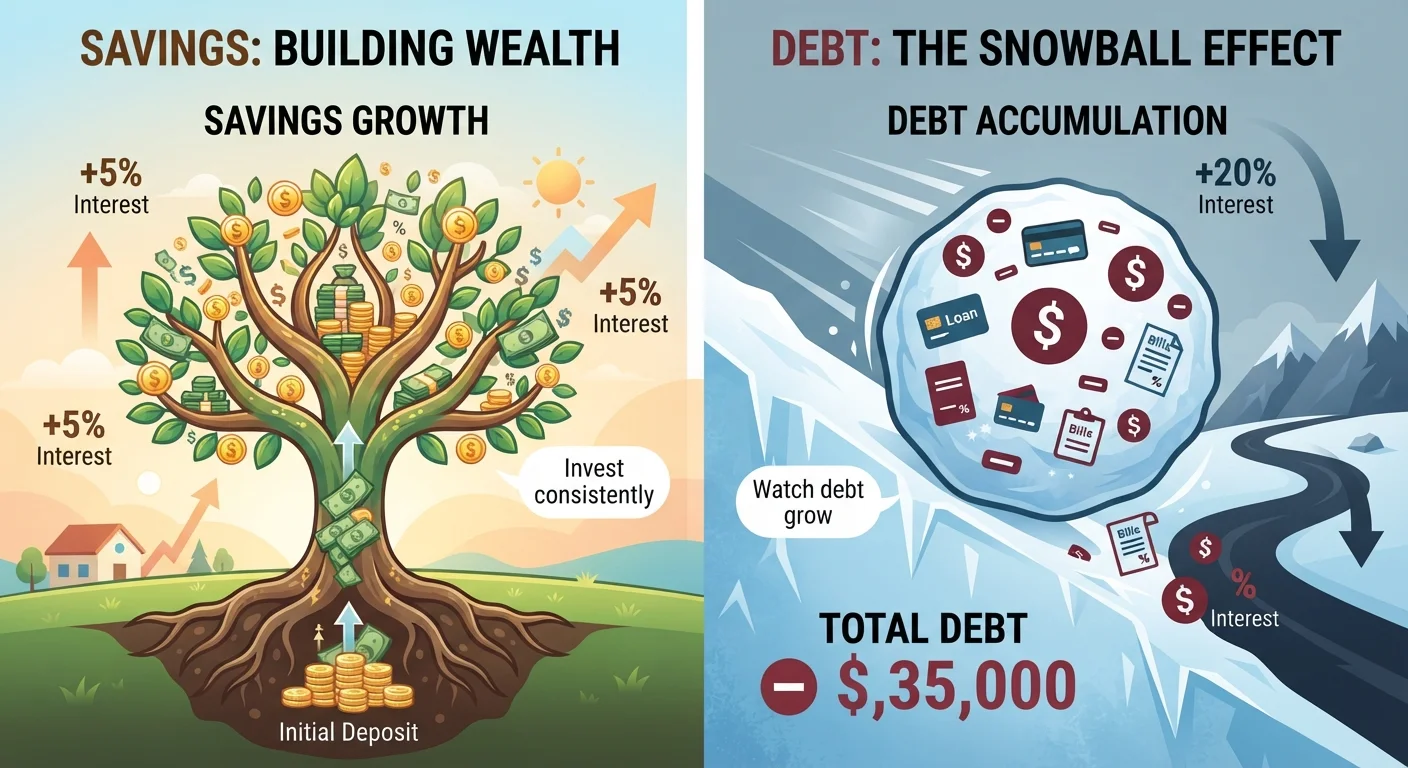
The Core Mechanic: Interest on Interest
The concept behind compound interest is straightforward: instead of earning interest only on your starting balance, you earn interest on your growing balance — which includes all the interest accumulated so far. This creates a feedback loop where each period's earnings become part of the base for the next calculation.
Consider a simple contrast. With simple interest, $1,000 at 5% annually earns $50 every year, no matter how many years pass. With compound interest at the same rate (compounded annually), year one still earns $50 — but year two earns interest on $1,050, not $1,000. By year 10, the compounded balance exceeds $1,628, while simple interest would yield just $1,500.
This difference seems modest early on, but widens considerably over longer periods. It's the mathematical reason why time horizon is often considered the most valuable asset in personal finance. For a deeper look at how this math plays out across different financial products, see why the math behind growing money matters.
$1,629
Value of $1,000 compounded annually at 5% after 10 years
Compared to $1,500 under simple interest — a $129 difference that grows substantially over longer horizons.
Daily
How often most credit card interest compounds
Daily compounding on high APR balances means debt can grow faster than many borrowers realize when only minimum payments are made.
20–30%
Typical credit card APR range in the U.S.
According to the Consumer Financial Protection Bureau, average credit card interest rates have risen significantly in recent years, amplifying the cost of carrying balances.
When Compounding Works For You
On the savings side, compound interest rewards patience and consistency. Money left to grow in an interest-bearing account — particularly one with a competitive rate — builds on itself without requiring additional contributions. The sooner you start, the more compounding periods your money experiences.
This is why financial education often emphasizes starting early over starting large. A person who begins saving in their mid-20s and contributes modestly may accumulate more over time than someone who waits until their late 30s to save aggressively, assuming similar rates of return. The early saver benefits from more compounding cycles.
Automate Contributions to Amplify Compounding
Consistent, automatic deposits ensure your principal grows regularly, giving compounding more to work with over time. Even small recurring transfers accelerate the effect meaningfully across years and decades. Automating your savings removes friction from the process — making growth more likely even during busy or stressful financial periods.
Accounts designed to maximize this effect — such as high-yield savings accounts — pass on a higher annual percentage yield (APY), giving your balance more fuel for compounding. If you're evaluating where to keep your savings, high-yield savings accounts explained covers how interest accrual works in these accounts versus standard options.
Pairing this with a consistent savings rate amplifies the effect further — every additional dollar deposited becomes a new principal base for future compounding.
When Compounding Works Against You
The same mechanism that quietly builds savings can quietly devastate finances when it's working on debt. Credit card balances, payday loans, and other high-interest obligations compound — often daily — meaning that carrying a balance means interest accrues on interest you already owed.
Credit cards are a particularly clear example. With APRs that commonly run between 20% and 30%, daily compounding means even modest unpaid balances grow quickly. Minimum payments are designed to cover mostly interest, leaving the principal nearly intact — which means the compounding cycle continues largely uninterrupted.
The Federal Reserve's benchmark interest rate influences both sides of this equation — affecting savings yields and borrowing costs alike. How the federal funds rate affects your wallet explains that connection in practical terms.
Understanding this dynamic can sharpen how you prioritize financial decisions. If high-interest debt is compounding faster than your savings are growing, that gap has a measurable cost. Before making drastic moves like drawing down savings to eliminate debt, it's worth reviewing the real tradeoffs — before you drain your savings to pay off debt, consider the full picture.
This article is for general informational purposes only and does not constitute personalized financial, investment, or tax advice. Consult a qualified financial professional before making decisions based on your individual situation.