How the Federal Reserve Uses This Rate
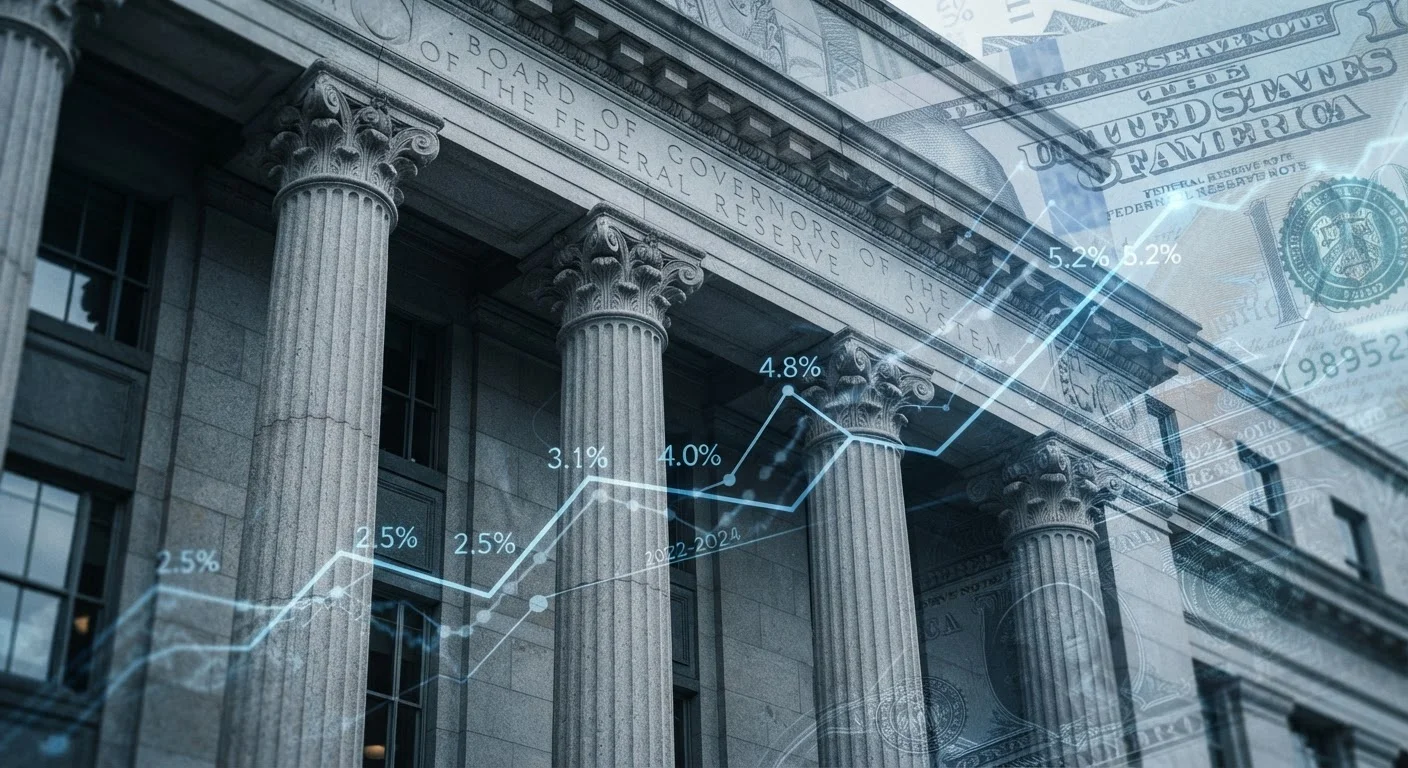
The Federal Reserve was established by Congress with a dual mandate: keep prices stable and support maximum sustainable employment. The federal funds rate is its primary policy tool for achieving both goals.
When inflation runs too high, the Fed raises the rate to make borrowing more expensive. This slows spending, reduces demand, and eases price pressure over time. When the economy weakens or unemployment rises, the Fed lowers the rate to encourage borrowing, investment, and economic activity.
These decisions are made by the Federal Open Market Committee (FOMC), a 12-member body that includes members of the Fed's Board of Governors and rotating regional Federal Reserve Bank presidents. The FOMC meets eight times per year and publishes its decisions along with an economic outlook known as the Summary of Economic Projections.
Rate Changes Work With a Delay
When the Fed adjusts the federal funds rate, the effects on the broader economy do not show up immediately. Most economists estimate that the full impact on inflation, employment, and consumer spending takes 12 to 18 months to materialize. This is why the FOMC makes decisions based on economic forecasts, not just current data.
Rate changes do not hit your wallet instantly. Economists generally estimate that the full effect of a rate change on the broader economy takes between 12 and 18 months to work through. The Fed is essentially steering a very large ship.
The Direct Effect on Borrowing Costs
For consumers, the federal funds rate matters most through its effect on the prime rate — conventionally 3 percentage points above the federal funds target. Lenders use the prime rate as a baseline when pricing variable-rate products.
- Credit cards: Most variable-rate credit cards are indexed to the prime rate. A 0.25-percentage-point Fed increase often translates to a 0.25-point increase in your card's APR within one or two billing cycles. See why carrying a balance becomes far more costly when rates are elevated.
- Home equity lines of credit (HELOCs): HELOCs are usually variable-rate and track the prime rate closely, so their costs rise and fall with Fed decisions.
- Auto loans: Short-term auto loan rates respond to Fed policy, though the relationship is less immediate than with credit cards.
- Fixed-rate mortgages: These track 10-year Treasury yields rather than the federal funds rate directly. However, Treasury yields tend to reflect broader expectations about Fed policy, so mortgage rates often move in the same general direction — just not in perfect sync.
11
Rate hike cycles since 1970
The Federal Reserve has enacted approximately 11 distinct rate-hiking cycles since 1970, each responding to specific inflationary or economic conditions, according to historical FOMC records.
3 pts
Prime rate spread above federal funds rate
By long-standing convention, the U.S. prime rate is set at 3 percentage points above the federal funds target rate, directly linking consumer loan pricing to Fed policy.
12–18 mo.
Estimated lag for full rate-change impact
Federal Reserve research and mainstream economic analysis generally estimate that the full macroeconomic effect of a rate change takes 12 to 18 months to work through the economy.
What Rate Changes Mean for Savers
Rising rates are not only a burden — they represent an opportunity for savers. When the federal funds rate increases, banks that compete aggressively for deposits often raise the annual percentage yield (APY) on savings accounts, certificates of deposit (CDs), and money market accounts.
The key word is compete. Large traditional banks with established deposit bases have historically been slower to pass rate increases on to savers than online-only banks or credit unions with narrower margins. Comparing deposit rates across institutions is a straightforward way to put Fed policy to work in your favor.
Understanding how compound interest amplifies both savings and debt helps clarify why even a half-percentage-point difference in APY matters meaningfully over a multi-year period. And if you are monitoring your overall financial health, your savings rate is a useful indicator of how well you are capturing higher yields when they are available.
Comparison Shopping Pays Off in High-Rate Environments
Online banks and credit unions often raise savings account yields faster than large traditional banks when the federal funds rate increases. Checking deposit rates across a few institutions takes minutes and can translate to hundreds of dollars in additional interest per year on a meaningful balance.
Putting It Into Practice
Knowing the direction of the federal funds rate gives consumers a useful decision-making lens — not a crystal ball, but context.
When rates are rising, variable-rate debt becomes more urgent to pay down. Locking in a fixed-rate loan before additional increases can reduce long-term interest expense. Shopping for high-yield savings options becomes more productive.
When rates are falling, refinancing existing fixed-rate debt at lower rates may become worthwhile. Variable-rate savings products will eventually yield less, making longer-term CDs or other rate-locking vehicles worth considering.
For a broader grounding in the vocabulary that surrounds these decisions — APR, yield, liquidity — see key terms every debt and savings conversation relies on. And for a wider financial vocabulary reference, financial terms every American adult should recognize covers the language you will encounter across banking, taxes, and investing.
The federal funds rate is one lever among many in the economy, but it is the one with the most direct and measurable effect on what consumers pay to borrow and earn to save. Understanding it is foundational to making confident financial decisions.
This article is for general informational and educational purposes only and does not constitute personalized financial, investment, or legal advice. Consult a qualified financial professional for guidance specific to your situation.