The Hidden Mechanics of Minimum Payments
Credit card minimum payments are designed by issuers to keep accounts current — not to help cardholders get out of debt efficiently. They are typically calculated as either a flat dollar floor (often around $25–$35) or a small percentage of the outstanding balance (commonly 1–2%), whichever is greater. On a $3,000 balance at 22% APR, a 2% minimum payment of $60 might look manageable. But after interest charges of roughly $44 are applied, only about $16 actually reduces what you owe.
That slow principal reduction is the core problem. And because most credit card issuers compound interest daily — not monthly — the balance has been accumulating charges every day of the billing cycle. To understand why this matters so fundamentally, see our primer on how compound interest works against you.
20%+
Average credit card APR in the U.S.
The Federal Reserve has reported average credit card interest rates exceeding 20% annually in recent years, making high balances particularly costly to carry.
~10 years
Typical payoff timeline on minimum payments
Consumer finance analyses consistently show that a $3,000 balance at around 20% APR, paid at a typical minimum, can take a decade or more to fully retire.
2–3x
Total cost multiplier from interest alone
On high-APR cards, the total interest paid over a minimum-only repayment period can equal or exceed the original balance borrowed.
Five Mistakes That Keep Cardholders Stuck
Most cardholders aren't making reckless decisions — they're making understandable ones, based on incomplete information or habits formed when balances were smaller. The mistakes below are common precisely because they feel reasonable in the moment.
Treating the minimum payment as the goal rather than the floor.
Why it happens: Issuers are required to show the minimum prominently, which frames it psychologically as the 'right' amount. When cash is tight, paying the stated minimum feels responsible.
Underestimating how quickly daily compounding erodes progress on a high-APR balance.
Why it happens: Most people think of interest as a monthly charge. In reality, most credit card issuers calculate interest daily, using the average daily balance, so interest is building every single day the balance exists.
Continuing to charge new purchases while paying only the minimum on an existing balance.
Why it happens: People separate 'old debt' from 'new spending' mentally, believing they can manage both simultaneously. This is a well-documented cognitive bias known as mental accounting.
Ignoring the minimum payment warning box on monthly statements.
Why it happens: Statements are dense, and cardholders often scan for the minimum due and due date, nothing more. The federally mandated disclosure is easy to overlook among other line items.
Assuming a consistent minimum payment will get you debt-free in a predictable timeframe.
Why it happens: Many consumers don't realize that minimum payments are usually calculated as a percentage of the outstanding balance. As the balance drops, so does the minimum — meaning repayment slows down precisely when it should be accelerating.
If the weight of multiple high-interest balances makes any single payoff feel futile, debt consolidation is worth examining — though it carries its own tradeoffs. And if avoidance or anxiety is part of why minimum-only payment has become a habit, the psychological side of debt is an honest read on what makes balances quietly grow.
Your Statement Already Shows the Real Cost
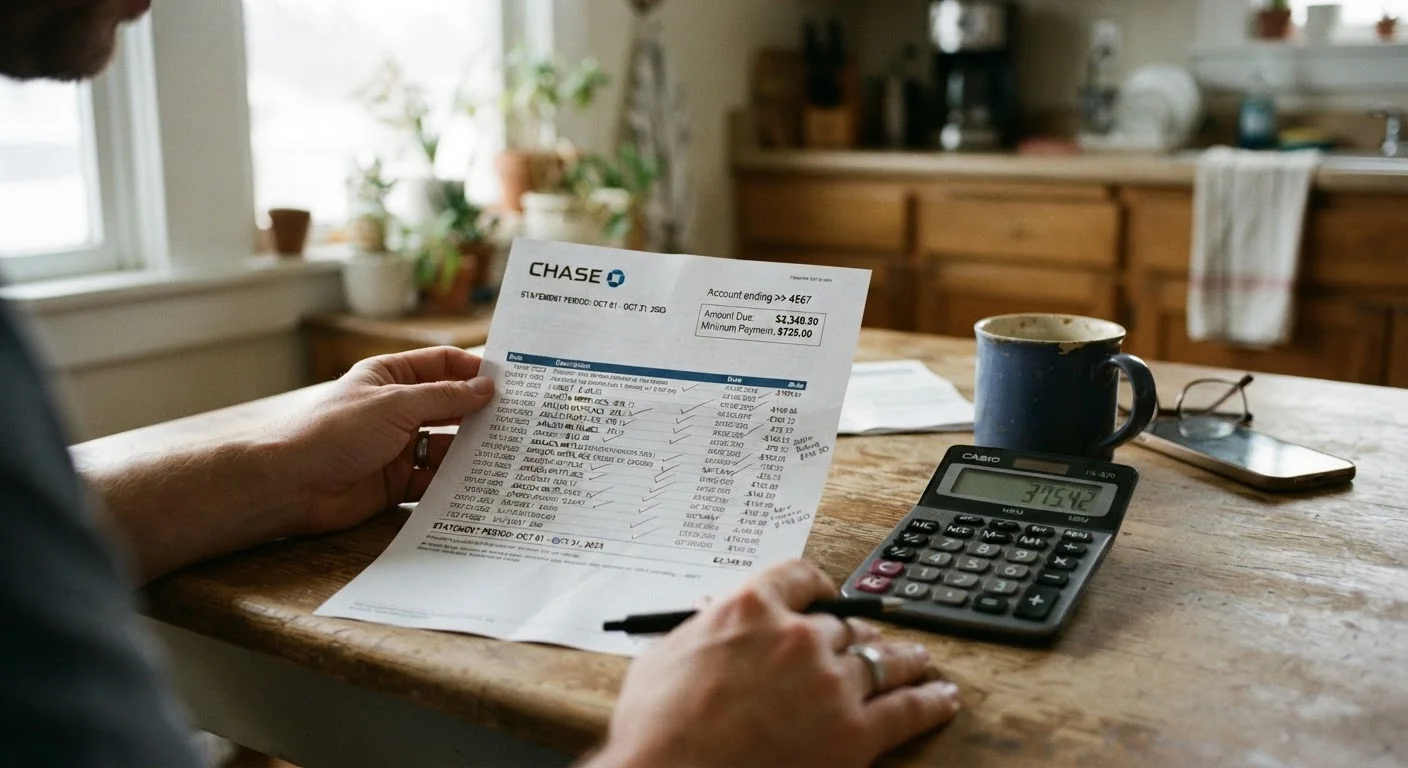
Federal law requires credit card issuers to print a minimum payment warning on every statement. It shows exactly how many years it will take to pay off your current balance at the minimum payment rate, and the total interest you will pay. Most cardholders overlook this box — reading it carefully can be a powerful motivator to change course.
A Practical Path Forward
The good news is that even modest changes to payment behavior produce meaningful results. Paying a fixed amount above the minimum — rather than a percentage that shrinks with the balance — is one of the most accessible adjustments a cardholder can make. Directing windfalls, tax refunds, or discretionary savings toward a high-interest balance accelerates payoff further.
Minimum Payments Are Not a Debt Strategy
Paying the minimum keeps your account current and protects your credit score from a missed-payment penalty, but it is not a path to becoming debt-free. On a typical high-interest credit card, the majority of each minimum payment is consumed by interest charges, leaving very little to reduce what you actually owe. Treating the minimum as the target, rather than the floor, is one of the most expensive financial habits a cardholder can develop.
Before making large lump-sum payments, it's worth reading whether draining savings to pay off debt makes sense — eliminating a balance quickly feels satisfying, but leaving yourself without a cash cushion carries its own risks.
Tackling credit card debt is ultimately a math problem with a behavioral solution. The interest rate is fixed; what you control is how much you pay and how consistently. Anchoring to a budget — see budgeting basics — makes it easier to identify money that can be redirected from discretionary spending toward faster debt reduction. Even an extra $50 a month applied to a $3,000 balance can cut years off the repayment timeline and save hundreds in interest charges.
This article is for general informational and educational purposes only and does not constitute personalized financial or legal advice. Consult a qualified financial professional for guidance specific to your situation.