
How Compound Interest Actually Works
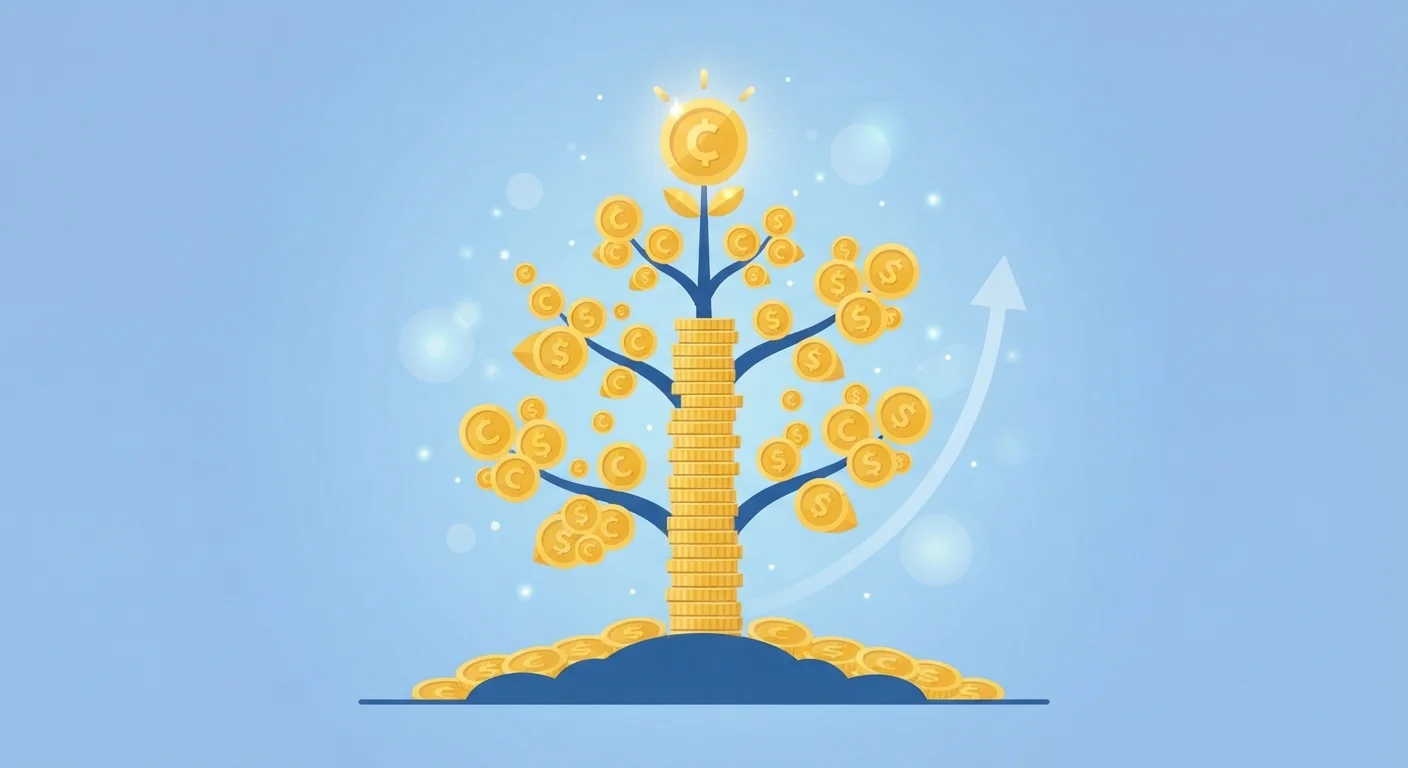
At its core, compound interest is interest earning interest. When you deposit money in an account that pays compound interest, each period's earnings are added to your balance — and the next period's interest is calculated on that now-larger balance. This cycle repeats, and the growth curve bends upward over time.
Consider a straightforward illustration: $1,000 deposited at a 5% annual rate, compounding annually, grows to $1,050 after year one. In year two, interest is calculated on $1,050 — not the original $1,000 — yielding $1,102.50. Each year, the base gets slightly larger, and the dollar amount of interest earned increases even though the rate stays the same.
Simple interest, by contrast, always applies the same rate to the original principal. The same $1,000 at 5% simple interest would earn exactly $50 every year — $500 over ten years, versus roughly $629 with annual compounding over the same period. The gap widens significantly over longer timeframes.
For a deeper look at the vocabulary used in interest calculations, see our plain-language glossary of debt and savings terms.
$629 vs. $500
Compound vs. simple interest on $1,000 over 10 years at 5%
Illustrative calculation based on standard compound interest formula (annual compounding) versus simple interest at the same rate and period.
~12 years
Time to double money at 6% annual compound interest
Derived using the Rule of 72, a widely used estimation shortcut in personal finance education.
Daily
How often many savings accounts compound interest
Many U.S. banks and credit unions compound interest daily and credit it monthly, per standard deposit account disclosures.
Why Time Is the Most Critical Variable
Compound interest rewards patience more than almost any other financial principle. The mathematical reason is straightforward: as the base grows, each successive period generates more interest in absolute dollars, even without any additional deposits. This acceleration is often described as exponential growth.
A useful mental shortcut is the Rule of 72: divide 72 by the annual interest rate to estimate roughly how many years it takes for a balance to double. At 6%, money doubles approximately every 12 years. At 9%, every 8 years. Starting a decade earlier doesn't just add 10 years of returns — it potentially adds one or more complete doubling cycles to your total.
Use the Rule of 72 as a Quick Check
Before evaluating any savings product or debt scenario, apply the Rule of 72 to develop an intuition for the rate's power. Divide 72 by the interest rate to estimate years to double. This simple check helps you compare options and understand the real cost of delaying contributions — or carrying a high-rate balance.
This is why financial educators consistently emphasize beginning to save as early as practical. Someone who starts contributing to a retirement account at 25 versus 35 doesn't just get 10 more years of returns; they get 10 more years of compounding on a base that grows larger each year. For more context on the role consistent saving plays in long-term financial health, see how your savings rate predicts long-term financial progress.
When Compound Interest Works Against You
The same mechanism that accelerates savings growth also accelerates debt accumulation. Credit cards, personal loans, and other revolving credit products typically apply compound interest to unpaid balances. If you carry a balance month to month, interest accrues on the growing total — including previously charged interest — not just the original purchase amount.
This is particularly consequential with high-interest debt. A credit card charging 22% APR (APR) compounds that rate against whatever you owe, and making only minimum payments keeps the principal nearly stagnant while interest continues to grow. The result is a debt balance that can persist — and expand — for years despite consistent monthly payments.
Understanding how this dynamic plays out in practice is essential before carrying any high-rate balance. Why paying only the minimum on credit cards costs more than you think examines the math in detail. You can also explore how compound interest works in your favor and against you for a broader comparison of both sides of the equation.
This article is for general informational purposes only and does not constitute personalized financial, investment, or tax advice. Consult a qualified financial professional for guidance specific to your situation.