
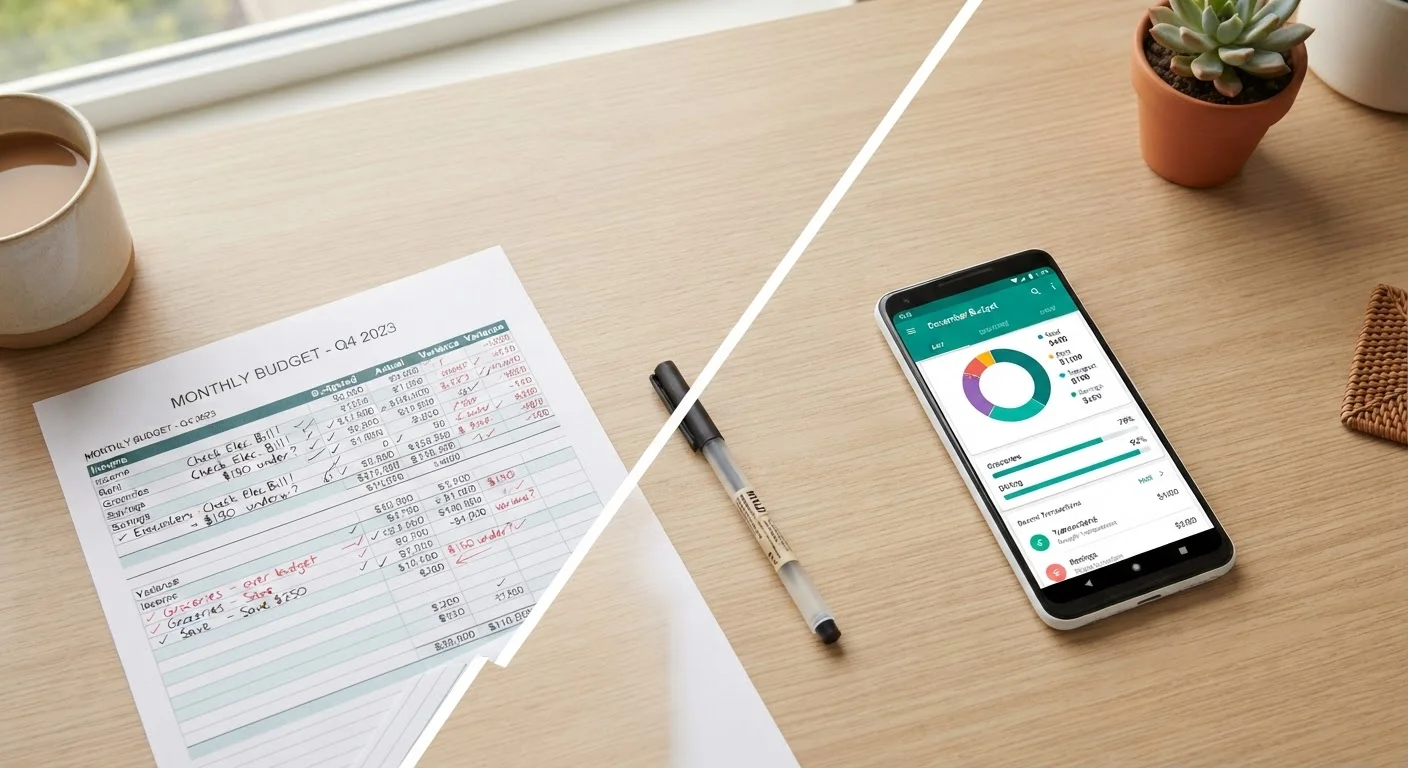
Two Paths to the Same Goal
Whether you track spending in a spreadsheet or tap through a budgeting app, the underlying goal is identical: understand where your money goes so you can make better decisions with it. But the experience of using each method is quite different, and picking the wrong one for your personality can mean abandoning your budget within weeks.
If you're just getting started, our guide to household budgeting from the ground up covers the foundational concepts before you commit to any particular tool. Once you understand the basics, the tool choice becomes much clearer.
It's also worth noting that the budgeting method — zero-based, envelope, percentage-based — is a separate decision from the tool you use to implement it. A spreadsheet or app is simply the container. That said, the container matters when it affects whether you actually stick with the plan.
The Case for Spreadsheets
A spreadsheet budget — typically built in Google Sheets, Microsoft Excel, or a similar program — gives you a blank canvas. You decide what categories to track, how to visualize your data, and exactly what formulas drive your calculations. That flexibility is a genuine advantage for households with irregular income, freelancers, or anyone whose spending categories don't fit neatly into an app's predefined buckets.
Spreadsheets also carry no subscription fees (free tools like Google Sheets are widely available) and require no connection to your bank accounts, which appeals to users concerned about data privacy. You control what information exists and where it lives.
The trade-off is effort. Every transaction must be entered manually, which takes discipline. A spreadsheet is only as accurate as the data you put in, and gaps in entry quickly erode its usefulness. For people who enjoy numbers or find satisfaction in building their own systems, this upkeep can feel rewarding. For those who find it tedious, it often becomes a chore that gets skipped.
Start With a Template, Not a Blank Sheet
If you choose the spreadsheet route, you don't have to build from zero. Free budget templates are available through Google Sheets, Microsoft Office, and many personal finance communities. Starting with a working structure lets you focus on your numbers rather than formula design, and you can customize from there as your needs become clearer.
The Case for Budgeting Apps
Budgeting apps connect directly to your financial accounts and automatically import and categorize transactions. This automation removes the manual entry burden, making it far easier to see a real-time snapshot of your spending without sitting down to update a file.
Many apps also send alerts when you approach a category limit or when an unusual charge appears — a passive safety net that spreadsheets can't provide unless you build complex conditional formatting yourself. For households juggling multiple accounts, shared finances, or simply a busy schedule, the low-friction daily experience of an app can make consistent tracking far more realistic.
The limitations are real, though. Apps require you to share bank credentials or use open banking connections, which involves trusting a third-party company with sensitive access. Automatic categorization is also imperfect — a grocery store purchase may be miscategorized, and correcting errors still requires active oversight. Many capable apps also carry monthly subscription costs that add up over time.
| Spreadsheet | Budgeting App | |
|---|---|---|
| Setup effort | High — build from scratch | Low — guided onboarding |
| Ongoing data entry | Manual, every transaction | Largely automated |
| Customization | Unlimited flexibility | Limited to app's framework |
| Cost | Free (most tools) | Often subscription-based |
| Privacy / data sharing | No third-party access needed | Requires bank account linking |
| Real-time alerts | Not available by default | Built-in spending alerts |
| Best for irregular income | Yes — fully adaptable | Varies by app |
| Learning curve | Moderate (formula knowledge helps) | Low for most apps |
How to Match the Method to Your Habits
Rather than asking which tool is objectively better, the more useful question is: which one will you actually use consistently? Research on behavior change consistently shows that friction is one of the strongest predictors of whether a habit sticks. A slightly inferior method you use daily beats a perfect system you abandon after two weeks.
Consider these practical questions before deciding:
- How comfortable are you with technology? If navigating app settings or linking accounts feels stressful, a spreadsheet's familiarity may lower that barrier.
- How irregular is your income? Variable earners often need the flexibility only a custom spreadsheet provides.
- Do you share finances with a partner? Some apps offer shared household views; spreadsheets require deliberate sharing setup.
- How much do you value data privacy? No app connection carries no third-party data exposure risk.
For a structured starting point regardless of which tool you choose, the monthly budget setup checklist walks through gathering income figures and listing expenses before your first budget month begins. And if hesitation is the real obstacle, common budgeting myths may address the doubts holding you back.
~30%
Adults with a detailed monthly budget
Gallup polling has consistently found that fewer than one-third of American adults maintain a detailed household budget, suggesting tool accessibility remains a barrier.
1 in 3
Budgeters who abandon their plan within 3 months
Behavioral finance research broadly indicates that friction and inconsistency — not financial knowledge — are the leading causes of budget abandonment.
Building the Habit That Lasts
The tool you choose is only the starting point. Long-term budgeting success depends on the habits you build around it — weekly check-ins, monthly reviews, and adjusting categories as your life changes. Neither a spreadsheet nor an app does this work for you automatically.
Once you have a system in place, habits that keep a budget working long-term offers evidence-backed practices for maintaining momentum well beyond the first month. You might also explore zero-based budgeting vs. the envelope method to pair a proven budgeting philosophy with whichever tool you select.
Some people find that a hybrid approach — using an app to capture daily transactions automatically, then reviewing and planning in a spreadsheet monthly — captures the strengths of both. The goal is a system that fits your life, not one you reshape your life to accommodate.
This article is for general informational and educational purposes only and does not constitute personalized financial advice. Consult a qualified financial professional for guidance specific to your situation.