
Why Budgeting Myths Are So Durable
Personal finance advice has a long history of unintentionally making budgeting sound like deprivation rather than empowerment. Phrases like "cut back," "sacrifice," and "tighten your belt" frame financial planning as something to endure rather than a tool you use actively. That framing sticks, and it keeps a significant number of people from ever trying.
The misconceptions below are worth addressing directly because each one functions as a concrete barrier. When the belief itself is wrong, removing it removes the obstacle. For a broader look at what budgeting can and cannot realistically accomplish, the balanced overview of budgeting's benefits and limits provides useful context.
Myth
Budgeting means giving up everything enjoyable — dining out, hobbies, and small luxuries have to go.
Fact
A budget allocates money deliberately, including for enjoyment. Spending on things you value is built into a well-designed budget.
This is one of the most persistent misconceptions about personal finance, and it stops many people before they even begin. A budget is not a punishment — it is a plan. The goal is to assign a purpose to every dollar so that you spend intentionally rather than by default.
Popular frameworks like the 50/30/20 rule explicitly carve out a category for wants. The structure is simple: roughly 50% of after-tax income toward needs, 30% toward wants, and 20% toward savings and debt repayment. Under this approach, spending money on coffee, a streaming subscription, or a dinner out is not a failure — it is part of the plan, provided it stays within your wants allocation.
The key insight is that budgeting replaces guilt with clarity. When you know you have set aside money for discretionary spending, you can enjoy it without anxiety.
Myth
Budgeting only makes sense if you earn enough money. People with low or inconsistent income have nothing to budget.
Fact
Budgeting is arguably most valuable on a limited income, where tracking every dollar can make the difference between stability and a financial crisis.
The idea that budgets are for people with surplus income gets the logic backwards. When income is tight, untracked spending is more likely to produce overdrafts, missed bills, or accumulating debt. A clear picture of where each dollar is going becomes more critical, not less.
For people with variable or irregular earnings — freelancers, gig workers, seasonal employees — specialized approaches exist. Income-first budgeting, for instance, involves setting spending based on your lowest expected monthly income and treating anything above that as a bonus to direct toward savings or irregular expenses. The guide to budgeting on an irregular income covers these strategies in more depth.
The point is that the financial stress associated with a low or unpredictable income is a reason to budget more carefully, not a reason to skip it.
Myth
You need sophisticated software or a complex spreadsheet to budget properly.
Fact
A working budget can be built on a piece of paper or a simple list. Complexity is optional, and often counterproductive for beginners.
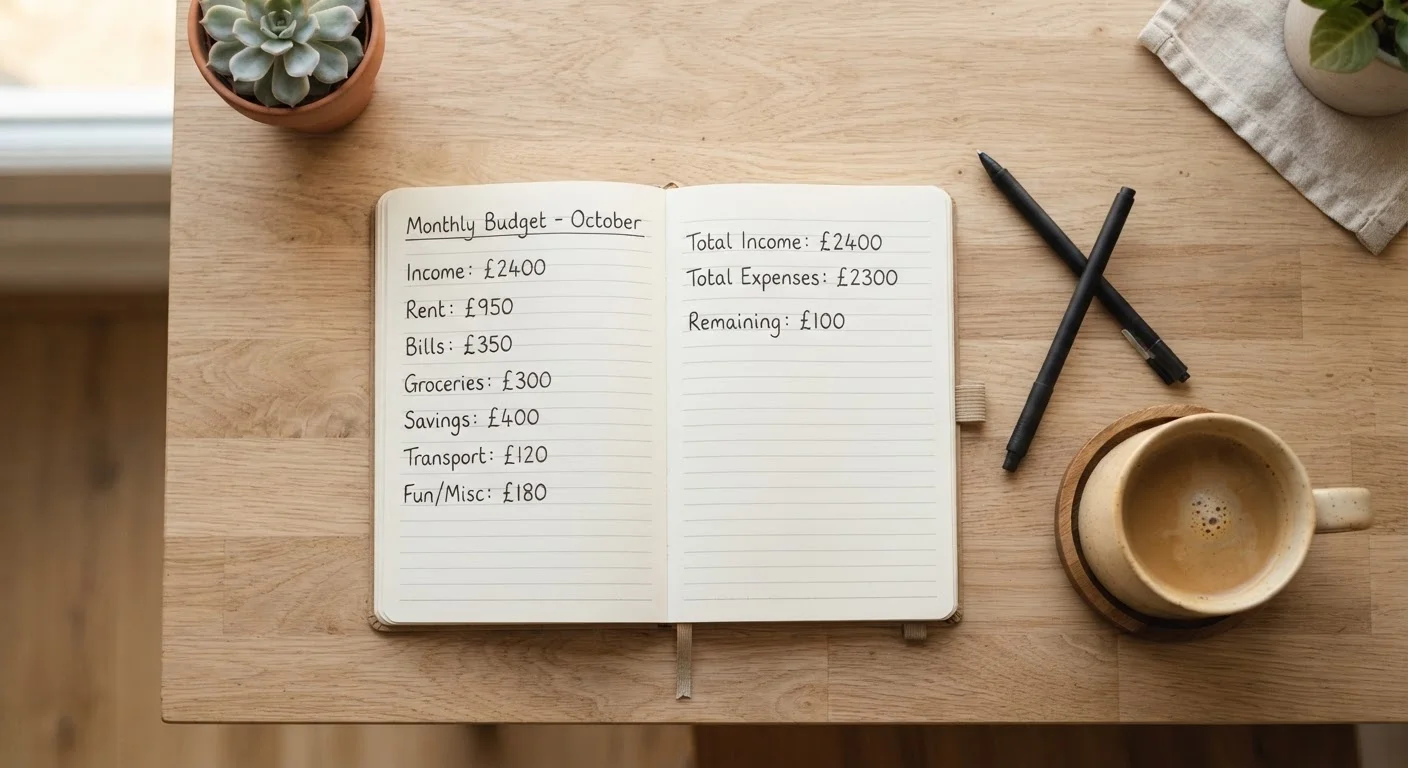
Technology can make budgeting more convenient, but it is not a prerequisite. The core task — listing income, listing expenses, and making sure the former covers the latter — requires nothing more than basic arithmetic.
The real risk of over-engineering a budget at the start is that the setup becomes so burdensome that it never gets used. Many people find that beginning with a simple, handwritten monthly summary and refining it over time is more sustainable than starting with a complex system. If you later want to compare tools, the comparison of spreadsheet budgets and budgeting apps outlines the real trade-offs between those approaches.
Start simple, stay consistent, and add complexity only when it solves a real problem you are experiencing.
Myth
If you go over budget one month, the whole system has failed and you should start over.
Fact
Occasional overruns are normal and expected. A single bad month does not invalidate a budgeting practice.
Treating any deviation as total failure is a classic all-or-nothing thinking pattern, and it is one of the most common reasons early budgeting attempts collapse. Budgets are dynamic — unexpected expenses arise, estimates are imperfect, and life is not perfectly predictable.
A more productive framing is to treat each month as a data point. If you consistently overspend in one category, that category's allocation probably needs to be adjusted. If a genuine emergency caused a one-time overrun, note it and move on. Neither situation means the budget itself is broken.
Understanding why budgets often stumble early can help. The article on why budgets fail in the first month identifies the most common pitfalls and practical ways to address them before they derail your progress.
Myth
There is one correct budgeting method that everyone should follow.
Fact
Multiple budgeting frameworks exist because different approaches suit different income types, lifestyles, and financial goals.
The 50/30/20 rule, zero-based budgeting, the envelope method, and pay-yourself-first are all legitimate frameworks — and they work differently. Zero-based budgeting assigns every dollar a specific job each month, leaving a balance of zero at the end of the planning cycle. The envelope method uses physical or digital cash allocations per spending category to create hard limits. Each has trade-offs in terms of flexibility, effort, and psychological fit.
For a side-by-side look at two of the most widely used approaches, see the comparison of zero-based budgeting and the envelope method. The right method is the one you will actually use consistently — not necessarily the one that sounds most rigorous on paper.
Starting Is the Hard Part — And It Gets Easier
Most of the friction around budgeting is front-loaded. The first month involves estimating spending categories you may never have tracked, and the numbers will not be perfect. That is expected. What matters is building the habit of reviewing income and expenses regularly, adjusting as you learn more about your actual patterns.
~33%
Americans with a written monthly budget
Surveys by the National Foundation for Credit Counseling have consistently found that fewer than one-third of U.S. adults maintain a detailed household budget.
78%
Workers living paycheck to paycheck
Various workforce surveys, including those by CareerBuilder and similar research organizations, have reported that a large majority of U.S. workers have little financial cushion month to month.
Once the habit is established, the cognitive load drops considerably. Research on habit formation consistently shows that decision fatigue decreases as routines become automatic. Monthly budget reviews that feel effortful in month two tend to become routine by month five or six. For guidance on the specific practices that help budgets stick long-term, see the habits that keep a budget working long-term.
If you are building a household budget for the first time, the comprehensive introduction to household budgeting walks through each foundational step in practical terms.
Avoid Overly Rigid Budgets Early On
Setting extremely tight limits across every spending category in your first month sets an unrealistic baseline and dramatically increases the chance of abandonment. Build in a small buffer for miscellaneous or unexpected expenses — typically 5–10% of discretionary spending — until you have two or three months of real data to work from. Adjusting a budget that is too tight is far easier than restarting one you gave up on entirely.
This article is for general informational and educational purposes only and does not constitute personalized financial advice. For guidance specific to your situation, consider consulting a licensed financial professional.