
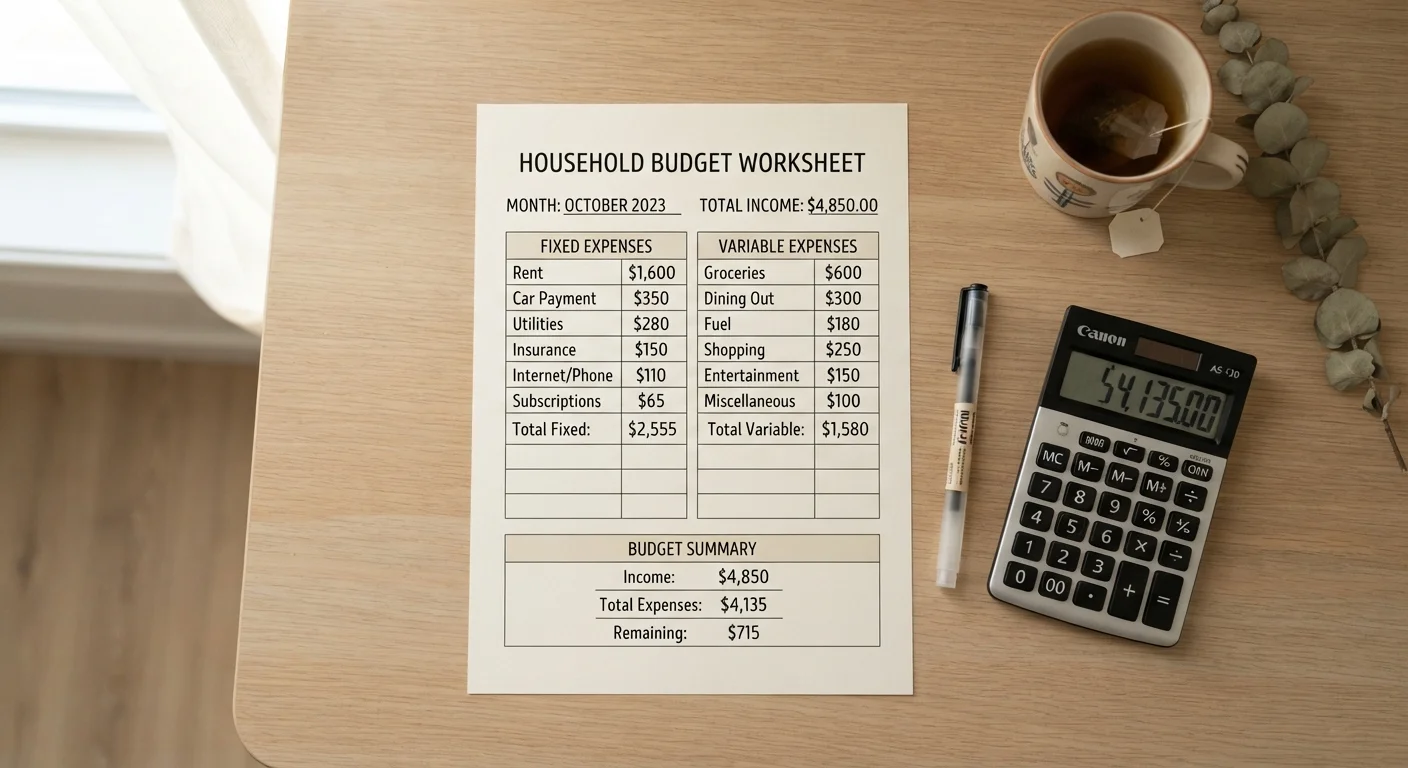
What Makes an Expense 'Fixed'?
A fixed expense is any cost that remains the same amount every billing cycle, regardless of how much you use a service or how your life circumstances shift month to month. You've agreed to pay a set amount — usually through a contract or recurring obligation — and that figure doesn't change.
Common examples include:
- Rent or mortgage payments
- Auto loan payments
- Student loan installments
- Insurance premiums (health, auto, renters)
- Fixed-rate subscription services billed at a flat monthly fee
The defining trait is predictability. You know the amount in advance, which makes planning straightforward. Fixed expenses form the non-negotiable core of any household budget. Before you make any other spending decision in a given month, these obligations are already committed.
Because they're difficult to reduce in the short term — changing a mortgage payment or canceling a lease mid-term typically involves penalties or significant friction — fixed expenses deserve careful scrutiny before you commit to them, not after. See our monthly budget setup checklist for guidance on accounting for these costs before the month begins.
What Makes an Expense 'Variable'?
A variable expense changes from month to month based on your behavior, consumption, or circumstances. There's no fixed contractual amount — what you spend depends on choices you make or conditions you face.
Typical variable expenses include:
- Groceries and household supplies
- Gas and transportation costs
- Utility bills (electricity, water) that fluctuate with usage
- Dining out and entertainment
- Clothing and personal care
- Medical co-pays and out-of-pocket costs
Variable expenses are where most budgeters find their greatest opportunity — and their greatest challenge. Because the amounts shift, they require more active tracking. But that same flexibility means they're also where you have the most control. When money gets tight, variable costs are typically the first place to look for reductions.
Understanding the variable side of your budget pairs naturally with the needs vs. wants framework, which helps you evaluate which variable costs are truly necessary and which reflect discretionary preferences.
| Criterion | Fixed Expenses | Variable Expenses |
|---|---|---|
| Amount consistency | Same every month | Changes month to month |
| Examples | Rent, loan payments, insurance | Groceries, gas, dining out |
| Short-term flexibility | Very limited | High — adjustable by choice |
| Budget planning difficulty | Easy to forecast | Requires tracking and estimation |
| Where savings come from | Negotiation or lifestyle changes | Spending habits and daily decisions |
| Risk if underestimated | Missed contractual obligations | Budget shortfalls and overspending |
The Gray Area: Semi-Variable Costs
Not every expense fits neatly into one category. Semi-variable expenses — sometimes called mixed costs — have both a fixed component and a variable one. Your cell phone plan, for instance, might have a flat base rate but add charges for data overages. A tiered electricity plan has a minimum charge plus usage-based costs on top.
When Utilities Straddle Both Categories
Utilities like electricity, gas, and water are often listed as variable expenses, but they may have a base service charge that's fixed regardless of usage. For budgeting purposes, it's useful to estimate an average monthly figure based on past bills — particularly for seasonal costs that spike in summer or winter. Reviewing 12 months of statements gives you a more accurate annual picture than relying on any single month.
Treating semi-variable expenses as entirely fixed can lead you to underestimate how much control you actually have over them. A closer look at your usage habits might reveal meaningful savings. Check our article on spending categories most budgets overlook — many of the expenses that fall through the cracks are semi-variable in nature.
Why the Distinction Shapes Your Budget Strategy
Separating fixed from variable expenses isn't a bookkeeping exercise — it directly determines how you respond to financial changes. When income drops unexpectedly, knowing which costs are locked in versus adjustable tells you immediately where relief is possible.
~33%
Average share of income spent on housing
According to the U.S. Bureau of Labor Statistics Consumer Expenditure Survey, housing consistently represents the largest single fixed expense for American households.
~15%
Average share of income spent on food
The BLS Consumer Expenditure Survey indicates food — a largely variable expense — accounts for roughly 12–15% of average household spending, making it one of the most adjustable budget categories.
This distinction also underpins many structured budgeting approaches. Whether you use zero-based budgeting or another method, expenses behave differently and need to be managed differently. See how these methods apply the fixed/variable framework in our comparison of zero-based budgeting vs. the envelope method.
If any of the terminology in this article feels unfamiliar, our glossary of everyday budgeting terms offers plain-language definitions for the concepts you'll encounter most.
This article is for general informational and educational purposes only and does not constitute personalized financial advice. For guidance specific to your situation, consider consulting a qualified financial professional.