
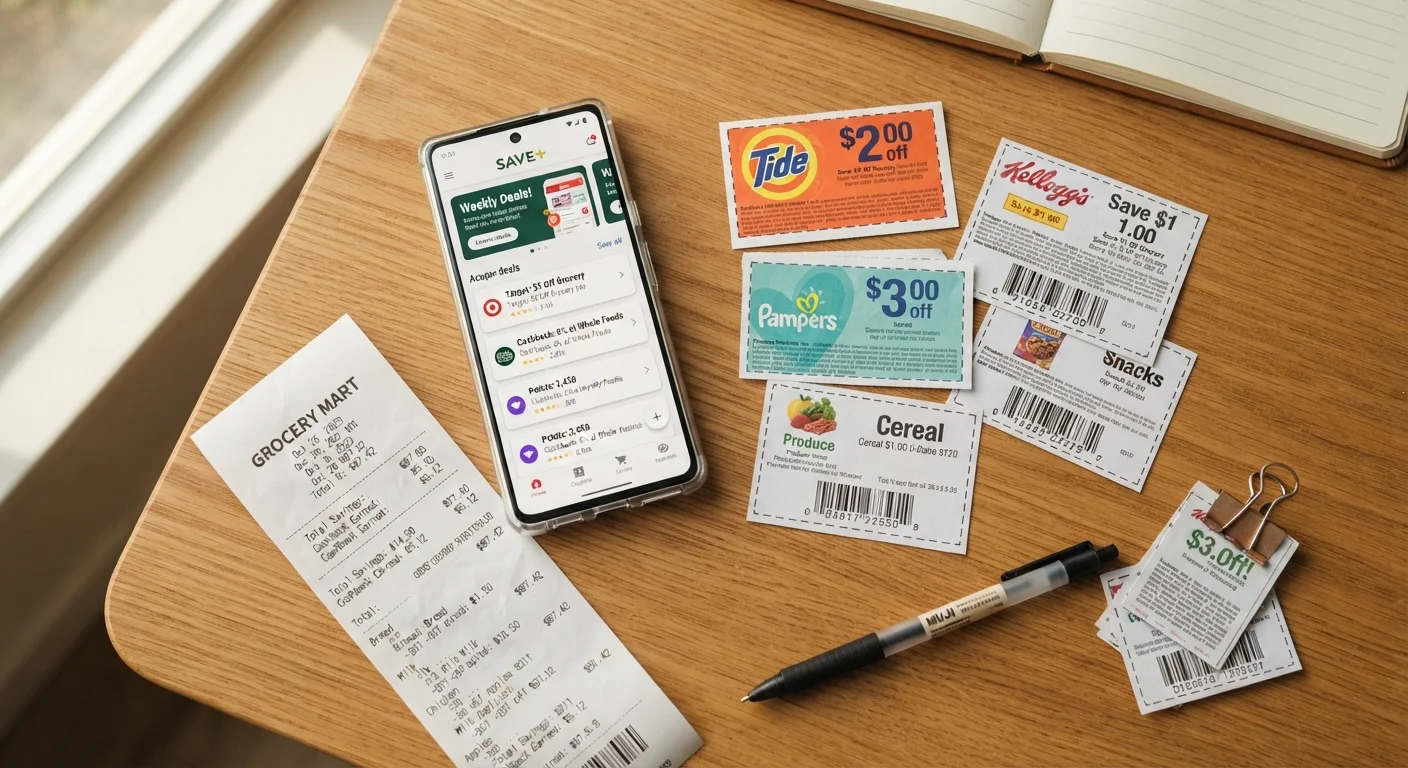
The Three Discount Types, Defined
Most money-saving tools fall into one of three categories. Understanding how each works prevents confusion - and prevents being misled by marketing that blurs the lines.
Coupons
A coupon is a voucher - digital or paper - that reduces the price of a specific product or category at the point of sale. Coupons are typically issued by manufacturers or retailers, and they almost always carry restrictions: expiration dates, quantity limits, exclusions on sale items, or requirements to purchase a minimum quantity. A manufacturer coupon can usually be used at any retailer carrying that product; a store coupon is locked to that specific retailer.
Cashback
Cashback is a rebate paid after a qualifying purchase. It arrives as account credit, a check, a gift card, or a deposit - depending on the platform. The important distinction: you pay full price at checkout, then receive a portion back later. Some credit cards build cashback into every transaction automatically; dedicated cashback apps or portals require you to activate the offer before you shop. Either way, the money isn't instantaneous.
Promo Codes
Promo codes (also called discount codes or coupon codes) are alphanumeric strings entered at online checkout to apply a discount. They can take the form of a percentage off, a flat dollar reduction, free shipping, or a free item. Unlike coupons, they're typically retailer-generated rather than manufacturer-issued, and they often have use limits - some are single-use personal codes, others are public and widely shareable.
Manufacturer vs. Store Coupons: A Key Distinction
Manufacturer coupons are funded by the product's maker and can generally be used at any store that carries the product. Store coupons are funded by the retailer and are only valid at that specific chain. Many retailers accept manufacturer coupons but not competitor store coupons - always check posted policies before shopping.
Where to Find Each Type
Knowing where to look reduces the time you spend hunting and increases the likelihood the discount is legitimate.
Coupons
- Retailer apps and loyalty accounts: Most major grocery and pharmacy chains load digital coupons directly into their apps, clipped to your loyalty account. No paper required.
- Manufacturer websites: Consumer packaged goods companies often post printable or digital coupons on their own sites.
- Sunday newspaper inserts: Still common for grocery and household product coupons, particularly in suburban markets.
Cashback
- Credit card rewards: Many cards offer rotating or flat-rate cashback on categories like groceries, gas, or dining. Check your card's current offer calendar before large purchases.
- Cashback portals and browser extensions: Several tools activate cashback by routing your browser session through an affiliate link before you shop. Read their privacy practices carefully - they collect browsing data in exchange for the rebate. See how browser tracking and cookies work for relevant background.
- Receipt-scanning apps: These apps award cashback when you upload a qualifying receipt after purchase. Useful for in-store grocery shopping.
Promo Codes
- Retailer email lists: Signing up for a retailer's email list frequently generates a first-purchase discount code. Unsubscribing afterward is straightforward.
- Public code aggregators: Sites compile submitted codes, but code validity is unreliable - many are expired or region-specific. Treat them as worth a 30-second attempt, not a reliable source.
- Abandoning your cart: Some retailers automatically trigger a discount email when you leave items in your cart without checking out. This is a deliberate retention tactic, not a guaranteed offer.
Before searching for a promo code, check whether the retailer's own loyalty account already has a personalized discount loaded - these are often better than public codes and don't require hunting.
Retailers frequently issue targeted discounts to loyalty members that aren't publicly advertised, making your existing account the most reliable first stop.
When using a cashback browser extension, disable it and compare the final price without it - some retailers detect the extension referral and suppress their best promotional prices or exclude certain payment methods.
Some e-commerce platforms adjust pricing or offer visibility based on the referral source, meaning the cashback gain can sometimes be offset by a less competitive base price.
Stacking Strategies That Actually Work
"Stacking" means applying more than one discount to a single purchase. The combinations that actually work depend on retailer policy - and that policy varies widely.
Common Legal Stacks
- Manufacturer coupon + store sale: A manufacturer coupon applied to an already-reduced item is the most common and generally accepted stack. The manufacturer and retailer discount independently.
- Promo code + credit card cashback: Applying a promo code at checkout while earning credit card cashback on the purchase is almost universally permitted because the discount and the reward occur through separate channels.
- Retailer cashback portal + promo code: Some portals allow a promo code to be entered after clicking through their link; others void the cashback if a code is used that isn't listed in their system. Check the platform's terms before combining these.
What Usually Doesn't Stack
- Two manufacturer coupons on the same item
- A store coupon and a competitor coupon at the same retailer
- Multiple promo codes in one checkout session (most cart systems accept only one code field)
For a broader look at how sale pricing interacts with advertised discounts, see how retail pricing and discounts really work.
Test Codes Before Completing Checkout
Always apply a promo code before entering your payment details - some codes reveal their terms (like minimum spend or excluded items) only when applied. If the code doesn't work as expected, you can abandon the session without any charge. Never assume a code is valid until the discount visibly appears in your order summary.
When Discounts Cost You More
The clearest hazard in coupon and cashback culture is purchasing something you didn't need because a discount made it feel justified. A 40% discount on a $60 item you wouldn't have bought otherwise is a $36 expense, not a $24 saving.
A Discount Never Justifies an Unwanted Purchase
Every coupon, cashback offer, and promo code is designed to increase purchase volume - that's their commercial purpose. Saving 30% on something you didn't plan to buy is still a 70% expenditure you wouldn't have made. Evaluate every purchase on whether you need it at full price first; apply discounts second.
A few patterns worth watching for:
- Minimum spend thresholds: Promo codes requiring a $75 minimum purchase to unlock $10 off can push you to add items you didn't intend to buy. Do the math on whether the qualifying spend is actually worth it.
- Cashback on inflated prices: A retailer offering 15% cashback through a portal may have quietly raised its baseline price. Compare the after-cashback final cost against competitors selling the same item. The anatomy of a retail sale piece covers anchor pricing tactics in detail.
- Expiring cashback that drives impulse redemption: Some cashback accounts require you to redeem earnings by a deadline. If the only redemption option at that moment is store credit at a retailer you don't need to shop at, expiring cashback can manufacture a shopping trip.
Before you add anything to your cart, the pre-purchase checklist is worth running through - discounts included.
Keeping It Organized Without Losing Your Mind
A practical discount habit should save time overall, not consume hours of weekly effort. Here's a realistic maintenance approach:
Set a Simple Routine
Check your retailer apps and clip relevant digital coupons once before your regular grocery or household shopping trip - not throughout the week. For large discretionary purchases, spend five minutes before checkout searching for a promo code and checking whether your credit card offers a relevant cashback category boost.
Don't Over-Optimize
Running three browser extensions simultaneously, maintaining accounts on six cashback portals, and cross-referencing every purchase across platforms is a second job. The diminishing returns arrive quickly. Pick one or two tools that fit your actual shopping habits and skip the rest.
Track What You Actually Receive
Cashback pending balances don't always pay out - retailer returns, technical attribution errors, and account deactivations can void earnings. If you're relying on cashback to justify a purchase price, verify that it has posted before considering it real money.
Discount tools overlap meaningfully with loyalty programs. If you're enrolled in a retailer's rewards program, understand how coupons and cashback interact with point earning - the two systems don't always combine favorably. The loyalty programs explainer covers this interaction clearly.
~$3B
Digital coupons redeemed annually in the U.S.
Industry estimates from coupon industry association reports consistently place annual digital coupon redemption in the multi-billion dollar range for U.S. consumers.
45-60 days
Typical cashback portal payout window
Most major cashback portals require a transaction validation period before releasing earnings, commonly ranging from 45 to 90 days after purchase.
~60%
Online shoppers who search for promo codes at checkout
Multiple consumer behavior surveys have found that a majority of online shoppers attempt to find a discount code before completing a purchase.