
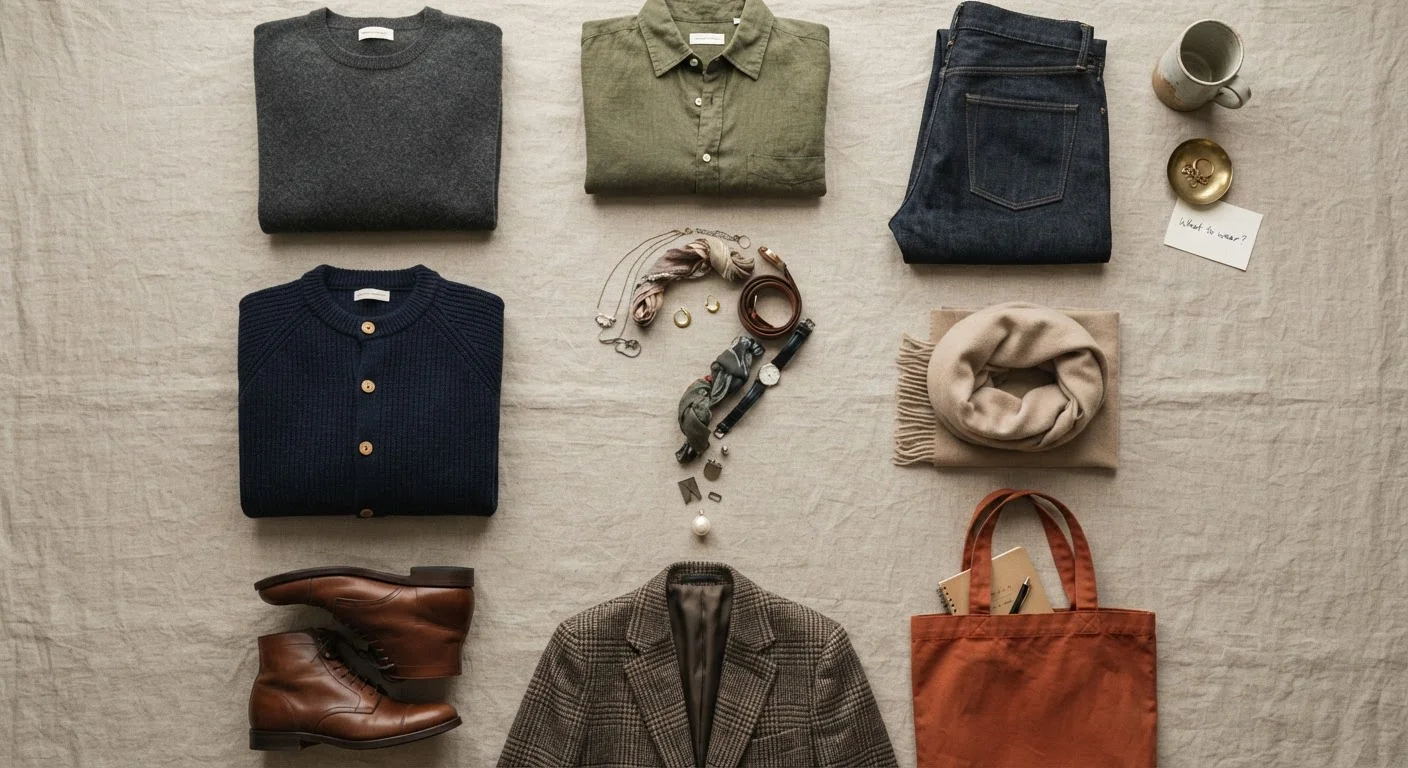
The Real Reason Your Closet Isn't Working
You've spent real money on real clothes. Each piece, on its own hanger, looks genuinely good. But every morning you stand in front of the closet feeling like nothing goes together — and somehow you end up wearing the same three combinations on repeat. Sound familiar?
This is one of the most common style frustrations people face, and it's almost never about taste. The culprit is usually a missing through-line: a consistent visual logic that lets individual pieces speak the same language. When that logic is absent, even great clothes read as a collection of strangers rather than a cohesive wardrobe.
The fix starts with understanding exactly which habits create the disconnect — and most of them are surprisingly easy to course-correct. For a deeper look at what you already own and how it fits together, our style audit guide walks you through the whole process.
Shopping for individual pieces without thinking about what they'll pair with at home.
Why it happens: In the store or while scrolling, a piece looks great in isolation — styled, lit, and presented perfectly. The context of your actual closet never enters the picture.
Mixing formality levels without a deliberate bridging strategy.
Why it happens: Casual-luxe dressing looks effortless on styled photos, so it's tempting to replicate — but those images usually involve precise calibration of fit and fabric that isn't obvious at first glance.
Ignoring proportion — pairing volume with more volume, or slim with slim throughout.
Why it happens: We tend to dress in moods: a cozy day means everything oversized, a polished day means everything fitted. But extremes in either direction can flatten an outfit's visual interest.
Letting a palette creep across too many temperature families — warm tones and cool tones with no bridge.
Why it happens: Colors are often bought separately, weeks or months apart, and it's easy to lose track of whether the overall palette holds together across seasons.
Keeping clothes that don't fit and trying to style around the fit issue.
Why it happens: Sentimental attachment, the cost of the piece, or optimism about future fit makes it hard to let go — so the piece stays and keeps disrupting outfits.
The Habits That Quietly Break Outfits
Once you can name these patterns, you'll start spotting them instantly — in your own mirror and everywhere else.
1 focal point
Per outfit for visual clarity
Style educators widely recommend anchoring each outfit around a single hero piece to reduce visual competition and create cohesion.
3 pairings
Minimum versatility test before buying
A common wardrobe-building rule of thumb: if a new piece can't be mentally paired with at least three items you already own, it risks becoming an unworn orphan.
Formality mismatch is one of the trickiest because it's subtle. A beautifully tailored blazer over a very casual graphic tee can work intentionally, but it requires careful calibration of fit, fabric weight, and confidence. Without those, it just looks like two different outfits collided. The same goes for fabric weight: pairing a heavy structured wool skirt with a tissue-thin blouse creates a visual imbalance that registers as 'off' even if nobody can articulate why.
Proportion is equally powerful. Our guide to fit, fabric, and finish goes deep on this, but the short version is: one volume-forward piece generally needs a counterbalance of something more fitted. Wide-leg trousers plus an oversized sweater can absolutely work — but it demands intention, not accident.
Too Many Trends at Once Backfires
Chasing multiple trends simultaneously — each individually appealing — is one of the fastest ways to end up with a closet full of pieces that don't cohere. Trends are designed around specific aesthetic moments, and they often clash hard when combined. Pick one or two trend-forward elements per season and build them into an otherwise consistent wardrobe base.
Color and pattern are where most people get tripped up first. Too many competing prints, or a palette that spans warm and cool tones without a bridge piece, makes the eye work too hard. The result is an outfit that feels chaotic even if every individual item is beautiful on its own.
How to Start Building Outfits That Actually Click
The good news: you probably don't need to buy anything new. Most wardrobe problems are curation and combination problems, not inventory problems.
Start by identifying your wardrobe's dominant aesthetic signals. Are most of your pieces relaxed and casual? Structured and minimal? Romantic and textured? If your closet is roughly split between very different aesthetics — say, polished office wear and festival-ready bohemian — then you have two separate wardrobes that don't naturally merge. That's fixable, but it requires deciding which direction you actually want to go. Our article on dressing consistently can help you think that through.
Next, audit fit ruthlessly. An item that doesn't fit well will drag down every outfit it touches, regardless of how much it cost or how much you love the color. For a closer look at when and why tailoring is worth it, see our piece on why fit changes how any outfit reads.
Fit Problems Undermine Everything Else
No amount of clever styling compensates for a garment that doesn't fit your body properly. A sleeve that's too long, a shoulder that sits off, or a waistband that gapes will pull attention away from every other element of the outfit. Before overhauling your wardrobe, check whether basic tailoring on key pieces might solve more than you'd expect.
Finally, practice the one-focal-point rule: choose one element per outfit to be the visual star — a great pair of trousers, a bold jacket, a standout accessory — and let everything else support it quietly. This single habit transforms how outfits read, because it gives the eye a clear place to land.
Building a wardrobe that actually works together is a skill, and like any skill, it sharpens with practice. The everyday fashion hub is a good starting point for practical, real-world style guidance as you keep refining your look.