
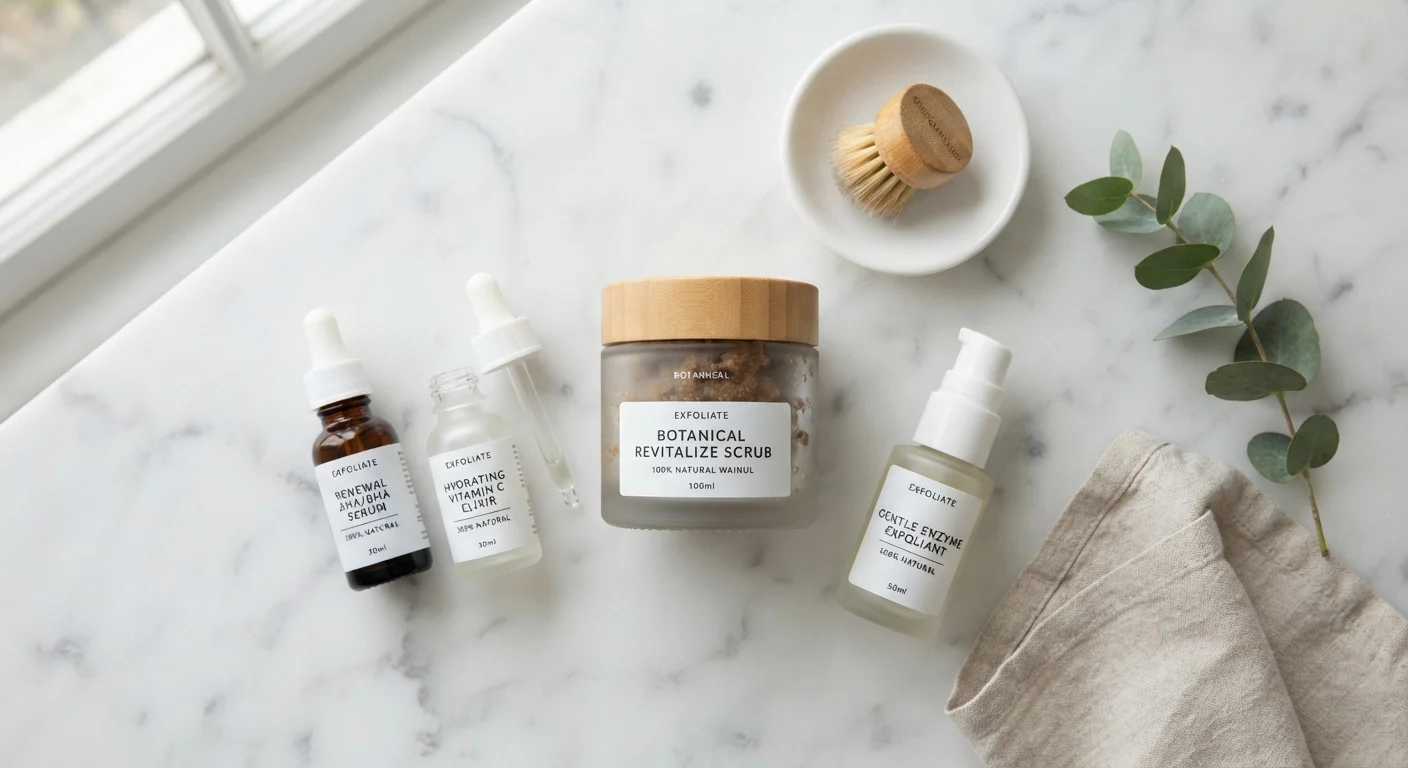
What Actually Happens When You Exfoliate
Exfoliation is the process of removing dead skin cells from the outermost layer of skin, called the stratum corneum. Your skin naturally sheds these cells on its own — a process called desquamation — but it slows down with age, hormonal shifts, and environmental stress. When dead cells linger, the result is dullness, rough texture, clogged pores, and uneven tone. Exfoliation gives that natural process a nudge. The key difference between chemical and physical methods is how that nudge happens.
Chemical exfoliants use acids or enzymes that chemically loosen the bonds holding dead skin cells together, allowing them to shed more evenly. Physical scrubs use friction — tiny abrasive particles, cloths, or tools — to manually slough cells off the surface. Neither is universally superior; both have real trade-offs depending on your skin type and goals.
Chemical Exfoliants: AHAs, BHAs, and PHAs Explained
The chemical exfoliant category is broader than many people realize. Here's a quick breakdown:
- AHAs (alpha hydroxy acids) — including glycolic acid and lactic acid — are water-soluble and work primarily on the skin's surface. They're excellent for improving texture, brightening dullness, and addressing fine lines. Lactic acid is generally considered gentler, making it a good starting point.
- BHAs (beta hydroxy acids) — salicylic acid is the most well-known — are oil-soluble, meaning they can penetrate into the pore lining itself. This makes them especially effective for oily, acne-prone, or congestion-prone skin.
- PHAs (polyhydroxy acids) — like gluconolactone — have a larger molecular size, so they penetrate more slowly and cause less irritation. They're often recommended for sensitive skin or exfoliation beginners.
- Enzymes — derived from fruits like papaya or pineapple — digest dead skin proteins gently and are typically the mildest option of all.
Because chemical exfoliants are active ingredients, their placement in your routine matters. See our skincare layering guide for exactly where they fit. It's also worth noting that some actives don't combine well — check our guide to ingredient conflicts before stacking exfoliants with other potent ingredients.
| Criterion | Chemical Exfoliants | Physical Scrubs |
|---|---|---|
| How it works | Dissolves bonds between dead skin cells | Manually buffs away dead skin cells |
| Speed of results | Gradual; builds over consistent use | Immediate surface smoothness |
| Pore penetration | BHAs penetrate deep into pores | Surface only |
| Best skin types | Sensitive, oily, acne-prone, aging | Normal to resilient, non-reactive |
| Irritation risk | Low to moderate (dose-dependent) | Moderate to high if particles are coarse |
| Addresses pigmentation | Yes, especially AHAs over time | Minimally |
| Learning curve | Moderate (pH, layering, frequency) | Low (but technique still matters) |
Physical Scrubs: Where Technique Makes All the Difference
Physical scrubs work immediately and tangibly — you can feel and see the difference right away. But they've also earned a complicated reputation, and for good reason. Scrubs with irregularly shaped particles (think crushed walnut shells) can create micro-abrasions in the skin, especially when applied with heavy pressure. These tiny tears can trigger inflammation and, over time, actually worsen the texture you're trying to improve.
That doesn't mean all physical scrubs are problematic. Scrubs with fine, uniform, smooth particles — such as round jojoba beads or sugar — applied with a light hand can be perfectly effective and much gentler. The variables that matter most are particle shape, particle size, and how much pressure you use.
~28 days
Average skin cell turnover cycle in young adults
Cell turnover slows with age, which is one reason exfoliation becomes more relevant as a skincare step over time.
1–2x/week
General frequency recommendation for physical scrubs
Most dermatologists suggest limiting physical exfoliation to once or twice weekly to avoid compromising the skin barrier.
Physical scrubs also can't address concerns below the surface — they work on what's already loose at the top layer. If your primary concerns are pore congestion, breakouts, or pigmentation, surface buffing alone is unlikely to deliver the results you're after. And over-scrubbing is a very real risk; protecting your skin barrier starts with not stripping it through excessive exfoliation.
Which One Belongs in Your Routine?
The honest answer is: it depends — and sometimes the answer is both, used thoughtfully and not simultaneously. Many skincare enthusiasts use a mild physical scrub occasionally for tactile satisfaction and a chemical exfoliant a few nights a week as part of their regular routine. The key is avoiding overlap that leads to over-exfoliation, which shows up as redness, stinging, tight or flaky skin, or sudden breakouts.
A few guiding principles:
- If you're prone to sensitivity or redness, start with a low-concentration AHA or PHA rather than a physical scrub.
- If your main concern is oily skin or clogged pores, a BHA is likely to make a more meaningful difference than any surface scrub.
- If you want to try a physical scrub, look for one with fine, smooth particles and use it no more than once or twice per week with gentle circular motions — no aggressive pressure needed.
- After any exfoliation session, follow with a moisturizer to help your skin recover and retain hydration. If you're curious about the best hydrating ingredients to pair with exfoliation, our comparison of hyaluronic acid and glycerin is a great next read.
A Note on Skin Tone and Chemical Exfoliants
For deeper skin tones, post-inflammatory hyperpigmentation (PIH) — darkening that occurs after irritation or breakouts — is a significant concern. Harsh physical scrubs that create micro-abrasions can trigger PIH. Well-formulated AHAs used consistently are generally considered a safer and more effective approach for managing uneven tone on deeper complexions, though individual responses vary. When in doubt, a dermatologist familiar with melanin-rich skin can give personalized guidance.
This article is for general informational and educational purposes only. If you have a skin condition or are unsure which exfoliation method is appropriate for your skin, consult a licensed dermatologist or skincare professional.