
Why Cat Training Myths Persist
The belief that cats are untrainable is one of the most widespread — and most limiting — ideas in pet ownership. Unlike dogs, cats weren't selectively bred over millennia to follow human commands, and their body language is subtler. These differences have led many owners to conclude that training a cat is pointless. The reality, supported by animal behavior science, is quite different.
Cats are highly capable learners. They respond to operant conditioning — the process of associating a behavior with a consequence — in the same fundamental way dogs, birds, and other animals do. What holds most owners back isn't their cat's nature; it's misinformation about how cats learn. Clearing up these myths is the first step toward a more rewarding relationship with your feline companion. For a broader look at how training principles apply across species, see Training Across Species.
Myth
Cats are too independent to be trained — they simply don't want to please anyone.
Fact
Independence and untrainability are not the same thing. Cats are motivated by self-interest, which is actually a reliable training lever.
Dogs were bred to seek human approval; cats were not. But that doesn't mean cats are indifferent to consequences. When a behavior reliably produces something a cat values — a tasty treat, a play session, access to a favorite spot — cats learn to repeat it. The key is finding the right motivator for your individual cat, whether that's a specific treat, a toy, or even a grooming session. Framing training as a mutually beneficial exchange rather than a command-and-obey dynamic works far better with felines.
Myth
You can only train kittens — older cats are set in their ways.
Fact
Adult and senior cats are fully capable of learning new behaviors. Age alone is not a barrier to training.
The idea that behavioral flexibility disappears after kittenhood has no strong scientific basis. While kittens may learn certain social behaviors more readily during sensitive developmental windows, adult cats continue to learn through experience throughout their lives. Many cats adopted as adults successfully learn cues like sit, stay, and come — and some owners find adult cats easier to train because they're calmer and less easily distracted than kittens. If an older cat is showing sudden behavioral changes, a veterinary checkup is wise, but age alone shouldn't stop you from attempting training.
Myth
Cats need to be punished when they misbehave — otherwise they'll never stop.
Fact
Punishment is largely ineffective with cats and can cause fear and anxiety that worsens behavior.
When a cat scratches furniture or jumps on counters, the instinct to scold or physically redirect can feel logical. In practice, cats rarely connect after-the-fact punishment with the behavior that prompted it. More significantly, physical punishment or loud reprimands can make cats fearful of their owners, increasing stress-related behaviors rather than reducing them. Effective alternatives focus on redirecting the cat to an appropriate outlet — a scratching post near the furniture, for example — and rewarding use of that outlet. Environmental management and positive reinforcement consistently outperform punishment in behavioral research.
Myth
Cats only respond to food — if your cat isn't food-motivated, training won't work.
Fact
While food is a common and effective reward, many cats are equally or more motivated by play, affection, or access to preferred locations.
It's true that small, high-value food treats are a reliable training tool for most cats. But motivation is individual. Some cats work enthusiastically for a brief session with a wand toy. Others respond to gentle petting or a verbal cue that signals attention from a trusted person. Discovering what your specific cat finds most rewarding is one of the most important early steps in training. Experiment with different reward types during a low-stakes play session and observe what produces the strongest, most consistent response.
Myth
Long training sessions give cats more time to learn and are therefore more effective.
Fact
Short, frequent sessions — typically three to five minutes — are far more effective for feline learning than long, marathon sessions.
Cats have a relatively short window of engaged focus during any one interaction. Pushing past that window doesn't extend learning — it produces disengagement, avoidance, or frustration. Multiple brief sessions spread throughout the day leverage the cat's natural curiosity without depleting it. Ending each session while the cat is still engaged and on a successful repetition leaves the animal in a positive state and more likely to participate willingly next time. Consistency over days and weeks, not length of individual sessions, is what builds lasting behavior.
Building a Training Practice That Actually Works
Once the myths are out of the way, the practical question becomes: how do you train a cat effectively? The fundamentals aren't complicated, but they do require consistency.
3–5 min
Ideal cat training session length
Animal behavior specialists generally recommend keeping feline training sessions to three to five minutes to maintain engagement and end on a positive note.
1–2 sec
Reward timing window for effective learning
Behavioral science indicates that rewards delivered within one to two seconds of a behavior are most effective at reinforcing that behavior in animals.
Keep sessions brief. Three to five minutes is often enough for a single training session. Cats disengage quickly once curiosity wanes, and ending on a successful repetition is far more productive than pushing past the point of interest.
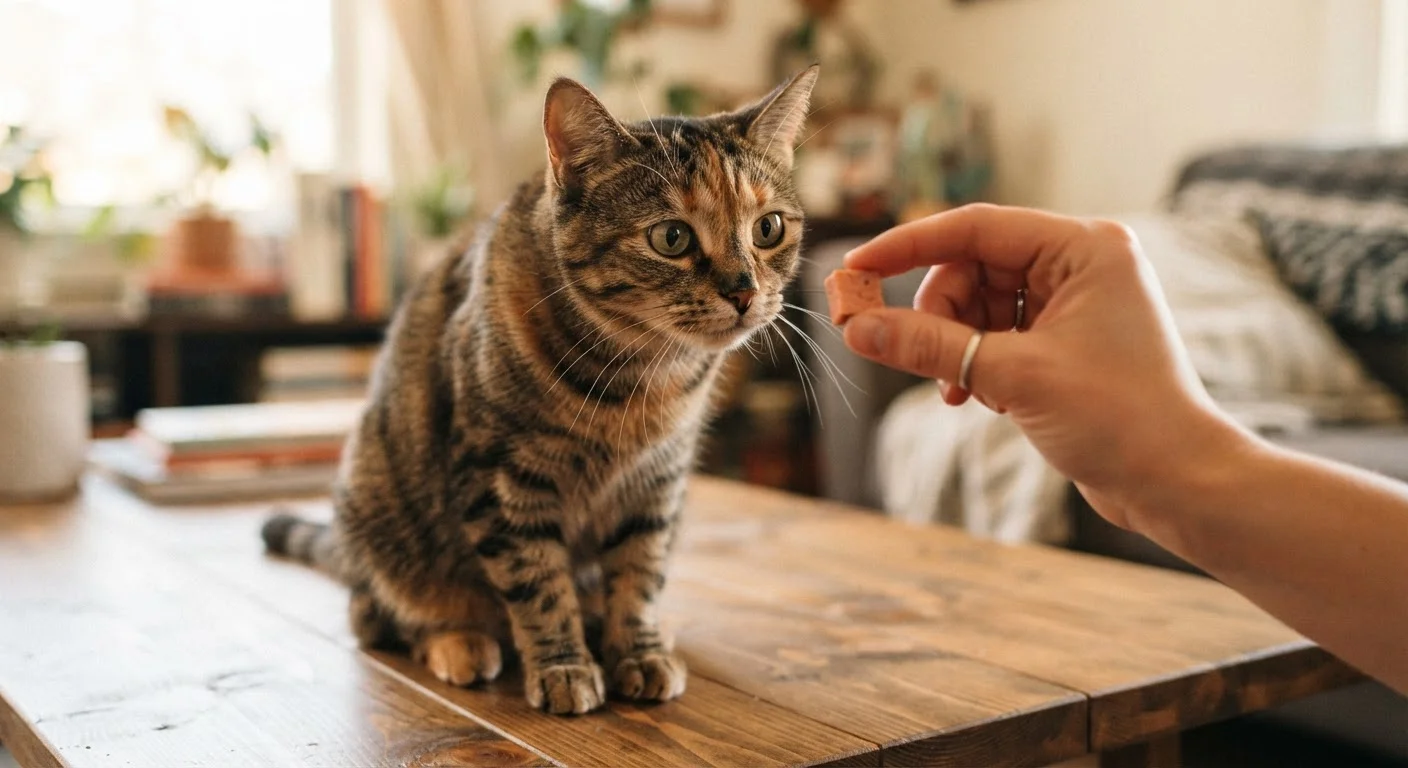
Time your rewards precisely. The treat or praise needs to arrive within one to two seconds of the desired behavior. Delayed rewards confuse cats and slow learning. A clicker — a small device that produces a sharp click sound — can bridge that gap by marking the exact moment the correct behavior occurs, then being followed immediately by a treat.
Work with your cat's schedule. Cats are more likely to engage when they're alert and slightly hungry, typically before mealtimes. Attempting training right after a large meal or during a nap cycle is likely to go nowhere.
For a detailed look at the principles behind effective training sessions — including how to maintain consistency across household members — see Pet Training Done Right. And if you've wondered why scolding your cat never seemed to work, the science behind that is explored in depth at Why Punishment-Based Training Often Backfires.
Start with small, achievable behaviors — your cat's name recognition, sitting on cue, or coming when called. These early milestones build momentum and establish a communication foundation that more complex training can build on.
This article provides general educational information about feline behavior and training. It is not a substitute for personalized advice from a certified animal behaviorist or veterinarian, particularly for cats displaying signs of fear, aggression, or anxiety.