
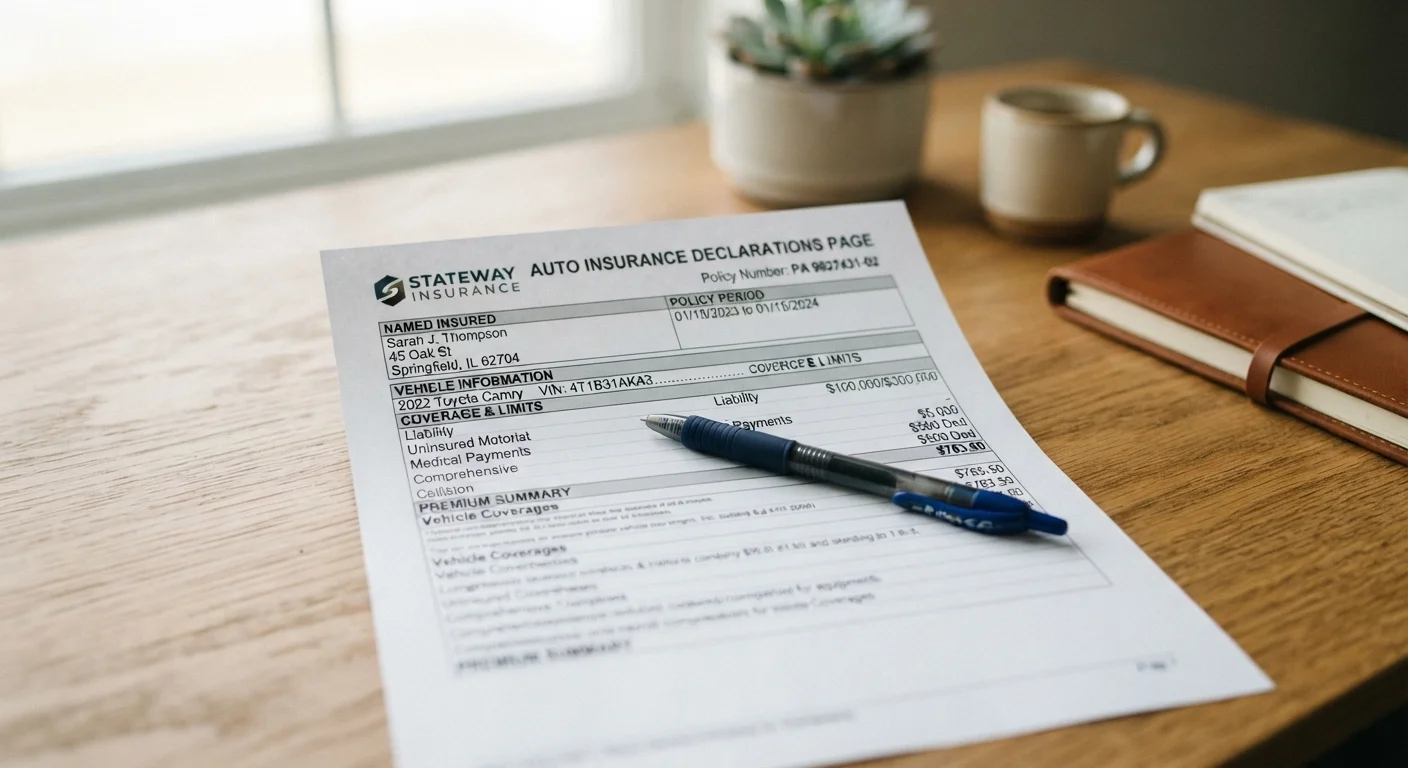
What the Declarations Page Actually Is
When your insurer sends you a policy, the declarations page - often called the "dec page" - is the front-facing summary. Think of it as a one- or two-page snapshot of everything that matters: who's insured, what's covered, how much the insurer will pay, and what you owe. The full policy contract sits behind it, spelling out conditions, exclusions, and definitions in dense legalese. The dec page is the readable version.
Most drivers never look past it - which is fine for day-to-day purposes. But when you need to file a claim or verify your coverage, you need to know exactly how to read what's in front of you. This walkthrough covers every standard section so nothing catches you off guard.
For definitions of terms you encounter along the way, the Auto Insurance Glossary is a plain-English reference covering everything from deductibles to subrogation.
What You'll Need Before You Start
Pull out your most recent declarations page - either the paper copy your insurer mailed or the PDF available through your online account portal. Having the actual document in hand makes this walkthrough concrete rather than theoretical.
What you will need
How to Read Each Section
Confirm the Named Insured and Policy Period
At the very top of the dec page you'll find the named insured - the person (or people) who own the policy - along with the policy number and the policy period (the start and end dates of your coverage term). Verify that your name, address, and dates are correct. Coverage only applies during the active policy period, and the address affects your rated territory, which influences your premium.
Identify the Covered Vehicles
The vehicles section lists every car on your policy by year, make, model, and VIN (Vehicle Identification Number). Check that each vehicle is listed correctly and that no car has been accidentally dropped or added. The VIN is the definitive identifier - a one-digit error can create problems during a claim.
Review the Listed Drivers
Most policies list all drivers in the household - including teenagers or family members who regularly use the vehicle. Confirm that every regular driver is listed. If a household member is excluded (intentionally removed from coverage), that will also appear here. An unlisted or excluded driver involved in an accident can result in a denied claim.
Understand Each Coverage Type and Its Limit
This is the core of the dec page. Each coverage is listed with two key numbers:
- Coverage limit - the maximum your insurer will pay for a covered loss
- Deductible - the amount you pay out of pocket before the insurer pays anything
Common coverages include:
- Bodily Injury Liability
- Pays for injuries you cause to others. Often shown as two numbers, e.g., 100/300 - meaning $100,000 per person and $300,000 per accident.
- Property Damage Liability
- Pays for damage you cause to someone else's property, such as their vehicle or a fence.
- Collision
- Covers damage to your own vehicle from a collision, regardless of fault.
- Comprehensive
- Covers non-collision damage - theft, weather, fire, animal strikes.
- Uninsured/Underinsured Motorist
- Protects you if the at-fault driver has no insurance or not enough to cover your losses.
- Medical Payments / PIP
- Covers medical expenses for you and your passengers after an accident, regardless of fault.
Check for Endorsements and Discounts
Endorsements are add-ons or modifications to your base policy - things like roadside assistance, rental reimbursement, or gap coverage (which pays the difference between what your car is worth and what you still owe on a loan). They appear as line items on the dec page. Discounts, such as multi-vehicle or good driver reductions, may also be itemized. Verify that any endorsements you've requested are actually listed, and that discounts you qualify for have been applied.
Note the Premium Breakdown
The final section shows your total premium - either for the full policy term or broken into installments - along with a breakdown by coverage type. This is useful for understanding which coverages are driving your cost. If your premium has changed significantly from the prior term, the breakdown can help you identify whether the shift came from a rate change, a coverage adjustment, or a new driver or vehicle on the policy.
The Dec Page Is a Summary, Not the Full Contract
Your declarations page does not list every exclusion, condition, or definition that governs your coverage. If a claim is disputed or you're unsure whether something is covered, you'll need to read the full policy document. Never assume that because a coverage type is listed, every scenario involving it is automatically covered.
Once you've worked through your dec page, cross-reference it against your life situation at least once a year. The Annual Policy Review Checklist is a structured tool for doing exactly that.
What to Do If Something Looks Wrong
Mistakes on declarations pages are more common than most people expect - a misspelled name, a missing driver, a vehicle listed with the wrong VIN or garaging address. Any of these can complicate a claim. If you spot an error, contact your insurer directly and request a corrected endorsement in writing. Do not assume a small mistake will be overlooked when it counts.
Beyond errors, you may find gaps - coverages you thought you had but don't, or limits that seemed adequate when you bought the policy but no longer match your situation. The most common auto insurance missteps often trace back to exactly this: not reading the dec page until after something goes wrong.
If a claim is already in motion, your declarations page becomes a key reference. See our step-by-step claim filing walkthrough for what to expect from first contact through resolution.
Store Your Dec Page Somewhere Accessible
Keep a digital copy of your current declarations page in a location you can reach from your phone - a cloud folder, email archive, or your insurer's app. If you're ever in an accident and need to verify coverage on the spot, you'll want it within seconds, not buried in a filing cabinet at home.
This article is for general informational purposes only and does not constitute insurance, legal, or financial advice. Coverage terms, limits, and exclusions vary by insurer and state. Always read your complete policy documents and consult a licensed insurance professional regarding your specific situation.