
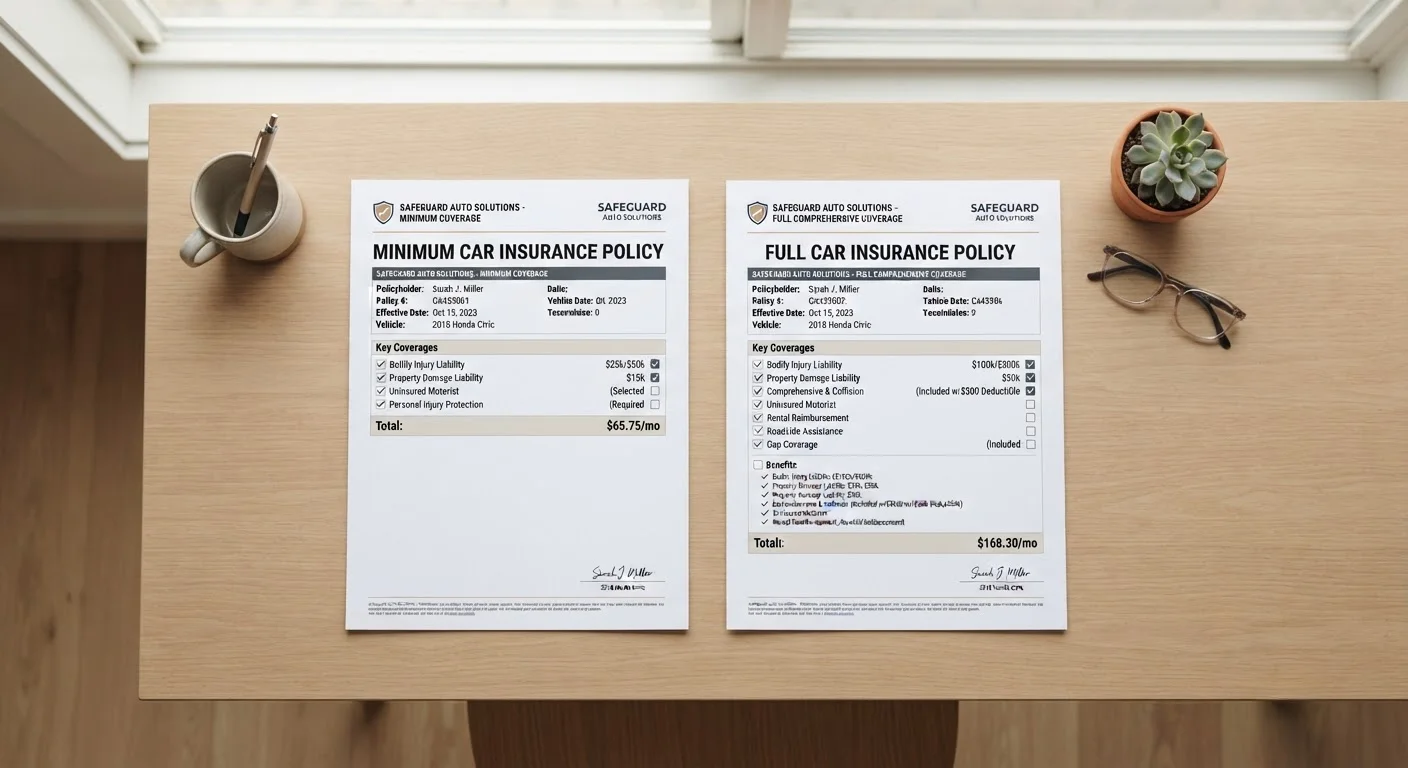
What "Minimum Coverage" Actually Means
Every U.S. state except New Hampshire requires drivers to carry a minimum level of auto insurance. These mandated minimums are almost always liability coverage - meaning they pay for injuries and property damage you cause to others, not damage to your own vehicle.
Liability limits are expressed as a three-number format - for example, 25/50/25 - representing (in thousands): maximum payout per injured person, maximum payout per accident for bodily injury, and maximum payout for property damage. These numbers differ by state. Some states also require additional coverages such as personal injury protection (PIP) or uninsured motorist coverage as part of their minimum requirements.
The critical thing to understand: minimum coverage protects other people from you, not you from other people or from your own losses. If your car is totaled, stolen, or damaged by a storm, a minimum-only policy pays nothing toward your vehicle. See our breakdown of the core coverage types for a fuller explanation of how liability coverage is structured.
| Criterion | Minimum Coverage | Full Coverage (typical) |
|---|---|---|
| Official insurance term? | Yes - defined by state law | No - informal industry shorthand |
| Covers damage to others | Yes (liability) | Yes (liability) |
| Covers your own vehicle | No | Yes (collision + comprehensive) |
| Required by law | Yes (in most states) | No (but lenders may require it) |
| Covers theft or weather damage | No | Yes (via comprehensive) |
| Consistent across states | No - limits vary by state | No - contents vary by policy |
What "Full Coverage" Actually Means
"Full coverage" does not appear in any insurance statute or standardized policy form. It's an informal shorthand - widely used by consumers and even some agents - that generally means a policy combining liability, collision, and comprehensive coverage.
- Collision pays to repair or replace your vehicle after an accident involving another vehicle or object, regardless of fault.
- Comprehensive covers non-collision losses: theft, vandalism, fire, flooding, hail, and animal strikes, among others.
Because the term isn't standardized, two people describing their policy as "full coverage" may actually have very different policies. One may carry high liability limits and low deductibles; another may have state-minimum liability with just enough collision and comprehensive to satisfy a lender. Neither policy covers everything - for instance, mechanical breakdowns, custom equipment (unless added separately), or diminished value are typically excluded.
For definitions of coverage terms you'll actually see in a policy document, the auto insurance glossary is a useful reference. And if you want to understand exactly when collision applies versus comprehensive, see collision vs. comprehensive explained.
49 of 50
U.S. states with mandatory liability insurance
New Hampshire is the sole exception, though it requires drivers to demonstrate financial responsibility if they cause an accident.
~13%
U.S. drivers estimated to be uninsured
The Insurance Research Council has estimated that roughly one in eight drivers on American roads carries no insurance at all.
Varies widely
State minimum liability limits
State-mandated minimum liability limits range from as low as 10/20/10 in some states to significantly higher thresholds in others - there is no national standard.
How to Decide What You Actually Need
The right amount of coverage depends on your specific circumstances - your vehicle's value, your financial cushion, your state's requirements, and whether you have a lender involved. Here are the practical questions to work through:
- Is your vehicle financed or leased? If yes, collision and comprehensive are almost certainly required by your lender. Check your loan or lease documents.
- What is your car's current market value? If its value is low, the annual cost of adding collision and comprehensive may approach what you'd actually collect in a claim. Factor in your deductible too.
- Can you absorb a large out-of-pocket loss? Minimum coverage leaves your vehicle unprotected. If replacing it would be a serious financial hardship, broader coverage makes sense regardless of the car's age.
- Does your state require anything beyond basic liability? Some states mandate PIP, MedPay, or uninsured/underinsured motorist coverage - these aren't optional additions in those states.
Coverage needs change over time. A policy that made sense when your car was new may be worth reconsidering as it depreciates. The annual policy review checklist walks through how to assess whether your current coverage still fits your situation.
This article is for general informational purposes only and does not constitute personalized insurance, legal, or financial advice. Coverage terms, limits, and requirements vary by state and insurer. Review your actual policy documents and consult a licensed insurance professional for guidance specific to your circumstances.