
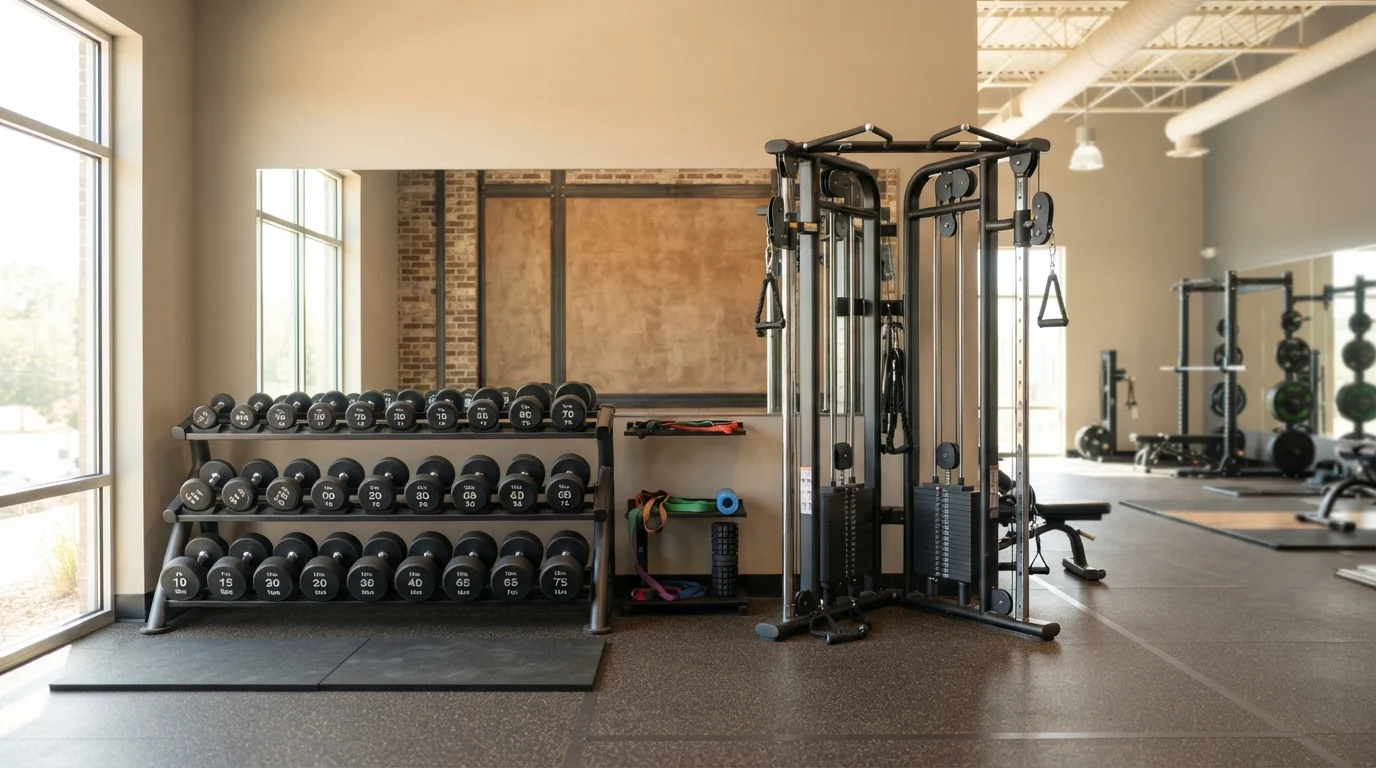
How Each Tool Actually Works
The core difference between free weights and resistance machines comes down to how your body is guided through movement. Free weights - dumbbells, barbells, kettlebells - move freely in three-dimensional space. Your muscles must not only lift the load but also control and stabilize it throughout the range of motion. That demand recruits smaller stabilizer muscles alongside the primary movers, building more integrated strength.
Resistance machines, by contrast, constrain movement to a fixed track or lever path. That guided motion reduces the coordination and balance demands, allowing you to load a specific muscle group with relatively less technique. This makes machines more predictable - which is a genuine advantage in certain contexts, not a flaw.
For readers brand new to the gym, our beginner's guide to strength training covers the foundational terminology and form principles worth understanding before choosing your equipment.
| Criterion | Free Weights | Resistance Machines |
|---|---|---|
| Movement path | Unrestricted, 3-dimensional | Fixed track or lever arc |
| Stabilizer muscle demand | High - required for control | Low - machine provides stability |
| Technique barrier | Higher - form must be learned | Lower - movement is guided |
| Functional strength transfer | Strong - mimics real movement | Moderate - more isolated |
| Injury risk (beginner) | Higher without coaching | Lower due to controlled path |
| Muscle isolation | Moderate - multi-joint focus | High - targets specific muscles |
| Training to failure safely | Harder - requires a spotter | Easier - no collapse risk |
| Equipment versatility | High - many exercises per tool | Lower - one or few movements |
What the Research Shows
Exercise science does not crown one approach over the other. Studies consistently show that both free weights and machines can produce meaningful increases in muscle size (hypertrophy) and maximal strength when training volume, intensity, and progressive overload are managed appropriately. The mechanism of adaptation - mechanical tension on the muscle fiber - is fundamentally the same regardless of the implement.
Where research does draw distinctions is in functional transfer. Free-weight exercises tend to show stronger carryover to real-world tasks and athletic performance, partly because they require neuromuscular coordination across multiple joints simultaneously. A 2019 review in the Journal of Human Kinetics found that free-weight squats produced greater activation of the gluteus maximus and biceps femoris compared with machine leg press, despite similar loads.
~Same
Hypertrophy outcomes: free weights vs. machines
A 2020 meta-analysis in the Journal of Strength and Conditioning Research found no significant difference in muscle hypertrophy between free-weight and machine-based training when volume and effort are equated.
~43%
Greater glute activation with free-weight squats
Research published in the Journal of Human Kinetics found meaningfully higher gluteus maximus activation during barbell squats compared with machine leg press at comparable loads.
2-3x/week
Recommended strength training frequency for adults
The U.S. Department of Health and Human Services Physical Activity Guidelines for Americans recommend adults perform muscle-strengthening activities on two or more days per week.
Machines, however, are not without distinct advantages. They allow safer training to muscular failure - a useful technique for hypertrophy - and make it easier to isolate muscles that are difficult to target with free weights alone, such as the hip abductors or the serratus anterior.
It's also worth separating fitness myths from evidence. Our editorial on common fitness myths addresses several misconceptions that may influence which equipment people gravitate toward - often for the wrong reasons.
Choosing Based on Your Goals and Experience
The most practical question isn't which tool is objectively better - it's which fits your current situation. A few factors to weigh:
- Experience level: If you're unfamiliar with movement patterns like the hip hinge or overhead press, machines let you load a muscle without first mastering complex technique. They can serve as a useful on-ramp before transitioning to free weights.
- Injury history: Those managing joint conditions or returning from injury may find that machines allow effective training within a pain-free range of motion. This should always be guided by a qualified physical therapist or physician - general information here is not a substitute for individual clinical assessment.
- Training goals: If sport performance or functional fitness is the primary goal, free-weight compound movements tend to be more specific. If aesthetic muscle shaping or rehabilitation is the aim, machine exercises may play a larger supporting role.
- Access and environment: Home gym setups often favor free weights for versatility; commercial gyms offer both. Neither is inherently superior - consistency with available equipment beats an ideal theoretical program you can't follow.
For those rebuilding fitness after a long break, machines can offer a lower-stakes re-entry point before reintroducing heavier free-weight work.
Most people benefit from integrating both. A common structure is to anchor sessions with compound free-weight movements - such as a squat, press, or hinge pattern - then use machines for accessory work targeting muscles that need additional volume or isolation. This hybrid approach is broadly supported by exercise science and works across a wide range of fitness levels.
You may also find it useful to explore how strength training fits within a broader program structure. Our overview of popular workout formats and our comparison of cardio vs. strength training can help you build a routine that aligns with your full set of health goals.
This article is for general informational and educational purposes only and does not constitute medical or professional fitness advice. Consult a qualified healthcare provider or certified fitness professional before beginning or modifying any exercise program, particularly if you have a health condition or injury history.