
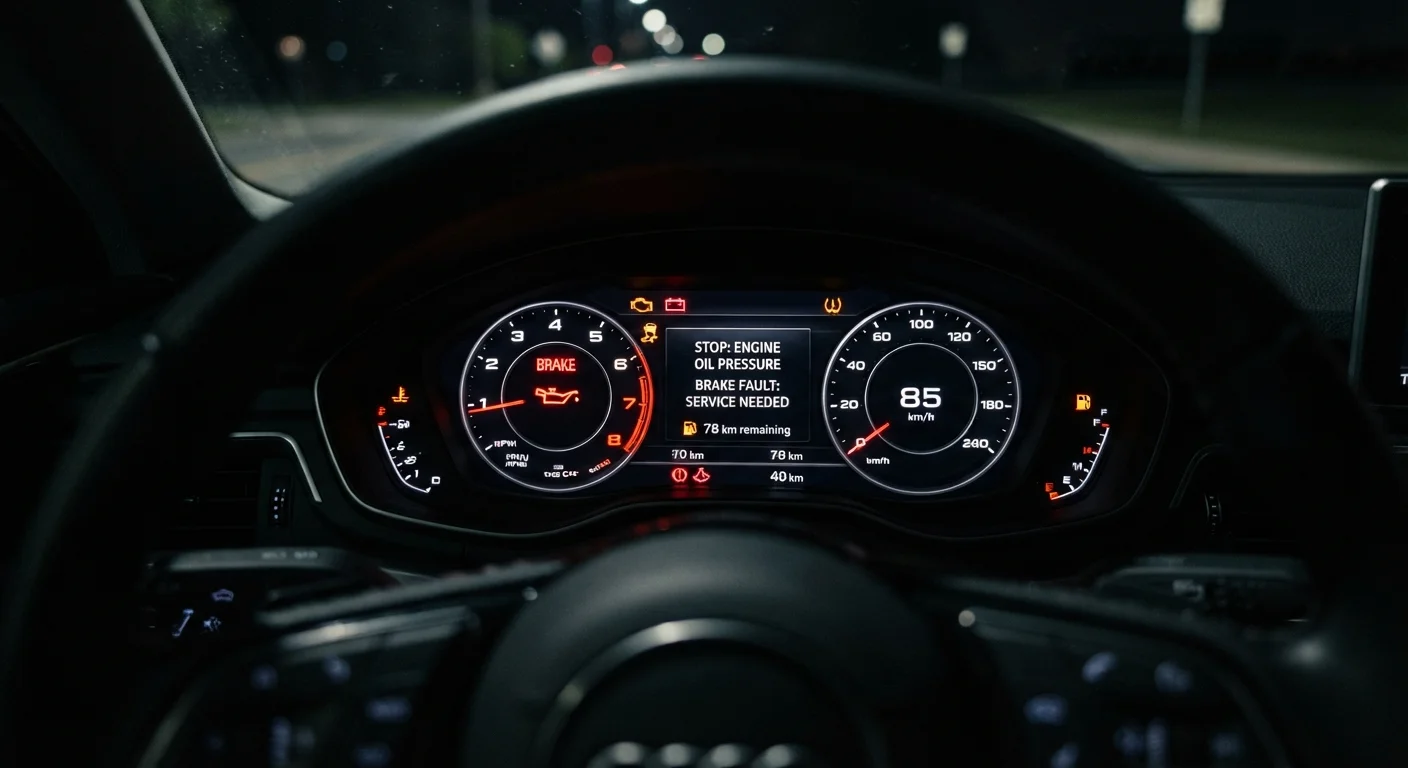
What Dashboard Warning Lights Are Actually Telling You
Modern vehicles monitor dozens of systems simultaneously, and when something falls outside normal parameters, the car communicates through dashboard warning lights. These symbols follow a loose color-coding system that gives you an immediate sense of urgency before you even know what the icon means.
| Dashboard light color: Red | Stop and investigate immediately |
| Dashboard light color: Amber/Yellow | Service needed soon; monitor closely |
| Dashboard light color: Green/Blue | Informational - system is active |
| Most misunderstood light | Check Engine Light (CEL) |
| Flashing vs. steady CEL | Flashing = urgent; steady = schedule service |
| OBD-II standard adoption | Required on U.S. cars from model year 1996 onward (U.S. Environmental Protection Agency (EPA)) |
Red lights generally indicate something that needs immediate attention - stop safely and investigate before driving further. Yellow or amber lights signal a condition that needs attention soon but isn't necessarily an emergency right now. Green and blue lights are informational, simply confirming a system is active (think high beams or turn signals).
Understanding this hierarchy alone can prevent panic - and prevent the opposite mistake of ignoring something serious. For similar symbol-decoding logic in a completely different context, see how garment care labels use icons to communicate care instructions.
The Warning Lights You're Most Likely to See
Here are the most common dashboard symbols and what they indicate:
Check Engine Light (CEL)
An amber warning light that indicates the vehicle's onboard diagnostic system has detected a fault in the engine, transmission, or emissions systems. A steady light suggests a non-urgent issue; a flashing light indicates an active problem requiring prompt attention.
TPMS (Tire Pressure Monitoring System)
A system that monitors the air pressure in your tires and alerts you via a dashboard light when one or more tires fall significantly below the recommended pressure. Proper tire inflation affects safety, fuel economy, and tire wear.
OBD-II (On-Board Diagnostics)
A standardized vehicle self-diagnostic system present in most cars sold in the U.S. since 1996. It stores fault codes that can be read with a compatible scanner tool to identify the source of a check engine or other warning light.
ABS Warning Light
Indicates a fault in the Anti-lock Braking System, which prevents wheel lockup during hard braking. The regular brakes may still function, but the ABS safety feature may be disabled until serviced.
Oil Pressure Warning
A red light indicating that engine oil pressure has dropped dangerously low. This is distinct from a low oil level reminder and signals that the engine is at immediate risk of serious damage if not shut down.
Traction Control / Stability Control
A flashing light during driving typically means the system is actively working to prevent wheel slip - normal in slippery conditions. A steady light indicates the system has been turned off or has a fault.
A few lights deserve special emphasis because drivers frequently misjudge their urgency:
- Check Engine Light (CEL): This amber light is one of the most misunderstood. It can mean anything from a loose gas cap to a misfiring engine. A steady CEL warrants a diagnostic scan soon - a flashing CEL means reduce speed and have the vehicle checked immediately, as a flashing light typically indicates active catalytic converter damage risk.
- Oil Pressure Warning: A red oil can icon is not the same as a low oil level reminder. Low oil pressure can destroy an engine in minutes. Pull over safely and turn off the engine if this appears.
- Temperature Warning: A red thermometer in liquid means the engine is overheating. Pull over, turn off the engine, and do not open the radiator cap. Allow the engine to cool before investigating.
- Battery Light: Usually indicates a charging system failure rather than just a low battery. The vehicle may continue running temporarily on battery reserve alone.
~80%
CEL triggers that are non-emergency faults
Industry estimates suggest the large majority of check engine lights are triggered by minor issues such as emissions sensor faults or a loose gas cap, though a professional scan is still recommended.
1 in 4
Vehicles on U.S. roads with at least one fault code stored
Studies of OBD-II data collected through vehicle inspection programs have found a significant share of vehicles carrying active or pending fault codes at any given time.
What to Do When a Light Comes On
Your first step is always the same: consult your owner's manual. Every vehicle manufacturer uses slightly different icons, and your manual includes the definitive guide for your specific car. Most manuals have a dedicated warning light section with color images.
For lights you can't immediately identify, many modern vehicles allow you to read a brief description directly on the instrument cluster or infotainment screen. Smartphone apps paired with an OBD-II diagnostic reader (a widely available, inexpensive tool) can pull fault codes for amber check engine lights and give you a starting point before visiting a mechanic.
General rules of thumb:
- Red light - stop driving when safe to do so; do not ignore.
- Flashing amber light - reduce speed and schedule service promptly.
- Steady amber light - monitor and schedule service within a reasonable timeframe.
- Blue or green light - informational only; no action required.
Keep in mind that some warning lights can affect your insurance situation if they point to vehicle safety issues. Understanding your coverage is part of smart vehicle ownership - a plain-language guide to auto insurance can help you understand how vehicle condition intersects with your policy.
This article is for general informational purposes only and is not a substitute for advice from a qualified mechanic. When in doubt about a warning light, consult a licensed automotive professional.